
Translated material
Kits have stress - they were very nervous during World War II
We talked with one of the scientists who made this discovery (thanks to the ear sil!)
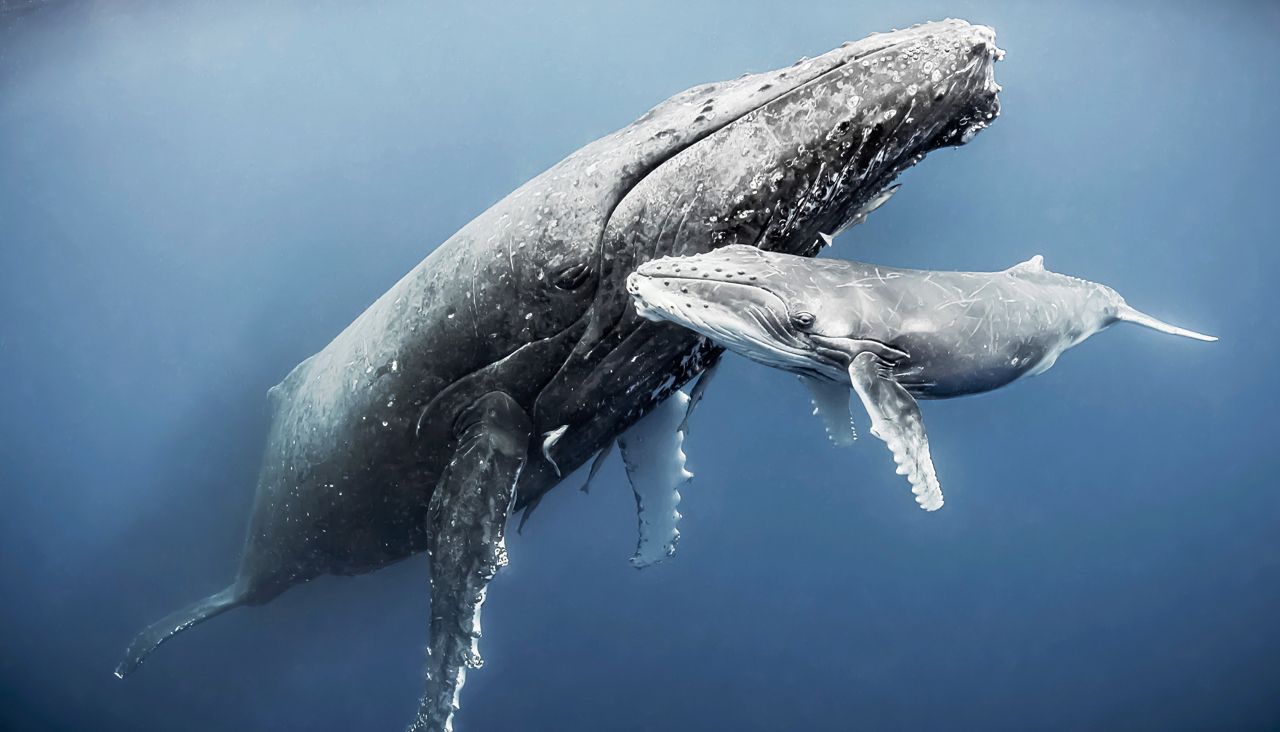
In November, Nature Communications magazine (and several more authoritative publications after it) published articles about the new work of scientists from Bailor University Sasha Usenko and Stephen Trombla. They found that the ear sulfur whales keeps the memory of the events of world history - and that animals react to a variety of stresses: from pregnancy to whaling and sea battles. The Special Corps of Medusa Polina Eremenko talked with one of the authors of the study on how such strange discoveries happen.
Studies of the ear sulfur whales began thanks to an accidental acquaintance in Texas. One of the scientists has Soviet roots
Dr. Sasha Usenko, co-author of the study “The level of cortisol of a mustachioed whale as a physiological reaction to whaling in the twentieth century”, begins a conversation with “Medusa” with a warning that in Russian he does not say: “My grandfather from Ukraine, but I was born in the USA, in childhood, the dad forced to teach Russian, but now I lost everything, so that in English.” Usenko was born and raised in Oregon. During his studies and work at the Oregon State University, he specialized in the bottom deposits - with them you can study the history of human influence on lakes and other ponds. “The upper layer of deposits is the youngest; The deeper, the older - the history of the lake can be traced in pollutants, ”he says“ Medusa ”. “I already thought that since there were so many history in the bottom sediments, it would be interesting to study the ice cores and the rings of trees.” After defending the dissertation, Sasha moved to Baylor University in Texas - and there he met a colleague six years ago, who sent Usenko’s career to a completely unexpected direction.
Professor of biology Stephen Trub studies how the environmental situation and various extreme conditions affect marine mammals. The main subject of his scientific interest is the mustachioed whales. This subordinate whaling includes the largest modern animals: for example, a blue whale can reach 33 meters in length. Trobble began working in Baylor simultaneously with Usenko - and they found themselves at the same introductory meeting of new employees. “During the break,” Senko recalls, “colleagues went to drink coffee and began to tell each other what they were doing.” A whale specialist told a specialist in the layers that the age of the whale can be determined by a traffic jam from his ear sulfur - just by alternating light and dark layers, approximately like the age of a tree in annual rings.
Usenko and Trub found out that by Sere you can study not only the age of the whales, but also their psychology, for example, the level of stress
“In the whale, like in humans and in all other mammals, ear sulfur stands out. This is a protective mechanism - to unload all unnecessary from the body through the ear, ”Usenko explains. - When the whales moved into the water from land, their inner ear canal was isolated from the external environment - otherwise cold water would be poured too deep. This blocked the output of Sere, she began to accumulate and form a cork. ” The sulfur cork of the mustachioed whale reaches 25 centimeters in length, it is similar to a goat horn or a piece of wood - and accumulates in the whale throughout his life, which can last up to a hundred years.
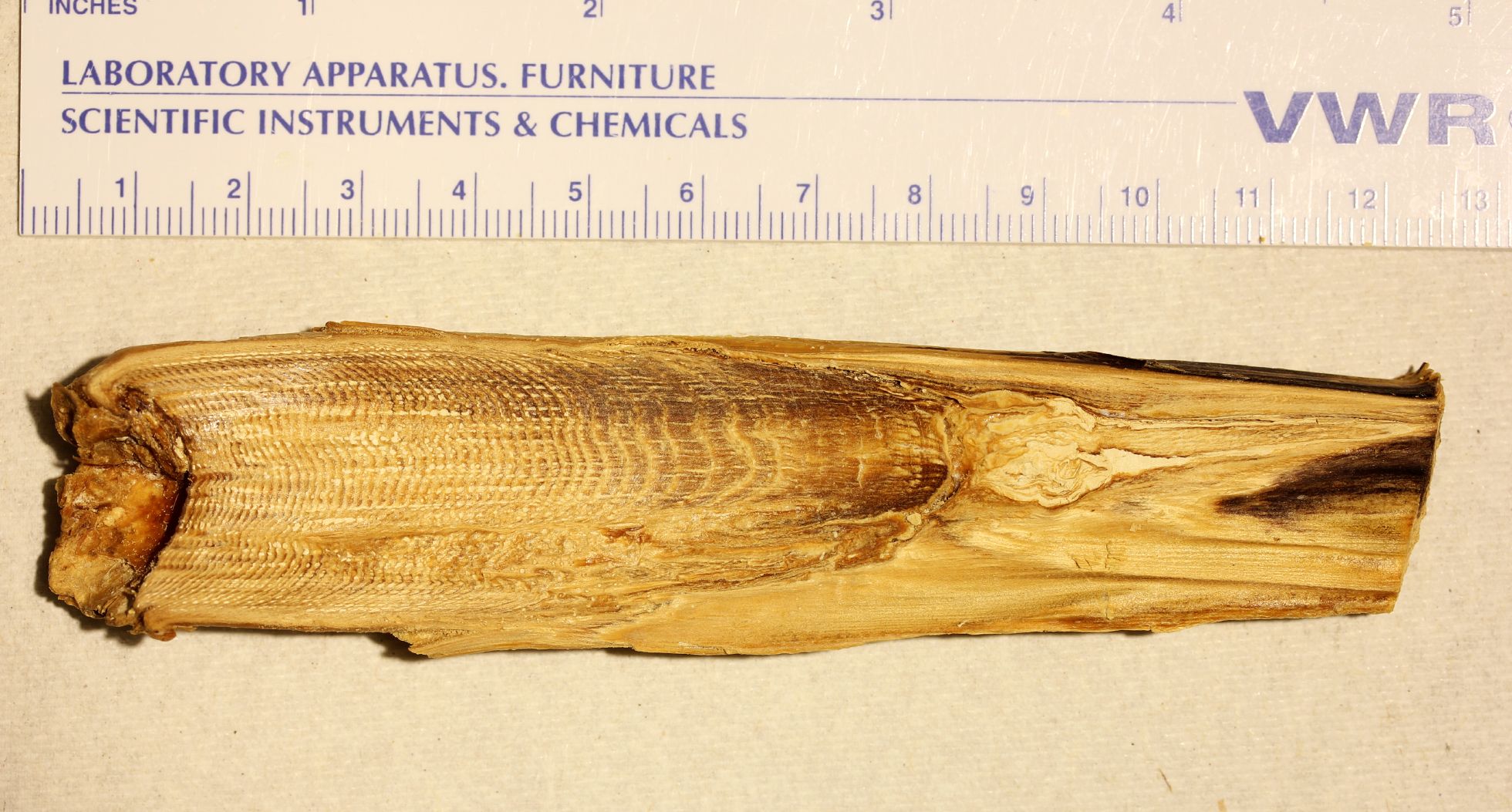
Usenko and Trub realized that they opened a completely new field for research - and began to work together. The fact is that sulfur stands out from the body along with different hormones. For example, it may contain a cortisol hormone that talks about the level of stress. At the whale, this all forms layers on a traffic jam - a new piece of sulfur with an admixture of different hormones is attached to yesterday's Sere, and so every day. Therefore, the traffic jam allows you to track how the stress level has changed in the whale: the auricle turns into a chemical cast of a whale biography.
“We had to figure out where to get the ear sulfur of the whale - it is not sold in supermarkets,” says Sasha Usenko. - We called there and there, and finally the guys from the Smithsonian institute said that they had sulfur - they were just about to throw it away because they did not know what to do with it. When we received sulfur, we have developed a method for studying it for another one and a half years, and then we searched for money for research for a long time. ”
First, Trump and Usenko were studied on the ear corps of individual whales. They were convinced that natural factors such as pregnancy or puberty affect the level of mammalian stress. Their first joint work proved that in the ear traffic jams of whales, data are preserved not only about hormones, but also about pollutants entering the ocean, for example, mercury.
Gradually, more and more sulfur plugs stored in different museums came to scientists. Their last study was built on the ear plugs of twenty whales, the most ancient of which was born 146 years ago. A comparison of the level of cortisol showed: according to these traffic jams, you can measure not only the individual stress of each whale at a single point in time, but also imagine how the environment, in particular human activity, influenced whales at different times.
Studies have shown: not only what is happening to them affects the level of whale stress, but also what is happening to people. For example, World War II
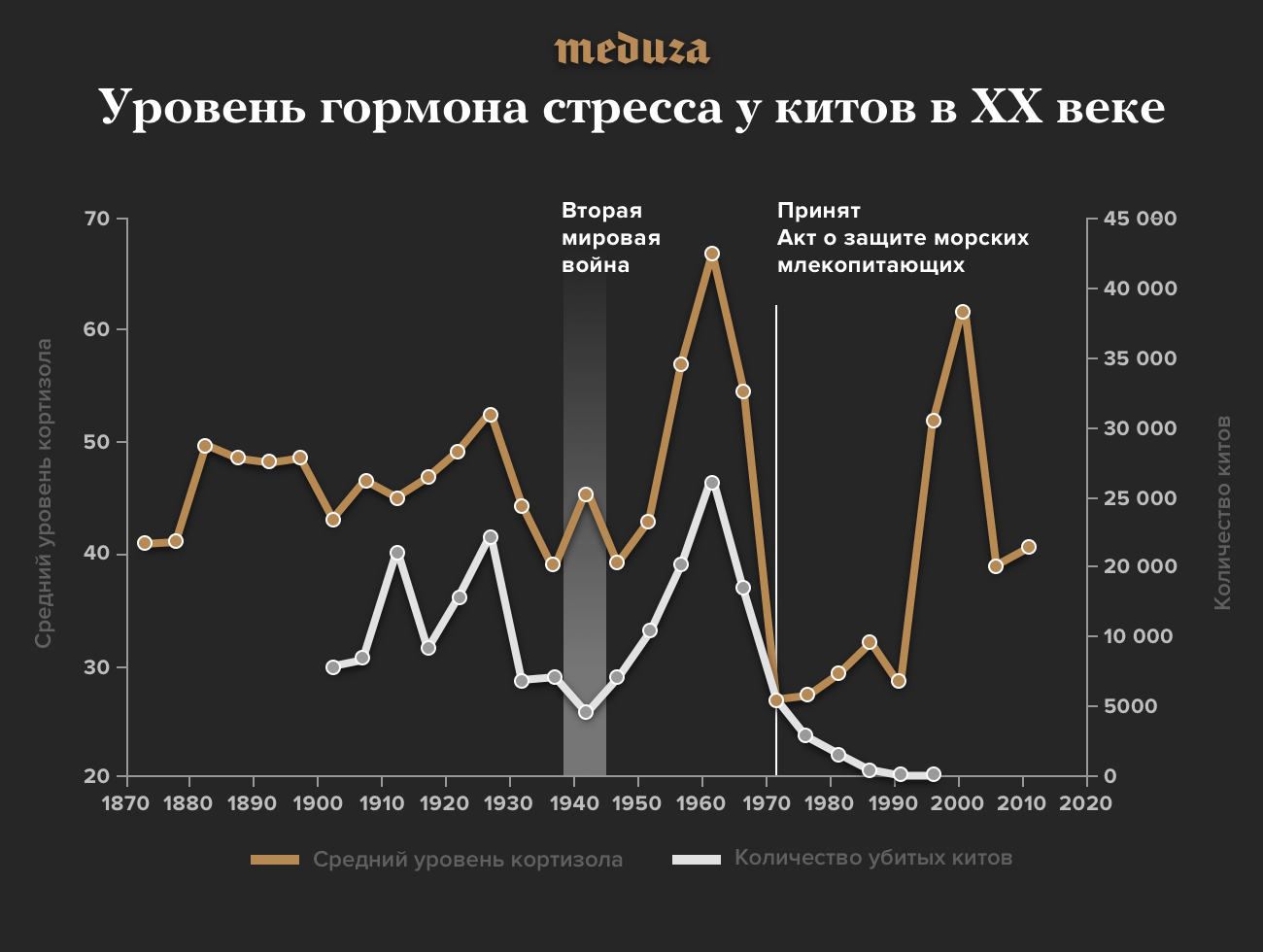
“The more active the hunting for whales, the noisier the water, the faster the population of the whales decreases and the higher the level of cortisol in whales,” Usenko explains. Researchers found that when whaling reached its peak in the 1960s, the overall level of stress of the studied whales also increased sharply. When strict restrictions were applied to whale hunting in the 1970s, the level of cortisol in Serepesny's Sereplaint began to fall 6.4% per year.
During the Second World War, whales were killed less, but the level of cortisol in their auricle increased by 10%. “The war was world - a lot of fleet was involved, many bombs. Very noisy. Whales hear thousands of kilometers at a distance and felt stress, even if they were far from hostilities, ”says the scientist.
The new discovery brought two scientists unexpected glory - at least at their own university. “When we were just starting our research six years ago, people said ( dismissively ):“ Oh, look, the team “The ear sulfur of the whale“ is on. “We were Fricam,” Usenko recalls. “Now, when our research is published by authoritative magazines, they say ( enthusiastically ):“ Oh, look, the Ear -Earian team! ” Now we all want to sit with us at the same table in the dining room.
Polina Eremenko