The bold "Artdokfest" returned to Moscow. What to watch? We recommend
Photo: Sergey Fadeichev / TASS
The festival continues the struggle for existence, despite the pressure from the Ministry of Culture, the courts and fines, the shows to be organized by provocateurs last year. In October, looked in Riga. From December 6 to 12, he will deploy work in Moscow and St. Petersburg.
The program has 128 films. Less than half of them are in cinemas. Some of the paintings can be seen online, part in the special missiles of the “real movie” on the Current Channel. Among them are the long -awaited “Putin's Witnesses” Vitaly Mansky and the “process” of Sergei Loznitsa, about which “new” was talking about.
"Circumstances of the place and time" Dmitry Kabakov
This multi -layer romance begins right in the sky. From the height of the cloud, we look at the usual near Moscow. From above everything seems toy: houses, front gardens, pond. The fences are not visible from above, a single green space of freedom, limited only by the limits of the frame. How to feel the boundaries of your and someone else's world, your own and someone else's land. The author came here with his family when he was three years old. Here live his elderly parents Henry Ivanovich and Victoria Sigismundovna. Their neighbors are a large Tajik family who escaped the war. The husband is ready for any work, his wife bakes cakes for sale. Children are refused to take to a local school. The local father is about to deprive their roof over his head. Victoria Sigismundovna is engaged in the Russian language with children, geography. He teaches them to understand and accept the circumstances of life in a foreign place and hostile time. The film, in which humor is adjacent, sadness, absurdity, life and death - looks in one breath.
"My dad Genghis Khan" Almira Safi
In the sight of the cells of Almira Safi - Mongolia as the crossroads of civilizations, ancient, nomadic, Soviet and modern. But nomadic civilization is gradually erased by the global world. And only one thing remains unshakable - the image of the father of the people, the powerful Genghis Khan.
The beam cuts the frame diagonally, steppe dust rises under the hooves of horses. A hurricane breaks a satellite plate from the yurt. In Ulan-Bator, secular festivities with selfies merge with prayers in temples. Next to the Golden Buddha are high -rise buildings. Otar rushes to a luminous highway alarming night, shepherds barely stop it. Among the shepherds and the heroine of the film. In her free time, she is engaged in ballet class. In the final, the horsemen will turn in the shade. And time itself will lose direct move: the past and present will merge into a single stream.
"Barking dogs in the distance" Simon Vilmont
One of the most sensual paintings about the war in the east of Ukraine. The war, which seems to be touched by the cold to your cheek. Ten -year -old Oleg lives here with her grandmother.
The war came last summer and froze life. Now Olezhek learns to prick firewood, goes to his mother in the cemetery - she whisper there with her.
He also plays with a cat, boys hunting to jump on the beds, rush to pillows, dump in the river. Only scary, something buzzes, explodes. Guys, of course, should undergo everything! But a neighboring child tears from every loud explosion - such a rare type of allergy. Grandmother is cleaning at home when they bomb - otherwise their hands tremble: the children will see it. Children here know about stretch marks, bombs, shoot at bottles, bullets can be bought for $ 7. They know that you can’t talk in a bomb shelter, otherwise all the air will come out.
"Book of the Sea" by Alexei Vakhrushev
This is more than ethno-kino, it is a spectacular poetic blockbuster-a legend about the sea hunters of Chukotka, Lorin Morzveroboxes. Monumental animaces were created for five years. But in fact, longer. Alexei Vakhrushev, born on Chukotka, all his life is being removed by the northern epic.
Two lines are woven in the film: documentary shooting of a sea hunt in the Bering Strait and animated traditions about the woman who gave birth to a whale. Animation was made by Eduard Belyaev, a follower of Alexander Tatarsky. Animation material is polymer clay, so the transfer resembles a revived voluminous rock painting. The scenes shot at sea seem to be continuing the myth. The “Book of the Sea” entered the short list of the “Lavra Branch” in the nomination “Best Art Film”.
"Robin Chikas" Denis Slepov
An unexpected and joyful picture. Two young adventurers Vika and Karina stagger around Guatemala with the good intentions - they want to build a charitable clinic. Outwardly, they are similar to hundreds of their compatriots, annually departing to the paradise of the GOA. Dates, quarrels with potential grooms. And girls are looking for sponsors, trying to get medicines, light bulbs and wires, but most importantly, they treat local poor. True, so far at school. They want the impossible: to save the world and find personal happiness. So they write in a marriage announcement. The most incomprehensible thing is that they succeed. And their brand new clinic is already accepting 40 people a day. And these crazy people found a new country for the feat: in November they begin to build a clinic in Nicaragua.
"Last photo" Yegor Sevastyanov
The real story of a man who discovered the burial of his grandfather in Germany, who had gone in 1941 as a boy to the front and died in a fascist prisoner of war camp. The grandson even saw the last lifetime photo of the young grandfather taken in the camp. It is now so beautiful here: sunny lawns near the forest coast. There are practically no traces of the camp, only a museum and burial with clay signs. The Nazis allocated a area for burial per 1000 bodies, and there are tens of thousands of thousands here. Already in July 1941, the compositions stuffed with Soviet prisoners of war came here. 400 people were dying daily. The trees were gnawed three kilometers around.
The difference in the content of Soviet and European prisoners was enormous. Those received letters, and gifts for Christmas. Soviet prisoners of war are still not recognized as a group of victims of the fascist regime. When the British entered the camp, they were horrified: the mountains of corpses and nearby are half -crazy, half -dead people. Many of the Nazis who "worked" here escaped punishment, and others gave short time. The historian Peter Vaningen says that for quite some time in school textbooks about the Second World War there was only a small headquarters, so as not to injure students.
"Shards of stars will break off the sky and disappear" Peter Starostin
During the filming, the author receives news of the death of the mother. Further, the action develops in two temporary dimensions: today and yesterday. Today is the mother’s dead body on the floor, funeral chores, the nastyness of the ritual and church business on the bones. Yesterday - home shooting: live, unhappy, drinking mother Olga pours out her grievances. She is not sixty, but she believes that life has long ended.
The degree of approximation of the camera to what is happening is almost unbearable. You feel like an involuntary witness of what is usually hidden. How the blood vessels of the family were torn. Those that associated Olga with life.
"New" Askold Kurov
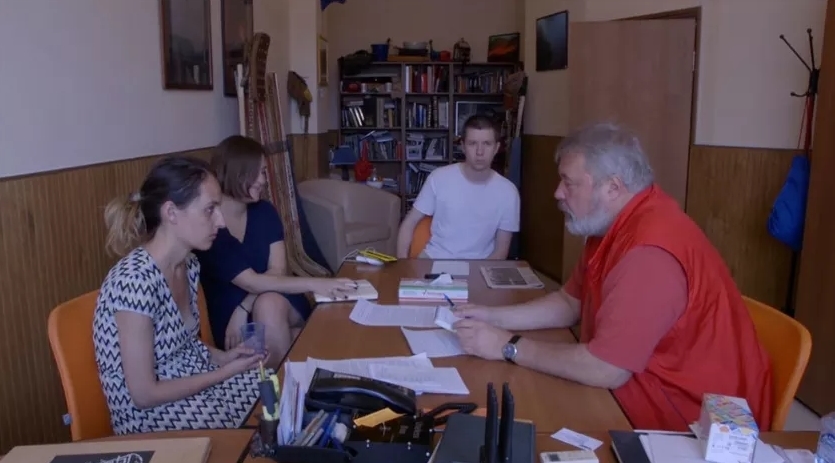
Frame from the film
Our comrade, a talented documentary Askold Kurov, shot this movie for the anniversary of Novaya Gazeta, founded in 1993, which turned out to be not only one of the first independent publications in post -Soviet Russia, but also one of the last.
This is not a ceremonial portrait at all, but an immersion in the life of the editorial office in a very difficult time.
Here they “draw” the plan of the next number, here they begin the next high -profile investigation, unfold the operation to save our colleagues Ali Feruz, build the “line of protection” of the editorial office after threats to the leadership of Chechnya, explain to foreign journalists “why they don’t close the newspaper”. Organize the election of a new editor -in -chief. Defend the priority of human rights over the rights of the state. They argue, offend, celebrate, say goodbye. Live.
"From slavery to freedom" Arkady Kogan
Exciting political novel. The history of the movement of Soviet refuseniks through the prism of the biography of the protagonist - the chairman of the Jewish agency "Dog", and in the past - concluded by the Soviet correctional colony of Nathan Scharansky. In 1977, Schazaransky was arrested on charges of espionage in favor of the United States, treason to his homeland and anti -Soviet agitation. For 9 years, his wife sought the liberation of the political prisoner.
Kogan’s film is a kind of time of time: we take off in the Soviet era with its inexplicable foundations, a sense of fear, insecurity in front of the system. Especially if you are a "disabled person of the fifth group."
Why didn’t the Soviets want the Jews to leave? They were afraid that Kazakhs, Armenians followed?
The submitted documents for departure were declared enemies of the people, they were kicked out of work, neighbors turned away from them. This is a story about the fate of several wonderful people who did not consider themselves such, but sacrificed their lives to their principles.
"Complicity" by Oleg Yakushenkov
Colony in the Ryazan region for minors. Girls live a common groundhog day: exercise, breakfast, production, lunch, school, dinner, a parade ground, a drill song, personal time, an elite. And the film itself is initially similar to hundreds of similar ones. Girls tell how they committed a crime, dream of love.
At some point, the camera enlarges the face of a young prisoner convicted of a fight, and now we are already meeting with her 10 years later. We follow her efforts to grow to a normal life: with her husband, child, with the family. If still life took a counter step.
"Childhood, summer and war" Alexander Rastorguev
Director Alexander Rastorguev, who was killed this summer in the Ts, shot his last film in the village of Belaya Kalitva near Rostov-on-Don for Radio Liberty. Ksenia Elean helped him. Military fees of cadets-little ones and adult reservists. The film was shot in the favorite “zero position” when the camera shows a phenomenon without an author’s assessment.
Children carry machines, shoot, want to be adult warriors. “Do not put your head on the weapon! - the instructor is angry, - attach the weapon to the cheek! " The restoration of monuments to Soviet soldiers ends with prayer and Cossack chants. Right here, children are taught to love the homeland: “Our young people are degrading, and according to the plan of Dallas they replace values, these are same-sex marriages, music, Coca-Cola.” And then about Cossack values and a refueling. Then the anthem and “Our Father”. Interesting installation: the boy is pulled up on the turnstile, with flour of terrible stress - up. The paratroopers-paratroopers jump from an airplane to a terrible pole-down (the film was collected by director Maxim Pakhomov).
And there will also be a black sheep, trying to escape from the leash again and again. In vain. Soon we will see her dead eye next to the shovel cuttings. This is a movie about how death "attaches a cheek to life." Today it seems that the documentary Rastorguevsky essay on Orthodox-patriotic militarism was a rehearsal before a large project-investigation of the actions of Russian mercenaries in Central Africa.
PS
You can watch the schedule of shows and purchase tickets for the films "Artdokfest" through the site.
Ajar show • Novaya Gazeta • RIMA — Russian Independent Media Archive