
Translated material
Without Kant and Letov: the results of voting for renaming Russian airports were summed up
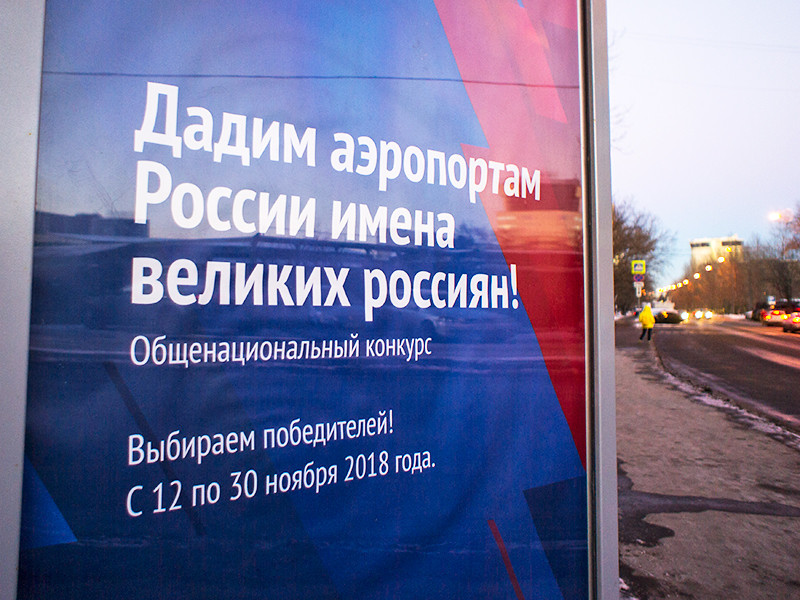
On the website of the project "Great Names of Russia" published the final results of voting on the choice of names of outstanding compatriots for Russian airports.
The Moscow Airport Sheremetyevo will receive the name of Alexander Pushkin, and Domodedovo will be Mikhail Lomonosov. The airport of Vladivostok will be called the name of the researcher of the Far East Vladimir Arsenyev. The Voronezh airport was chosen by the name of Peter I. The Kazan Airport will receive the name of the poet Gabdulla Tukay, the airport of Krasnoyarsk - the opera singer Dmitry Hvorostovsky.
- Boris Vishnevsky: "Leave the names of the airports"
In Yekaterinburg, the name of the industrialist Akinfiy Demidov won, and thanks to offline voting, according to which he gained 4,8409 votes (36%), while 3,9414 people (32%) voted on the Internet. Open Media write about this. It was possible to vote on board the aircraft, at airports or at railway stations.
The Russians could also choose the names of the writer Pavel Bazhov or Marshal George Zhukov. Before the final summing up the results in the Internet voting, the name of Bazhov was leading, while the vote offline did not display on the site until the final results of the vote on the evening of December 4.
As of 16:50 on December 4, Bazhov, Demidov and Zhukov received an almost equal number of votes each. The leader Pavel Bazhov with 41466 votes (34% of all who took part in the competition for the choice of a name for the Yekaterinburg airport). However, in the end, the storyteller received 43505 votes (32%).
In total, the organizers of the competition offered Russians to choose names for 47 Russian airports. Everywhere, except for Yekaterinburg, in the overall standings, the same names won that were the leaders in Internet voting. Thanks to offline voting, Gorno-Altaysk Airport could get the name of the artist Grigory Choros-Gurkin: in online, the gap between his name and the name of the artist Nikolai Roerich was less than 1000 votes. However, in the end, Roerich defeated: after accounting for offline voting, the gap increased to a little more than 1000 votes.
For five airports, the names on December 4 were never chosen. In relation to the Moscow Vnukovo and the Penza Airport, the commission must decide later (the names of Sergei Korolev and Mikhail Lermontov, respectively, won the names there; the commission decided to assign their names to the Samara and Mineral Water airports, respectively). At the same time, different airports can be called the same name. The names for the airports of St. Petersburg, Arkhangelsk and Nizhnevartovsk will be selected in the second round.
In November, Russian President Vladimir Putin signed a decree according to which airports, railway stations, sea and river ports can be assigned the names of outstanding state, military and public figures, representatives of science, art, culture and sports. As follows from the text of the Decree , the airports will not be renamed completely, and the assignment of an outstanding figure to the geographical object does not entail a change in the established name of the object.
“That is, Sheremetyevo will not be renamed the Pushkin Airport. Most likely, the full version of the name will look like this: the Sheremetyevo International Airport named after Pushkin. The same applies to the rest of the airports,” Blogger Ilya Varlamov concludes on his website .
The project selection project for Russian airports started in the country on October 12. Until November 30, a national vote was held on the website of the Velikiyamin.rf at the choice of one of three or four surnames for each airport, accompanied by scandals and disputes. The most discussed campaign was to rename the airport in Omsk.
The problem here arose at the stage of drawing up a short list of applicants. According to the competitive procedure, the Long List was made up of local public chambers, and a short list for popular vote was formed according to the results of "sociological surveys". Fans of the Civil Defense group launched a large -scale campaign in support of the candidate of the leader of this musical team Yegor Letov, a native of Omsk, who died in 2008. In preliminary surveys in social networks, the leaders were leading .
The situation was intervened by the Minister of Culture of the Russian Federation Vladimir Medinsky, who first stated that it was a “bad sign” to call the airport in honor of a person “during his lifetime”, and then called fans of the musician a “marginal audience”. As a result, Letov did not get into the final short list: it included the hero of the Great Patriotic War, General Dmitry Karbyshev, aircraft designer Andrei Tupolev and theater actor and director Mikhail Ulyanov. After Letov’s non -playing in this list in Omsk and in Moscow, protests were held. And on November 28, in honor of the musician they named a small private airfield in the Omsk region. As for the final name, the largest number of votes (41%) was given to Dmitry Karbyshev.
In Astrakhan, the artist Boris Kustodiev, the poet Velir Khlebnikov, military pilot Nikolai Skomorokhov and the Russian emperor Peter I won, for the assignment of his name to the local airport, “Khlebnikov won the Russian emperor, but on the night of November 15, the results of the vote were updated and Petr the Great , who received about three thousand new votes, was eager for Khlebnikov, while Khlebnikov was over The same period of time voted only a thousand people.
After this, the voting organizers began to be accused of wrapping: the regulation on the competition notes that a priority criterion for nomination of candidates should be their connection with the territory on which the airport is located. Peter I visited Astrakhan only once - in 1722 before his Persian campaign. And city activists accused local officials of the “cult of Peter”: in recent years he was first erected a monument in the center of Astrakhan, and then in his honor he was named the main embankment of the city.
Another apple of discord was the airport of Kaliningrad Krugrovo, on the list of which was the German philosopher Immanuel Kant, the Russian Empress Elizaveta Petrovna and participants in the Great Patriotic War, the heroes of the USSR Alexander Vasilevsky and Ivan Chernyakhovsky. At first, Kant was the leader in the vote, but then his candidate began to raise questions from representatives of the authorities. On November 20, the State Duma deputy from Tatarstan Marat Bariev opposed Kant, saying that the very presence of a German in the list of applicants insults veterans, although Kant died 137 years before its beginning.
On November 26, unknown people repelled a monument to Kant at the Baltic Federal University, bearing his name, and also scattered leaflets with a call to students of this university to abandon the "name of the enemy." On the same day, the grave of the philosopher and a memorial plate on one of the houses in Kaliningrad were doused with paint.
And the chief of staff of the Baltic Fleet, Vice Admiral Igor Mukhametshin, turned to the sailors and their relatives not to vote for the assignment of Kant Kaliningrad Airport, who "was humiliated and crawled on his knees to give him some incomprehensible books that none of those standing here, will never read."