
Translated material
How to grow a "unicorn": 50 typical features of the founding fathers
In early December, the venture capitalist from the DVCV Foundation Ali Tamaseb, known for creating the first modular “smart” clock, published the first part of his project about the founders of successful startups. He spent 300 hours on collecting data on “unicorns” - startups worth more than a billion dollars. Tamaseb published 100 graphs describing various features of “unicorns”. It recalls that the correlation should not be confused with causality, but the knowledge of how “unicorns” are arranged will definitely not hurt. Here are the main conclusions of Tamaseba.
Superproofers
- The central term of the study is “Super Founder” - the founder with at least one output of $ 50 million or the owner of a business that generates at least $ 10 million revenue per year.
- Usually the "unicorn" has 2-3 founders. Only 20% of superpowed startups are founded by loners.
Age and gender
- The typical founder of the “unicorn” in the USA is a man and, judging by his last name, a migrant. Among the diagram of the 15 most common names are not a single female.
- Over half of the founders over 35 years old. The second person in the tables about the ranks (usually the technical director or director for the scientific part) most often belongs to the age segment of 28–32 or 60–64 (!). The founders of companies engaged in SaAS and automation of enterprises, younger, pharmaceutical companies and energy "unicorns" are significantly older.
- Half of the founders have more than 10 years of experience. For technological companies, we are talking about 10 years of experience, for pharmaceutical and medical companies - about 28 years.
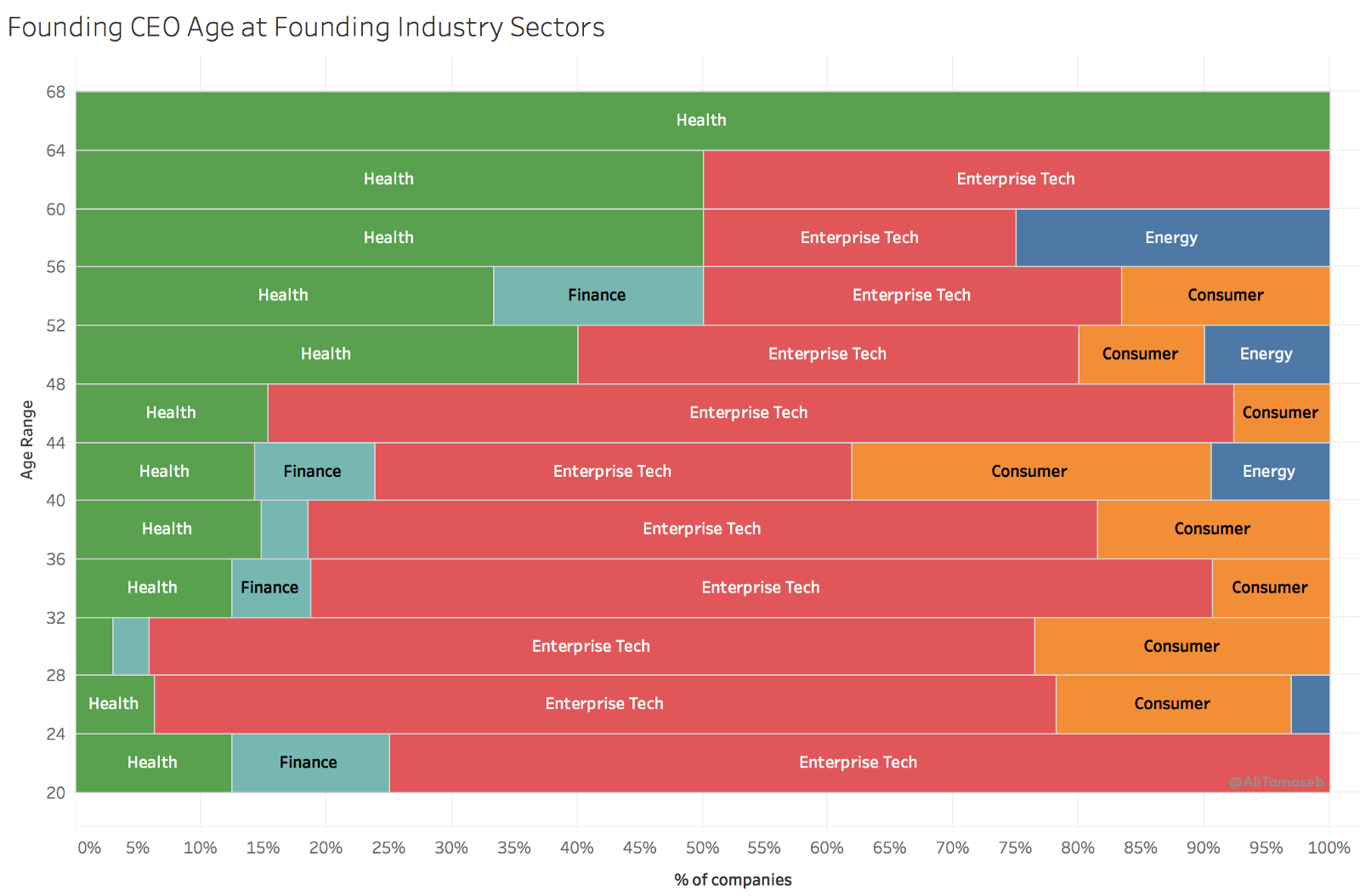
Distribution of the ages of the founders depending on the industry, the schedule of Ali Tamasab
Previous experience
- The previous area of interests of the founders does not necessarily coincide with the sphere of his new startup. The exception is all the same pharmaceutical companies and startups engaged in healthcare and biotheh. There, 80% of the founders have the previous experience corresponds to the topic of the startup.
- For almost 60% of the founders, this is not the first business. About a quarter of the founders of the "unicorns" before that were the founders of other businesses for 2-3 years.
- For many, the first and even second business experience was a failure. However, almost 70% of entrepreneurs who had previously tried themselves in business previously founded a successful company. Almost half of the “super -workers” boast of more than one successful exit.
- If the founder worked in the corporation before (and many worked only for themselves), then it was usually a large company.
- Most of the founding billionaires are produced by Google, Oracle and IBM.
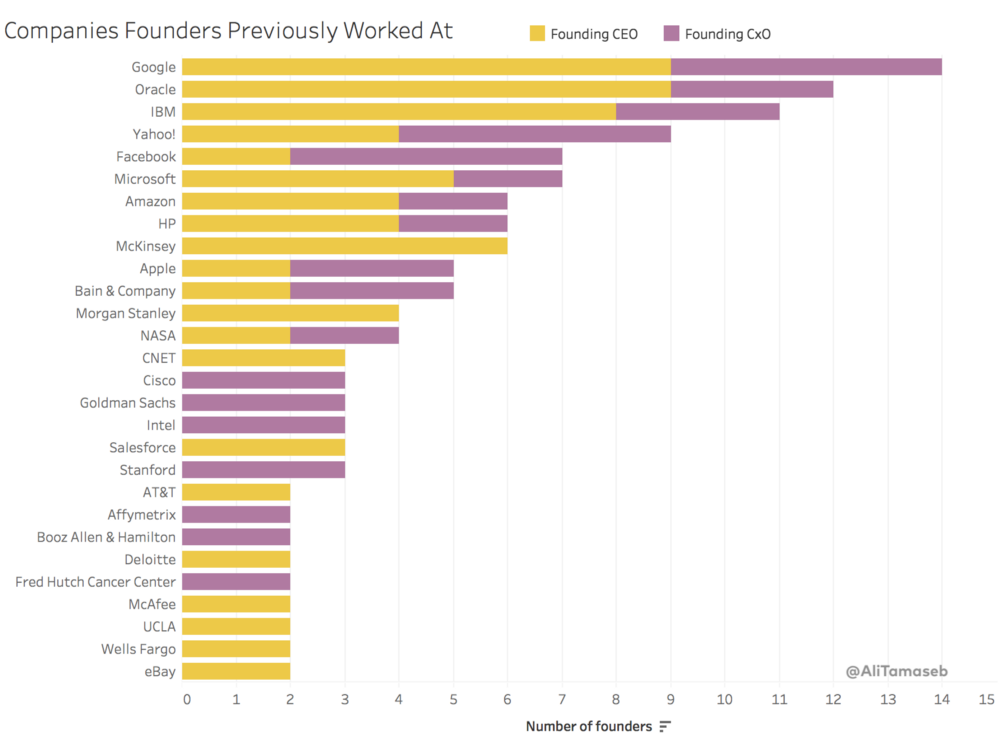
Companies where the founders of Unicorns used to work, the schedule of Ali Tamasab
Education
- Most among the "super -workers" of bachelors and entrepreneurs with the degree of MBA. A separate cluster consists of the founders of pharmaceutical and biotechnological companies. There are many professors, candidates of sciences, etc.
- In the battle of physicists and lyrics for "unicorns" - a draw. Humanitarians among the leaders of startups with billions of assessments are almost as much as techies.
- Work in other startups does not matter. Tamaseb considers the startup phase of the first four years of the company's life. It is unlikely that the experience in startups taught future founders.
- The fathers of the "unicorns" release Stanford, Harvard and MIT.
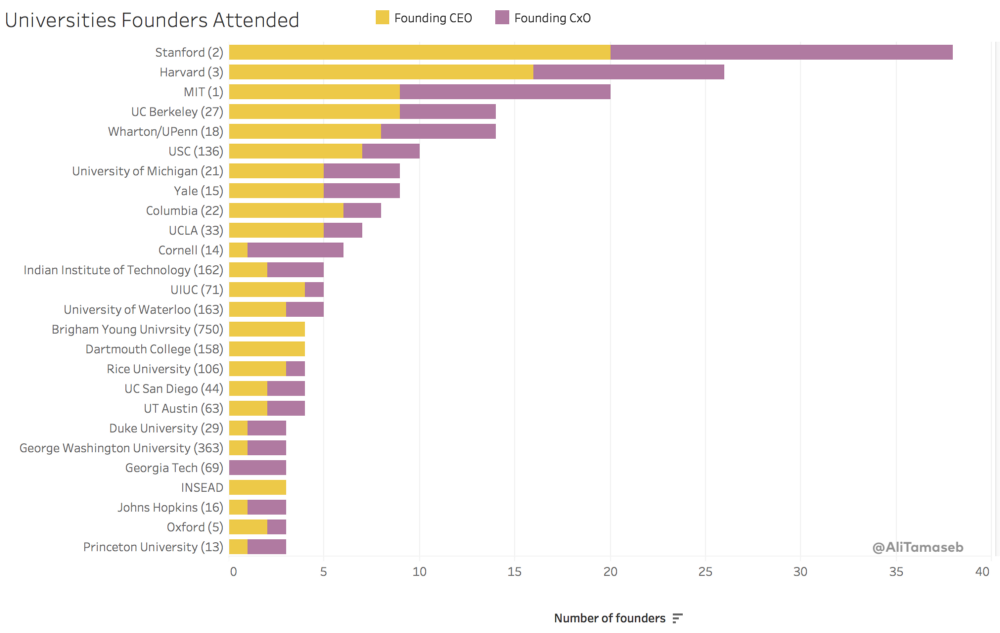
The number of the founders of "unicorns" released from universities. The Ali Tamaseba diagram, in brackets indicates the place of the university in the world ranking in 2018.
Where "unicorns" are found
- Basically, billionth startups appear in California, New York and Massachusetts.
- “Unicorns” are focused on cloud solutions, data, mobile technologies and the development of marketplaces.
- IPO is not necessary, although biotechnological corporations go to the exchange faster, and fintech companies and developers remain private for longer.
- A large margin is leading companies engaged in increasing labor productivity. Then there is a saving of money, convenience, entertainment, health and safety.
- 60% eliminate a certain difficulty, about 30% improve the situation (as Tamaseb formulates: “You need to be an analgesic, but the vitamin also works”).
- In 65% of cases, the Unicorn tries not to occupy a new niche, but to select the existing market share. At the time of the base, the target market is usually huge, but the nuclear product of the “unicorn” is significantly different from the existing ones.
- Almost no one is engaged in simultaneously B2B- and B2C models.
- Below is a diagram with the most fashionable words from the descriptions of the companies (TOP-7: cancer, loans, raids, wearable devices, unmanned vehicles, medical insurance, social networks):
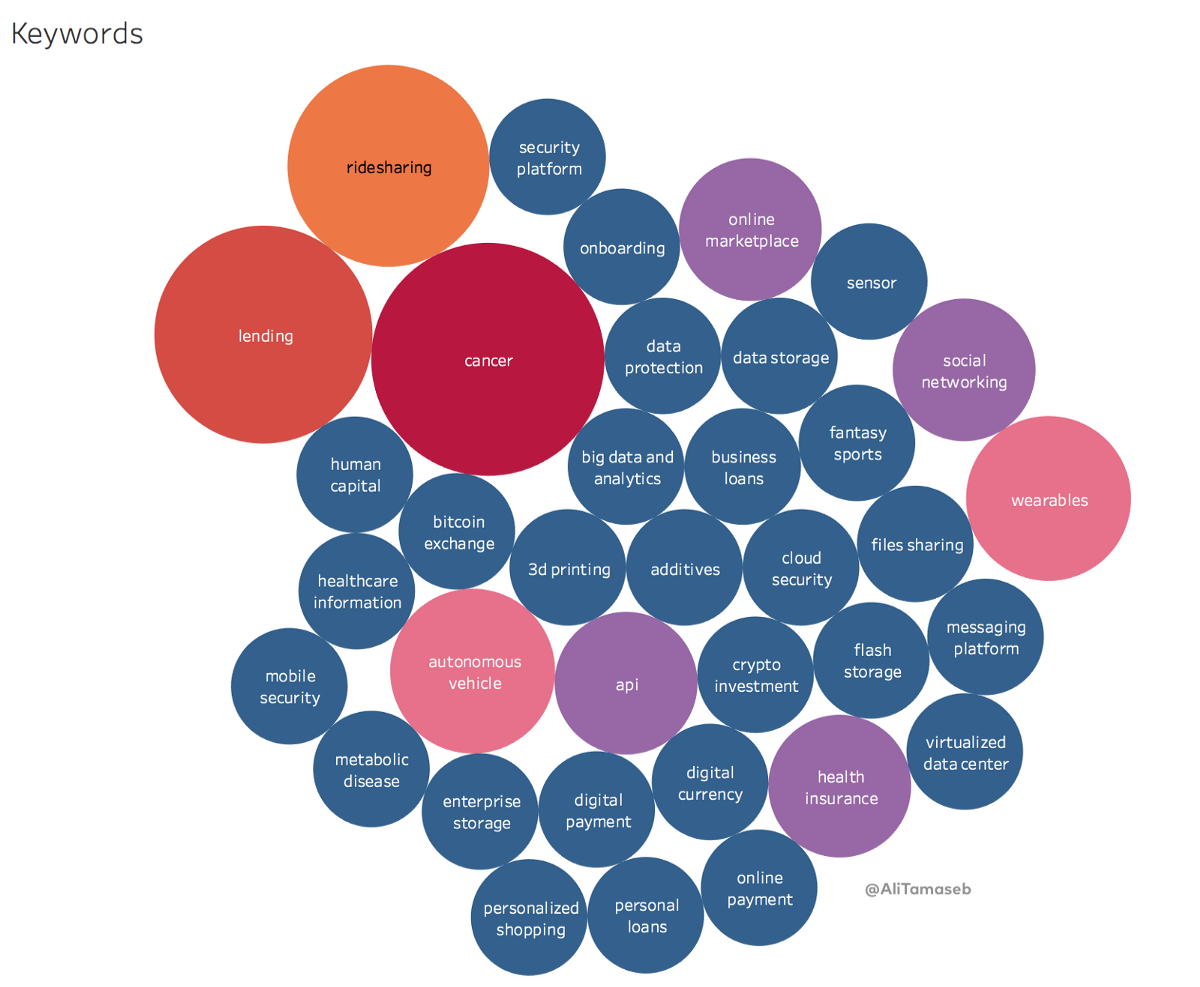
From Cancer to Rydshering. Ali Tamaseba diagram
About the growth of "unicorns"
- The best business angels are former founders.
- Over 90% of the “unicorns” were funded by venture funds, and almost 90% did not pass accelerators. Almost everyone else passed Ycombinator.
- Successful technological startups grow very quickly. 22% of them needed only two years to reach an estimate of a billion dollars. The bulk of the technic companies raised $ 250 million from investors, pharmaceutical companies - $ 400 million.
- The sowing round of investment grows rapidly over time. If earlier it amounted to half a million dollars, now for promising startups it reaches $ 10+ million.
- “Unicorns” were originally very expensive. The typical size of the first round of investments is $ 5 million, and a typical estimate is $ 13.1 million. Investments are attracted by feverish pace - sowing the round for 6 months, and the first - 18 months after the foundation.
- The assessment is distributed according to the stepped law. Over 50% of “unicorns” cost $ 1-2 billion.
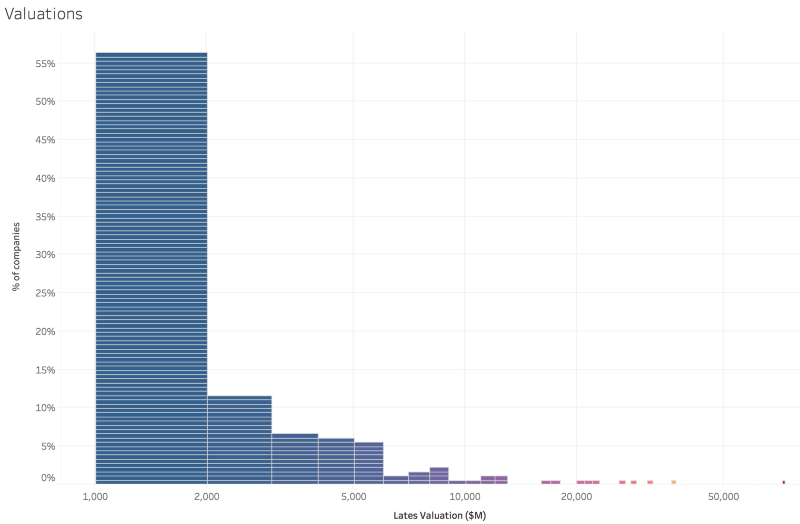
Assessment of "unicorns." Ali Tamaseba diagram
The main conclusions
- Yesterday's “super -residents” who made multimillion -dollar businesses now create billionths.
- Of great importance is the general experience of work, and the industry itself is not always important.
- "Unicorns" appear in the markets that are already huge. They do not create new demand.
- Competition is good. Many “unicorns” from the very beginning fell into a competitive environment, which already attended more traditionally tuned leaders.
- The difference between the product is extremely important for success. New companies with a billionth assessment had a proposal that was very different from existing market products.
Alexander Ambzin