
Translated material
Who is mr Solzhenitsyn
With what the country and Alexander Isaevich came to the 100th anniversary of the writer
On Solzhenitsyn Street, the former large communist, it is not very good to walk with the orchestra. Yes, the monument to the writer is opening, and Putin visits the opening ceremony, but in general the power has recently forgotten how to exploit the date for its benefit-the 100th anniversary of the Great October, it was also Super, let the 50th anniversary of the tanks in Prague were sluggishly charged with the propaganda poison, the Soviet sport on the basis of the centennial anniversary of Anatoly Tarasov. Solzhenitsyn clearly could not cope with Solzhenitsy: who, in his journalism, crystally purely expressed the entire ultra -conservative discourse with his anti -shipping and Russian nationalism, is attacked from this ultra -right flank. And it is precisely for how he was a writer: for the “Archipelago”, for “The First”, for the “Cancer Corps”.
Solzhenitsyn is called contradictory, but he was always completely whole, otherwise he would not have written so much significant for the nation of prose and so many absolutely intelligible journalism, completely not conflicting with the novel genre: the gulag is separate, conservative discourse - separately. It is not “great Solzh” contradictory, judgments about him are contradictory.
In 1994, when Solzhenitsyn traveled to his native Russian land after many years in the forest of Vermont, he was accepted as a Messiah. And he, speaking in Vladivostok and Khabarovsk, said that he was never read. They did not read as a writer. And Vinille in this Mikhail Gorbachev: they say, he did not allow his publications to the last, and then the book market fell apart. Both that and another was an unfair replace: “I used to think that I would come to Russia after my books and they would already know me as an author. Today, as an author, they almost do not know me. They know more as a publicist. ”
So, as Solzhenitsyn was welcomed in 1994, in 1909 they met Kuprin in Kyiv-they did not allow them to touch the platform. So they met Gorky in 1928 in 1928-they also did not let them go down on sinful land. And when he finally felt the asphalt with his feet, he was immobilized by pioneers who clung to his long legs.
The writer in Russia is more than the writer. This is the drama of Solzhenitsyn, who was heated by his article “Education”, his two-volume “Two hundred years” about Jews full of errors, his didactic outline of the 1990 “How to equip Russia” (circulation-27 million), his “Russia in the collapse” of 1994, with which any communist could agree.
And books ... books - for many - are very thick.
Tvardovsky equates Solzhenitsyn with Platonov, Zoshchenko, Akhmatova, Pasternak: “In life we poison, fuck, drive into the coffin, and after death we select leaves and lines”
"I was not mistaken in you"
Perhaps, as Solzhenitsyn was, he was accepted only by Alexander Twardowski, who was in love with his prose, but admitted to himself in his diaries, that with dramaturgy (“Deer and Shalashovka”), Isaich has all “f *** o”. After reading the manuscript of A. Ryazan “Sh-854” in December 1961, Trifonych realized that he had found a diamond that was not even in the “New World” equal. But in order to show the jewel to all the Soviet people, it will be necessary to apply the tactics and strategy of the court. A letter to Khrushchev with a request for a meeting is an “exceptional case”. A conversation with Nikita is not servant, frank: he understands, Alexander Trifonych says that I would not break this thing without you. And the first secretary himself honestly said: a drunken reading is not for me, but here, on the second attempt, it was tightened. And then the 11th book of the New World is being prepared for 1962, which was to be exploding Soviet power. “I am glad that I was not mistaken in you,” says Solzhenitsyn, forever in a hurry and elusive, Tvardovsky. And the one who found his author and released “Ivan Denisovich” is not offended by the writer's arrogance and replies: and I am glad that I was not mistaken in you. And in yourself!
The relationship between Isaich and Trifonych did not work out. But everyone knew with what scale a person deals. Solzhenitsynsky “butt of a calf with an oak” - his view of relations with the “new world”, critical, touchy and offensive to those who for years have been holding defense from censorship for years. Tvardovsky in diaries - not a single word about the beloved author. In March 1967, already being exhausted not by literary, but by the political struggle, losing privileges and posts, which becomes “himself” from this, Tvardovsky equates Solzhenitsyn with Platonov, Zoshchenko, Akhmatova, Pasternak: “In life, we poison, we dudy, drive into the coffin, and after death we select leaves and lines.” He would have known that three years later - after unprecedented persecution - it is behind him, Twardowski, will collect leaves and lines, and Solzhenitsyn would kiss his editor on the ice forehead.
Twardowski died. Solzhenitsyna was driven from the country. Only Makkiavelliyevsky, an intelligent man sent a note to Brezhnev that it was not necessary to drive. His name was Nikolai Shchelokov, the Minister of the Interior, after some time he will shoot himself: "We must not publicly execute the enemies, but to strangle them in his arms ... You have to fight for Solzhenitsyn, and not throw it away." Too subtle for Ilyich. And unacceptable for the KGB.
In 1963, Tvardovsky tried to consolidate success-nominated Solzhenitsyn to the Lenin Prize. They did not give, and then Khrushchev was thrown away, the atmosphere changed. The prize - state - Solzhenitsyn will give a modest officer of the KGB Putin V.V. after 45 years after 45 years
In a polemic with Sakharov, Solzhenitsyn called for a “lower cost of folk energy”, which gives an authoritarian rule in the transition from communism to a different form of political existence. Probably accepting Putin, the elder saw just such a person in the president
Quote for the chairman of Putin
It’s not that Vladimir Vladimirovich wound in Trinity-Slykovo as to work. But Solzhenitsyn had, talked about three hours about something behind a high fence with a hermit, who first changed his covering shelter to Vermont, and Vermont on the Trinity-Likovo. He charged with charisma. But not only: the president went to the former KGB client to understand how to think. In order to make sure of your rightness and find a mission. It’s like a trip to the holy elder - other committees knew the price of interrogated literature and art figures.
The first person, of course, was evaluated by the journalism of Solzhenitsyn. It is not known what exactly the first person read, whether it was familiar, for example, with the articles of Alexander Isaevich in the collection “From under the blocks” (1974). But the student Putin was brilliant.
“On the return of breathing and consciousness”-a polemic with Andrei Sakharov: “The West has already choked with all types of freedoms, including the intellectual. And what, did it save him? ” Parliamentarism and freedom - "passive imitation of the West." Authoritarianism is bad? “And Russia, too, has existed for many centuries under the authoritarian power of several forms - and also retained itself and its health, and did not experience such self -destruction as in the 20th century ... It might admit that the evolutionary development of our country from one authoritarian form to another will be more natural, smooth, more painless?”
“Repentance and self-restraint as a form of national life”-here Solzhenitsyn falls on, in our current terms, the liberal collection “Metanoya”, not knowing that it is polemicizing with young philosophers and religious figures hiding under pseudonyms, including with one of its “liaison” ones, with which he will then break relations due to ideological disagreements. Here is already a criticism of capitalism, which does not self -limit itself. Then Solzhenitsyn will fall on the soulless West-quite in the current style of Patriarch Kirill-in Harvard speech of 1968. But in 1974, he devoted the “education” in 1974 to the fierce debunking of the class that had been born in the late USSR, which we today call the middle-class of active, educated, enterprising people with normal attitudes for normal life: its representatives are denounced by Solzhenitsyn-are chased at the ranks, apartments, colored western rags.
“Come on,” writes the collector “From under the blocks,” “would we lose half the Research Institute, the most important and secret,“ would science stopped? No". And suddenly, after more than a quarter of a century, in 1999, at the anniversary of the Russian Academy of Sciences, he says that science has never been “thrown back in such neglect and poverty”.
In a polemic with Sakharov, Solzhenitsyn called for a “lower cost of folk energy”, which gives an authoritarian rule in the transition from communism to a different form of political existence. Probably accepting Putin in his own way, the elder saw in the president such a person - capable of saving folk energy without western things. I saw the best of the Russian imperialists who “brought science and high culture to the outskirts ... They developed all technology, industrialization” (“Russia in the collapse”). And in the national republics, Russians "insulted on the streets, in trams, in the most crowded places, molested women." And then “our millionth extinction”, “growing people”, as well as (from speech to the Russian Academy of Sciences) “freedom, brought to complete irresponsibility”, “a pirate state under a democratic flag”.
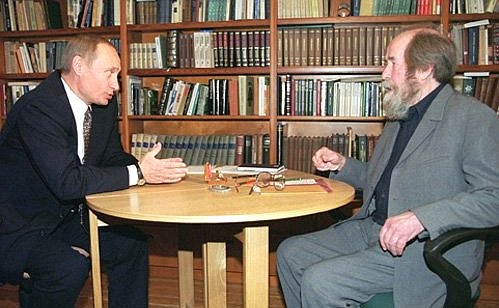
Vladimir Putin visiting Alexander Solzhenitsyn, 2000
The Prophet, which is erupting the banalities worthy of picket vests at the entrance. It looks like a monologue of the average taxi driver, carried away by political rhetoric.
For some time, Putin will adopt the formula “Savings of the people” in his speeches, but then he will forget about it, because the “Savings” will affect only the part of the people to which the “National Distributions” do not belong. Solzhenitsyna will also forget, remembering him only in the days of celebrations, because he will disappear in moral authorities - he will become for himself the most important moral authority, classic and source of inspiration and quotes. Under him, the nation will begin to justify repression - and this will come into conflict with the "Gulag Archipelago".
In 2016, Solzhenitsyn took 11th place (5%) among the most outstanding writers called respondents of the Levada Center. Dontsova, among others, scored 3%. Nabokov - 2%. Pasternak 1% together with Marinina and Pelevin
"My God, writer"
Really - the Nation Solzhenitsyna has not read. And he behaves like Brezhnev from a joke, when he is angrily thrown from the crowd: “The Gulag Archipelago!” And he politely answers, greeting: "Gulag Archipelago!" Neither a short presentation for schoolchildren of the Archipelago, nor a good series on the “First Circle”, nor collecting works, or new publications, help. The time has come for Solzhenitsyna-publicist, but the current heralds of the right-conservative discourse and without him cope. However, as they coped before him. It seems that the time of Solzhenitsyna-writer is leaving. In 2016, he took 11th place (5%) among the most outstanding writers called respondents of the Levada Center. Dontsova, among others, scored 3%. Nabokov - 2%. Pasternak 1% together with Marinina and Pelevin.
Many are not in the list at all. Perhaps because they are considered primarily poets. For example, Mandelstam. “What is this street? Mandelstam Street. " There is no Mandelstam's streets, there is Solzhenitsyn, and when this new toponym was introduced, the tenants were unhappy - where it is better to live on the communist, and even large. However, Solzhenitsyn is not a poet - Twardowski did not publish his verses, delicately noticing that their level was inferior to the level of prose. Journalism - too.
So who is mr Solzhenitsyn?
From the notes of Twardowski on November 18, 1962: “My God, writer. No jokes. The writer, the only concerned with the expression of what lies “on the basis” of the mind and heart. Not a shadow of the desire to “get into the apple”, to put it on, to facilitate the task of the editor or criticism - as you want, and turn around, but I will not get away with my own. ”
Alexander Isaevich Solzhenitsyn has yet to be read again. In essence, a long happy fate.