
Translated material
My Solzh
Delight against the background of myth
The path from a living god to a strange man from the TV: the editor of Gorky, Konstantin Milchin, talks about his relationship with the myth of Solzhenitsyn.1. It is worth starting with a small warning. This article is not a philologist or a literary critic. This is not even an article by a book critic and not quite an article by the reader. This is a text about the Solzhenitsyn myth and his life in the head of one individual character. Me.
2. I was born in a family that adhered to moderately dissident views. That is, the matter did not go further than reading moderately prohibited literature and conversations in the kitchen. I grew up in the world of Betheism: there were two good deities in the sky, the great academician of Sakharov and the great writer Solzhenitsyn, what their greatness was - the five -year -old boy was unlikely to guess, but did not try to doubt. One God was in exile, the other lived far in America. Sakharov was the god of conditional Westerners, Solzhenitsyn - conditioned soils, we worshiped Sakharov more, but the second deity also admired and offered him intellectual phimiam. Already in more adulthood, reading the stories and novels of Dovlatov, I found in them a similar religious doctrine.
3. About 1988; “Radio Liberty” * media is recognized in Russia by a foreign agent and the unwanted organization is no longer jamming, and my first experience of a clash with the texts of Solzhenitsyn is taking place - I listen to the audio version of “One Day of Ivan Denisovich”. As I understand it, it was a record made by the BBC in 1982. A soft, velvet voice, almost no emotions from the told. For an eight -year -old, everything heard was represented by one continuous incessant horror. It was, on the one hand, it was scary, and on the other, it was better pushed to the main simple thought of the text: this is a completely monstrous day for me, it is very good from the point of view of the author and the hero. It has solid joys. Not sick. Hacksaw. Balanda. Fish bones. Bread. A great day. What is the bad day then? And one more thing: the story has something irrational, mystical, anti -scientific, not fixed by the scientific equipment of philologists. This is the power of the narrator, the inhuman force standing behind each line of the text.
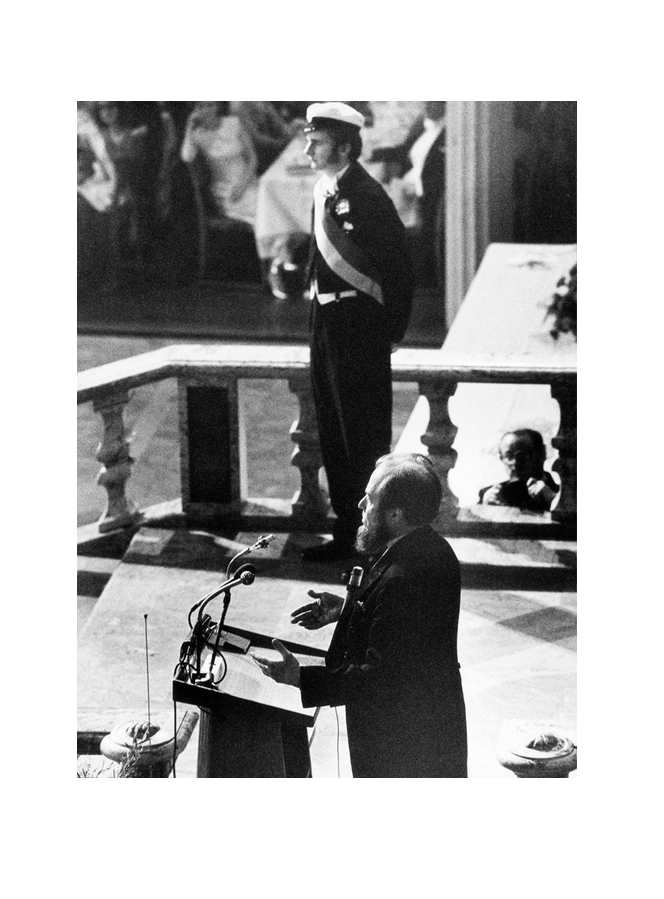 Alexander Solzhenitsyn reads Nobel speech. Stockholm, October 10, 1974
4. The same 1988. The same “freedom”: Vladimir Voinovich reads “Moscow 2042”. The writer Kartsev, a dissident living in Germany, goes to the future in a time machine, there the USSR turned into the DPRK of the worst sample, but soon this world will collapse because the great Russian writer Simych Karnavalov will wake up from hibernation in emigration, he will enter Moscow on a white horse, cancel the progress, and he will become a self -holder. Who is Simych Karnavalov was quite obvious. This is he, the second God, night, but from that no less important luminary. “Moscow 2042” is a perfect incessant delight. But my admiration for Voinovich’s text cannot shake Solzhenitsyn’s location in a heavenly arch. Despite all my children's maximalism, I was not alien to pluralism. But in the case of Voinovich, it was obvious: a person challenged God himself, but the divine essence of Solzhenitsyn is in no way questioned by this daredevil.
5. Perestroika begins. Sakharov dies, Solzhenitsyn still lives in exile. He is popular. He is the Messiah, he is the king under the mountain, who is waiting in the wings to return and save his homeland. In 1994, everyone is waiting for great reasons. It seems that there are no other topics in newspapers and magazines: everyone just talk about him. He will return and correct everything. Solzhenitsyn to the conditional soils seems to be a messenger, the conditional liberals were either silent or joined the choir enthusiastically awaiting. There is still one teaspoon of bile in the stream of pathos: philologist Grigory Amelin in the “Independent Gazeta”, then one of the most influential, writes Pasquilus article. “A multi -volume to a hernia, from a Hollywood beard and a conscience polished to an unthinkable brilliance, he is a festive, like May Day, and, like him, godlessly outdated.” The army of fans explodes with response pamphlets. The text is compared with denunciation. But who can be reported to Solzhenitsyn in 1994? Who is higher than him? One of the conversations, as I remember now, ends with quite predictable jokes about the surname: “Harse, Amelin!”.
6. Meanwhile, he really returns. He begins in the Far East, goes through Siberia to Moscow, on the way in each city crowds of people come to the meeting. Just like Sim Simych Karnavalov in Voinovich’s novel. And what will happen next? Coronation? Restoration of the Emperor? The ban on machines and other mechanisms? Now the possibility of coming to the power of the ruler of the Duma seems to be something incredible, but we will try to return in 1994. Everything is shaky and not very clear. The small civil war has just ended right in the center of Moscow, the executive branch defeated the legislative. But then the elections to the new parliament were won by some very strange people far from the executive branch. But the state system itself is unsteady. Positions are invented under specific people, and when people leave power, the positions disappear with them. There was Gennady Burbulis - and we had the position of state secretary, as in America, only with other functionality. But Burbulis left - and since then there are no state secretaries in Russia. Or Yeltsin had a once very popular ally - Vladimir Shumiko. They joked about him then (it seems that it was the inevitable and system -forming Columnist M. Yu. Sokolov in those years) that noisyko is his position. But these are all new, recent people. And here is not just a position, but a living God, the connection of the eras, the Nobel laureate, the most famous Russian writer in a literary -centric country in the world. The deity comes to Moscow, performs in the Federal Assembly, where all deputies, senators and ministers applaud him. Solzhenitsyn receives a regular television program. These are all attributes of power. It seems that he is about to receive the power itself, real. She herself, like an overripe fruit, will fall at his feet. Well, or at least let the Trinity-Slykovo become a new clear clearing, and we will have two presidents, as there used to be two kings. One in the Kremlin, the other in the Trinity-Slykovo. How all this was logical for a young political strategist with a volume of Voinovich in one hand and a “red wheel” in the other. Well, not with a volume, of course, but sewn under one cover with extinguished notebooks from the numbers of the "New World". It was the peak of his popularity. But he did not take the authorities, he did not even touch. Further, popularity rolled down.
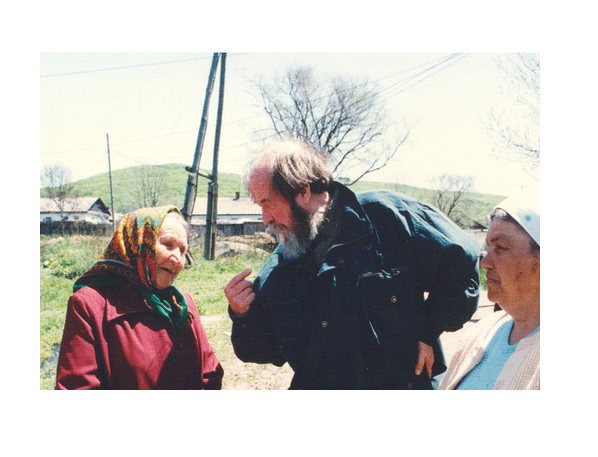 Solzhenitsyn is exchanged by opinion with the inhabitants of the island of Popov. Vladivostok, May 29, 1994
7. In 1994, Solzhenitsyn’s return to his homeland was violently discussed at school. My friends were delighted. I exuded bile and skepticism. So that this does not look like a boast, I will immediately make a reservation that there was more poserity and senseless non -conformism here than sound logic. 2.5 years will pass, and in 1997 we will go through the texts of a living classic in a literature lesson. The situation will turn over 180 degrees. Friends will exude poison, and I will babble something about the great contemporary . About the very irrational power that is hidden behind the texts. And again, there will be more posterity here, but something happened over these 2.5 years. The universal idol, the one to whom the crowds applauded, the one from whom they expected and from whom they expected something, which they could not even formulate, turned into a strange person from the TV.
8. And then I grew up and became a book journalist. It was a harsh adult world. Here the deity was called in amicoshonian-Solzh. We work here, in business, there is no time for a complete pronunciation of a long surname. And I began to say so, and then became insolent so much that I wrote a review of the second volume of the book Two Testament Together. And something in this book was wrong. Not content, not ideology, features with them. It was not so that at first there seemed to be ordinary Solzhenitsyn, with his desperate struggle with the Russian language and endless neologisms - for example, the word “Bolshevitsky”. But here's the bad luck: all these verbal exercises and the notorious inhuman power were first at first, and then they came to naught to the middle of the book, then to completely disappear. And this led to a sad thought that the second part was written at least with someone’s help.
9. When Solzhenitsyn died, I expected that the Trinity-Slykovo metro station (which, as it was not there, was not there, but there is an even section of the path, where theoretically, with a great desire to build a platform), they will call Solzhenitsynskaya, but then they limited themselves to the street on Taganka. However, the oddities of his posthumous fate are not this. And the fact that everything is now upside down and everything has changed places. He fought with the state all his life, now the state cherishes his memory, puts monuments to him and calls him the street in his honor. Books about him are written by representatives of the liberal camp, and the current conservative wing does not like him. On the other hand, that he - the victorious death and the aroused oak is our miserable showdowns and assessments.