
Translated material
Alice and Taumatrop
"Gorky" in "Labyrinth": Do not miss these books
Two books about Alice in the Wonder of Wonders with riddles, rebuses and unusual facts; a book about Victorian England, which can not only be read, but cut and glue; The black-and-white drawings familiar from childhood to Alice, which have now been published in color, and, finally, the modern edition that looks like an antique treasure: in today's issue of the “Gorky” section in Labyrinte, we talk about the most unusual editions of Lewis Carroll’s dilogy, which can become the ideal New Year's gift to both adults and children. 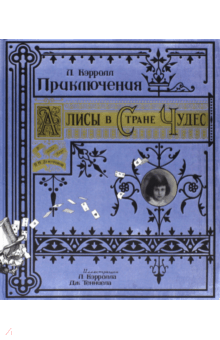 Lewis Carroll. The adventures of Alice in the Wonder of Wonders. M.: Labyrinth Press, 2018. Translation from English Nina Demurova
In fact, under one cover, with which Alice looks at us with squint, is posted not one book, but several. So this is not only a popular fairy tale, decorated with drawings by Carroll himself and classic illustrations of the famous cartoonist John Tenniella, also comments that immerse in the context of the fairy tale. Firstly, they explain many places that are incomprehensible today simply because of the prescription of their spelling. For example, why hats, or “boobers” seemed crazy even in real life, which in England there is a separate proverb. Secondly, they talk about the history of the creation of the work, and about the sources that the author addressed. Here we find out what characters of the fairy tale appeared at the personal request of the prototype of the main character Alisa Liddell or as a fairy tale was published for the first time. Separately, it is worth mentioning that in the songs of the fairy tale, Carroll frankly parodilized the real songs and poems, and the comparison with the original makes them only funnier. Thirdly, comments reveal the essence of some details that are considered to be the usual fiction of the author, although having a completely logical explanation. Say, the quasi is constantly crying tortoise, and if you consider it a sea turtle, this is normal: in this way, excess salt is excreted from the body.
Before us is a real children's encyclopedia with countless facts about England of the Victorian era. A special way to prepare a cod from one of the first culinary writers in the world of Isabella Biton; shoes sewn one pattern for both legs; collecting bird eggs (!); Non -existent coins that indicate the prices of noble goods; The cunning method of writing a long letter with a lack of paper; Ties, stations, footmen, pets, heralds, gardens, chimney sweeps and, of course, tea. The compilers talk in detail about the oddities of the English court (with the death penalty for theft in the amount of more than the shilling), about the development of mail (with five -wheeled mail bicycles), about the construction of schools (with one teacher for 300 students).
And this is a whole storehouse of puzzles, puzzles and games: the turns are teeming with opening windows, pseudo-coaters and hidden doors (at some point you already start to get confused, where the usual drawing is, and where the cut figure). It is said a lot about the fun and games that adults and children of that time were fond of - in the house, in the salon or in the fresh air. Starting from a more or less known crockete to a “blind postman”, looking for a lost parcel. The rules are attached, so that Alice herself may even remain unfinished. However, it seems that Carroll would like this approach - he himself was a great inventor and came up with new games right on the go.
In a word, be more careful: nothing happens here just like that. Even the fact that the portrait of Alice with a squint on the cover, depending on the angle of view, changes to her photo, also for a reason - find the explanation of this yourself.
Buy on Labyrinth.ru
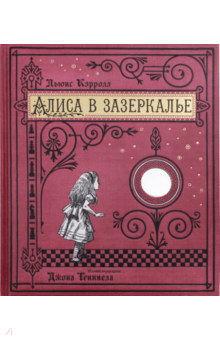 Lewis Carroll. Alice is in the behind -the -ry, or through the mirror and what Alice saw there. M.: Labyrinth Press, 2019. Translation from English Nina Demurova
The continuation of the famous fairy tale was released in the same stylistics and in the same splendor as the first part, only a mirror is attached to the ribbon-Lass. It, as a gun hanging in the first act of the play, is useful to the reader, because part of the text or images can be disassembled and understood only with the help of a mirror. And now an adult, having shoved a child, is playing with the book himself. Jokes jokes, but the new two -volume “Alice” performs a fairly important humanitarian function: it re -revives a variety of books with notes where comments are no less, or even more important than the text itself. It revives in a playful way, without which nothing will work now.
And again we are immersed in the sea of facts: Alice gets on the train - and we will find out when railway tickets appeared in England, and then all over the world, in 1850. There were no corridors in the English trains of that time, and the passengers went into the right compartment directly from the platform. One boy was somehow sent with a living load, just clinging the tag for him. In the episode, when Alice divides the plum pie, a primary cake recipe appears, and at the end of the book there are paper, but quite real chess.
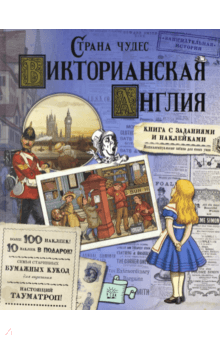 Arina Akulova, Ekaterina Buntman, Elena Novichkova. Wonderland. Victorian England. M.: Labyrinth Press, 2016
There is no longer a fairy tale of Carroll in Victorian England, but there are many applied educational tasks based on the era. To figure out what was invented during the time of Queen Victoria, and what later; to indicate the boundaries of the British Empire; to trace the history of fashion with examples of male and female outfits; To build a schedule of home hassle among the owners, cooks and servants and, finally, in order not to get lost in the local market, you need to prepare well; This book helps to do.
Here you can cut, glue (more than a hundred stickers will need to find your places in the book), finish, pass the labyrinths - and thus compose their own limits, wear citizens as it is appropriate, plant guests at the table in accordance with the rules of the etiquette and even make a real valentine from the 19th century. Perhaps the most interesting is to build details for your Taumatrop. In the UK at that time, the so -called optical toys were popular: some of them could be made from improvised means, they themselves created an amazing effect of moving or voluminous pictures. Taumatrop is one of such fun; It is made easily - it is able to take it all evening. And the stickers can be adapted for the tablet.
Buy on Labyrinth.ru
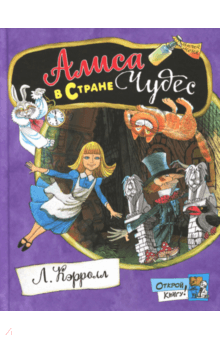 Lewis Carroll. Alice in Wonderland. M.: Labyrinth Press, 2018. Retelling from English Boris Zasdrador
This book is noteworthy in that it was created by two classics of Soviet children's literature and animation. Carroll’s fairy tale was retold by Boris Zakhoder, who wrote many children's poems in his life, first translated books about Mary Poppins, Peter Pan and, of course, Alice. His most famous work is the scripts for cartoons about Winnie Puch, the first translation of the tale of the bear also belongs to him. Illustrations in the book-Viktor Chizhikov, a national artist of Russia, who invented the very Olympic bear, with whom in 1980 in Moscow they said goodbye to tears in his eyes.
Zakhoder retold Carroll's fairy tale, because it is extremely difficult for (accurate) translation. Everyone who worked with her note that in it almost every paragraph is playing in her; In addition, all the verses in the fairy tale are parodies for songs popular at that time. According to the recognition of the visor himself, he was afraid to take up Alice for a long time, intending instead to proceed with the scientific article about the reasons for the indistinctness of the famous fairy tale. As a result, he nevertheless took up the transfer, but provided him with small comments to the most interesting and incomprehensible places. The text used here was written back in 1970 (Boris Vladimirovich himself died in 2000).
The drawings are also an interesting story. They were made 40 years ago for Pioneer magazine, but then they remained black and white. Now Viktor Chizhikov “painted” them at the request of the publishers - and it seemed as if completely different illustrations. In general, the book, on the one hand, is new, on the other, as if found in the Bukinistic department.
Buy on Labyrinth.ru
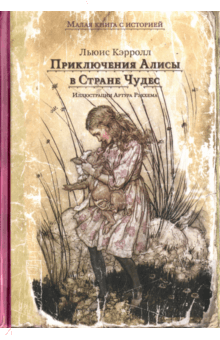 Lewis Carroll. The adventures of Alice in the Wonder of Wonders. M.: Meshcheryakova Publishing House, 2016. Translation from English Nina Demurova
You can approach the Victorian era differently. In this book, the publishers made a bet on drawings and design. The volume is very compact and even at first glance does not look like a children's book. It’s as if you are holding in your hands somehow preserved from the 19th century the publication: an erased crankshaft, a battered cover, the damaged edges, yellowed pages. It seems that if you carefully take the book, it will simply crumble in her hands. In fact, this, of course, is just a good work of the designer - to do as if you got the very first edition of Alice in Wonderland.
The most valuable greetings from the mentioned era are the illustrations of Arthur Rekham. This is a well -known book artist who lived just at that time, one of the most revered British illustrators, which greatly influenced artists, photographers and even directors of the 20th century. He illustrated not only Lewis, but also the Grimm brothers, and William Shakespeare, and Redyard Kipling, and Jonathan Swift, and Charles Dickens; He made out the "Ring of Nibelung" Richard Wagner in the theater. His drawings to Alice are peculiar and not similar to anything: somewhat gloomy - but extremely detailed. And it seems that since the artist worked with an almost modern fairy tale, it was his details that can be called the most believable.
Buy on Labyrinth.ru