
Translated material
Extraneous V.
Review of the first biography of Venedikt Erofeev
Can the biography of Venedikt Erofeev be a story about his various reflections in texts and memories? Why exactly “Moscow -Petushki” played such an important role in the self -identification of the post -Soviet reader - and at the same time is highly appreciated in the West? At the request of Gorky, the literature historian Alexei Evstratov tells what questions the first biography of Erofeev answers and what questions she prompts to ask.Oleg Lexmanov, Mikhail Sverdlov, Ilya Simanovsky. Venedikt Erofeev: outsider. Moscow: AST, 2018
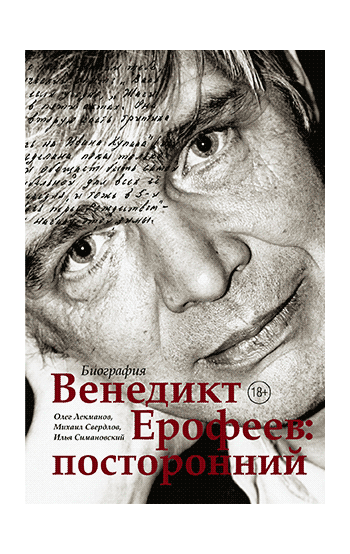 Last October, it turned eighty years since the birth of Venedikt Erofeev (1938–1990). The writer’s anniversary was his first biography, written in collaboration with two professional literary critics (Lexmanov and Sverdlov) and an expert on the Erofeevsky biography from unprofessional fans of his work (Simanovsky). The study that underlies the publication makes the book an event. But the issues that grow from the narrative about the Soviet man who believed in his own exclusivity are no less important and managed to inspire this faith in others.
“Venedikt Vasilievich Erofeev is very early, at the age of eighteen, once and for all came out of the path, mandatory for almost any intellectual care of his own well -being,” so, from the expected thesis about exclusivity, a preface to life description opens. For similar reasons, Erofeev can hardly be called a writer without quotes - by virtue of the objective properties of the literary field of these decades, and the difficulties of the professional trajectory of Erofeev himself. His Opus Magnum , “Moscow - Petushki”, was completed in 1970, when the author worked in cable work in the suburbs. And this is not the most unexpected employment of the author-nomadic with a dangerous habit of losing a passport. The manuscript "Moscow - Petushki" was already going to Samizdat, and its author continued to master new professions. Erofeev was especially in the heart of the laboratory assistant as part of a “parasitological expedition” in Uzbekistan, organized by the All -Union Resignation and Sterilization in 1974.
Before the abbreviated edition of the Poem appeared in the perestroika magazine “Sobriety and Culture” in 1988, the book was translated into a dozen languages. The glory of “Moscow - Petushkov” and its creator was first sub -Soviet and nonsense: the text had a walk in Samizdat, and in 1973 was published in the Israeli journal. Both within the USSR and beyond the book, the book caused some fuss, often, coupled with enthusiasm. In the catalog of the Imka-Press publishing house, the essay of Erofeev was accompanied by the following annotation: "The Grotesk poem about one of the most terrible ulcers of modern Russia-about the general, unprofitable drunkenness of the assigned, deceived people." In the Soviet Union, the even rumble of the underground popularity of “Moscow-Petushkov” broke into the event of the event of art and university life of large cities in the late 1980s. The beginning of the public existence of Moscow - Petushkov in the USSR almost coincided with the death of the author in 1990.
Since then, a lot has been written about the text and its author. However, the most interesting publications about “Moscow - Cockerels” - articles, heads of books or collections; noticeable exceptions are the total commentary on the “Moscow - Cockerels” of Eduard Vlasov and the “Psychoanalytic Research” by N. A. Blagoveshchensky (“Case of Vena E.” M., 2016). In this sense, it is not surprising that the first full biography of the author of one of the most recognizable texts of the last decades of the last century was released only in 2018. At the same time, the book of Lexmanov-Sverdlov-Simanovsky is embedded in the poetics of fragmentary literature about “Moscow-Cockerels” and the author of the poem. Firstly, she has three authors-a rarity for the biographical genre. Secondly, the narrative technique, chosen by co-authors, is built on multiple. In the biographies of Mandelstam and Yesenin, Lekmanov and Sverdlov have already tested the role of “selectors, thematic classifiers, as well as inspectors ... to the factual accuracy” of memoir statements, which are quoted with the works of their protagonists. Installation, it should be noted, was a favorite narrative technique of Erofeev, from his youthful notebooks to “My little Leninian”. The “outsider” gives, on the one hand, already published in the literary and scientific periodicals and interviews, and on the other, memoirs written specifically for the anniversary composition.
The last feature makes the book a unique artifact. In October, not only eighty years since the birth of Erofeev turned out, but also almost thirty years from the date of his death. And this means that his friends and even irregular interlocutors are becoming fewer every year - the youngest of them is under sixty. Therefore, the collection of memoirs, their rechecking and authorization is the most important component of the documentary project: this is probably the first and last biography from contemporaries of the protagonist.
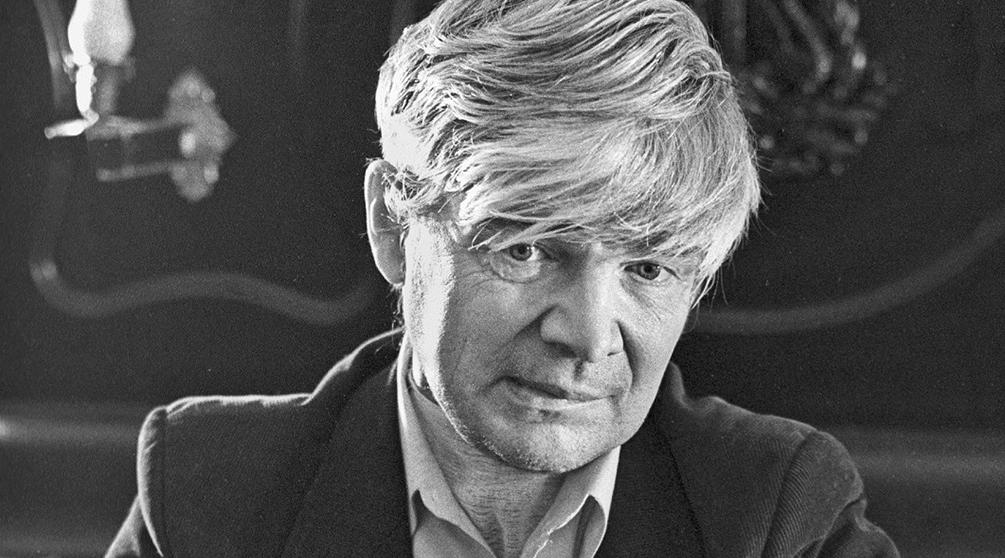 Venedikt Erofeev
This valuable feature of the book could not but affect the mode of the biographical narrative. And the stinginess of the author’s commentary affects the intelligence of the statement. The main audience of the book, probably also contemporaries - genuine or imaginary - Erofeev, which many realities of Soviet culture can restore from memory. (It is characteristic that the presentation of the book in Moscow took place in the presence of a significant number of its defendants; see video recording of the meeting ). Those who do not attribute themselves to this imaginary community will probably be difficult to accept the language of the biographical narrative as a whole (the installation effect is almost leveled by a certain monotony of the material) and the thesis permeating the “absolute freedom of Erofeev from the surrounding world” in particular.
The epigraph from the essay of Vladislav Khodasevich “Andrei Bely” was pre -pre -izing biography, in which the biographical “Podars” is opposed to the “elevating truth” and the fullness of understanding. How do the authors try to achieve full understanding? To begin with, they needed to find a solution to the basic problem - sources for biographical reconstruction. Erofeev was not only for the time being with a circle, semi -underground author, but also diligently evaded those institutions of Soviet reality that had bought paper production, such as an army or permanent residence permit. The consequences of the nomadic life of the protagonist for the biographer are obvious: the facts of the Erofeevsky biography are shouted mainly from retelling in the first, second or third person. The role of bureaucracy, which sometimes helps to maintain traces of life, is third -rate for this reconstruction. The testimonies of close friends and acquaintances of Erofeev, who were often his first readers and admirers, fill out a lot of gaps and, it would seem, should help to find the “feelings and dreams” of the hero of the biography. Here, however, the logic of biographical research is on the active writing life -making.
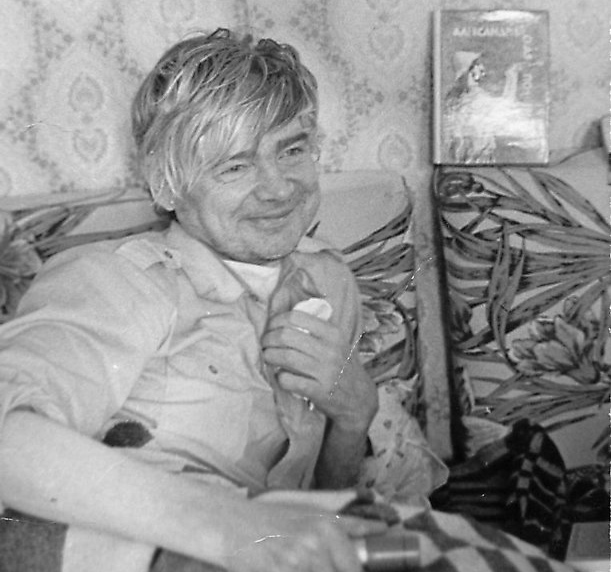 In the essay, preceding the early 1995, the collected works of the writer, Mikhail Epstein drew attention to one of the motives of Erofeev’s circle reputation - about the underlife of his talent, that he was more significant than his works. His closest friend, philologist Vladimir Muravyov, spoke even more decisively: “Freedom was the most important in Erofeev. He achieved <...> of course, he destroyed himself. Well, well - he thought that life is self -destruction, self -combustion. This is the price of freedom. " Galina Erofeeva, “The second wife of the writer” (as it is customary to represent the defendants in creative lives), said: “Probably, you can’t say that, but I think that he imitated Christ.” The Holy Scripture was, of course, the most important, but, as it seems, nevertheless one of the “modeling systems” of the life of Erofeev-along with world literature (according to the catalog of the corresponding series of “library”) in general and Russian poetry in particular, but also with other areas of ordered experience. Following these reflections, the book about Erofeev turned out to be a book about the character of Erofeev in his different hypostasis - a circle genius; fulfilled contradictions of booze; the writer in the continuous and non -bombed process of formation; The author of the text exceptional in qualities and brooms from this very text.
The biographical genre is based on the idea of the unity of the autonomous subject, Unitary Subject , which, in turn, is fixed by biographical narratives in culture. In the life of Erofeev, despite her social restlessness, some constants are indeed visible - in addition to passion for alcohol, literature and music. For example, he masterfully passed exams to universities (and participated in the educational process with much less hobby) and with pleasure subjected the examination of others - for example, to knowledge of the gospel or Russian poetry. “He set us points! As in figure skating: 5.7 - 5, 4 - 5.9 ... ”, recalls the actor of the student theater of Moscow State University of the appearance of the author of“ Walpurgis Night, or the steps of the commander ”. And so, right up to the “33 sounding questions from the applicant Ekaterina Gerasimova”, found in the writer's archive.
Nevertheless, the unity of the personality is best constructed in literature, especially in the first -person narrative. Having tracked how a separate observation from the notebook moves to the pages of “Moscow -Petushkov” (and there are quite a lot of such cases), the authors concluded that it was the poem that can be considered the most complete and trustworthy source for the study of the inner world of Erofeev. Thus, life ( bios ) is closed to literature, a letter ( graphic ): in seven out of eight chapters of the book, the story of “Venedikte” is accompanied by the analysis of the poetic trip “Benes”. Such an interweaving of the biographies of the author and the hero is the course, of course, interesting, but also characteristic in the sense of maintaining the insignificance-imperfection of two narratives. As if the biography of Venedikt Erofeev was empty without his masterpiece.
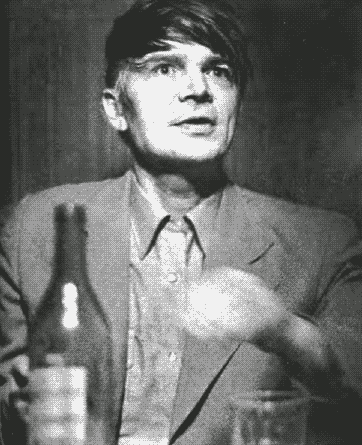 In my opinion, here the conversation about the “outsider” is finally inferior to the reflections of the genre - the pages freed in this way could be devoted to two approaches to the relationship “Protagonist (biography) - contemporaries - literary text - reception”. Within the framework of the first approach, it would be curious, abolishing the thesis of the deliberate exclusivity of Erofeev, to think about the phenomenon of late -Soviet circles, drinking and not very, but always men - and their pseudo -religious, varying degrees of ironic culture. “Moscow - Petushki” can be considered as the fact of this circle culture, but it is not entirely clear how to interpret interest in the translations of the poem into foreign languages. Qualified readers - from Brodsky to the Austrian Slavist - argue that only “Russian”, “compatriot” can appreciate the text. However, giving rise to dense fantasues of “Russianness”, the composition of Erofeev is read by many and differently, often very personally. It is enough to compare with each other the three English translations of the poem.
On the other hand, it would be appropriate to study the exit of the text out of the circular context into a wide existence, which fell on the 1990s. As it seems, it was the book “Moscow - Petushki” that became the place at the same time the mass and very personal experience of the self -Soviet reader. Why? Why did Erofeev’s text become the main contender for the status of “grief” among reading and drinking city communities? Both prospects imply a distance, exit from the text, and from the imaginary community of contemporaries of the writer. The first biography of Erofeev brilliantly demonstrates that "the situation is rushed."