
Translated material
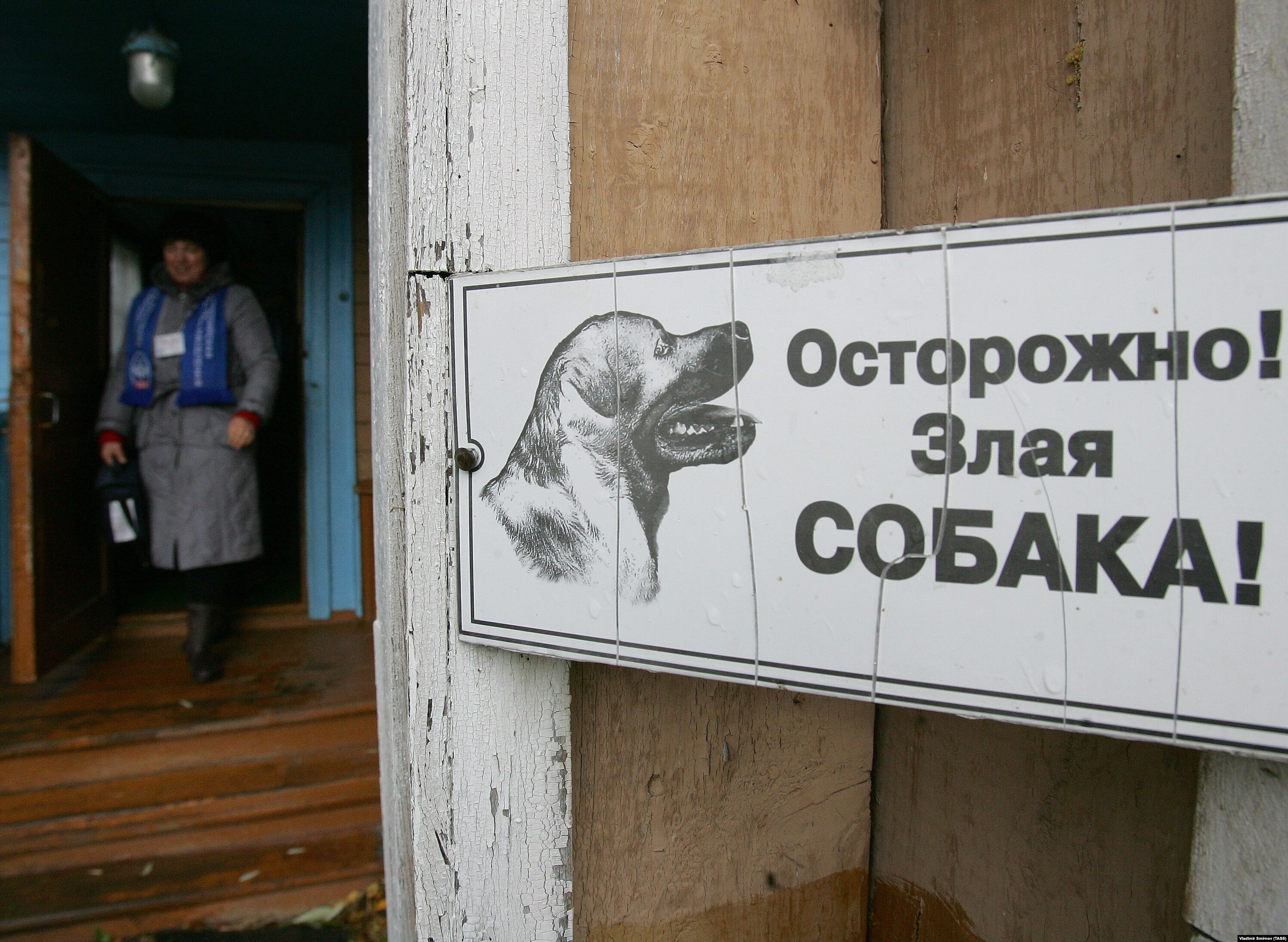
All around the collective farm ...
Do they respect private property in Russia?
- Private property in Russia was not lucky: the state usurped after a century. In folklore, the owner was called a world -eater, a fist.
- The Soviet experience of socialization and the dubious privatization of the 1990s, the appearance of oligarchs also did not strengthen the authority of private property.
- In fact, the right of ownership in today's Russia is not guaranteed: there are cases when the state takes away from people and apartments and business.
- European history indicates that property helps to turn a person into a citizen.
- In modern Russia, the origin of the sprouts of civil society takes place in the struggle for the property that the state encroaches on.
Sergey Medvedev: “Retain and divide”, as Polygraphovich Sharikov clearly formulated almost 100 years ago in Mikhail Bulgakov’s novel “Dog heart” ... What has changed since then? How does the attitude of Russians towards private property change? Did she become the final piece of paper that Professor Preobrazhensky spoke of?
Correspondent: Private property - reality or illusion? We buy an apartment, a car, build a cottage, start our business, honestly pay for the right to own, but this does not always mean that this right cannot be taken away from us. Few people think about who owns a plot of land under the house in which he buys an apartment - a partnership of owners or the state. Often a state or municipality can simply confiscate housing and give out something in return. The independence of private business from the state is also very conditional - problems with land rental, the arbitrariness of bureaucracy and bandits.
Video version of the program
At the same time, everyone claims the inviolability of their property, many insist that property as an institution in Russia exists or must exist. However, not everyone understands how to protect themselves and their property from the invasion and where the border between the private, public and the state passes.
Sergey Medvedev: We are visiting sociologist Denis Volkov , Head of the Department of Applied Sociological Studies of the Levada Center , and Andrei Kolesnikov , Head of the Russian Internal Policy and Political Institutes of the Moscow Center of Carnegie . Our guests are co -authors of brochures called "New Russian Dream: Private Property for Children."
When there was a night of "long buckets" , the ill -fated kiosks near the subway destroyed. Under spotlights, people hung out the Constitution of the Russian Federation in the windows of these destroyed kiosks, its article 35, which speaks of private property. And this constitution was breaking the bulldozer bucket. Given this, in Russia there is at least some trust in private property?
Andrey Kolesnikov: Where to go? There is a sense of property, exists formally, legally and even in fact, but there are problems with its protection, immunity and inheritance. At this stage of transmission, in fact, everything breaks. There are whole businesses that relate to the transfer of inheritance property by rich people. As a rule, even rich people do not think about what will be with businesses, how children will behave with this property, how to protect and transfer it.
Sergey Medvedev: Now I own this, but she does not have a third, fourth time measurement.
Property exists formally and even in fact, but there are problems with its protection, inviolability and inheritance
Andrey Kolesnikov: This is the problem. The feeling of temporality of this property given to feed ...
Sergey Medvedev: Say, in Russia there are no family sagas - Buddenbrokov, Saga about Forsytes. Apparently, these long ownership cycles of some kind of asset are simply impossible in Russian history?
Denis Volkov: In a sense, private property nevertheless appeared in the 90s-it was formed and given to people for possession. Awareness and thoughts about private property just arise at such moments when they break something, take it away. But if someone is taken away from someone, then this is still not with me, and I do not think about it. About the night of "long buckets" respondents in Moscow say: "What? It became good, beautiful." And only when you ask: "What did you do with businessmen?" - "Yes, it’s not very good with businessmen. It turned out not good." But this arises, already when we ask, and by themselves people do not understand this topic as a violation of private property. Here is an apartment, car, cottage - this is understandable ...
Andrey Kolesnikov: It was personal property in the Soviet Union. It has become private - and for a person it is understandable.
Denis Volkov: Business, for example, is already much less clear. This is some kind of incomprehensible process, it is not so much referring to private property.
Sergey Medvedev: But legally, it is one and the same. Now in fact there is no difference what to take a kiosk from a person, what to select a car.
Andrey Kolesnikov: In general, yes. But it is psychologically easier to select a kiosk than a car or apartment, although this is also realized. This story with two quarters in Kuntsevo : the company of Peak came, and people did not know that, it turns out, the land under them did not belong to them. People do not want, this is an emotional attachment to property. The apartment is not just an apartment. She is filled with the lives of generations: moms, dads, - the favorite yard, the beloved dog went there three generations back, are not bad at home.
I look at a similar quarter, for example, in Berlin: no one demolishes these houses that rushes with an excavator and is not going to put a shopping and entertainment complex. It's just some kind of plague! And she came exactly that they neglected private property rights. And the authorities can get any piece of paper and say that this is illegal, but everything is legal for us, we agreed everything.
Sergey Medvedev: Recall the film "Leviathan" ... I have the feeling that this is not a Soviet or even a post -Soviet problem. This is what Marx wrote about the Asian production method, what historians now call "power-ownership". This began not with Yeltsin, not with Putin, not with collateral auctions. I have the feeling that this has been drawn since the emergence of the Moscow state. This communal mentality is a fist, a worldwide, so that a cow's neighbor is dead ...
Denis Volkov: Stolypin reforms still laid some foundations of the separation of this community property.
Sergey Medvedev: Let us recall Tolstoy's polemic with Stolypin, when Tolstoy said that "a Russian person rejects the most evil, malicious, vicious form of property - ownership of land."
Andrey Kolesnikov: This is what is called patrimonial property - given for a while. If you are in power - you have property, if not in power, it is cleaned. This is what Deripaska said: "Well, this property fell on me in 2007 - I am ready to give it to the state at any time when it asks."
Sergey Medvedev: I remember an interview with Timchenko - completely the same words.
Andrei Kolesnikov: In the history of any state, including European ones, there was property of this type, however, it was during the time of feudalism and changed a bit during the time of capitalism. In our country, this line somehow stretches and stretches in an amazingly way.
Sergey Medvedev: Yes, because in Europe at the dawn of the New Age this maxim was very important: power to the king - property of the family. This divorce of power and property took place 500-700 years ago, and in Russia everything continues as before ...
Andrei Kolesnikov: But the scandalous story that Navalny developed with Medvedev was not the private property of Medvedev, but quasi -laws. While he is the Prime Minister, he has these mansions, he ceases to be the Prime Minister-he does not have them.
Sergey Medvedev: How did the 90s affect the attitude of Russians to private property?
Denis Volkov: The 90s-rather about large business, greater private property. The attitude to large businesses is bad even in advanced groups: there is a feeling that something was unfairly distributed. And the attitude to medium and small business is good: people would like to become entrepreneurs themselves, and even more so that their children become entrepreneurs. Hence the name of the brochure - "Private property for children." The sensation prevails: it would be nice if the children work for themselves, and not for uncle.
Sergey Medvedev: And how do people perceive apartments that were privatized in the 90s: how is the gift or as their merits to the state?
Denis Volkov: This is not so important. There is a feeling that "this is mine." We see that people are ready to defend apartments if they see a threat. Here, however, it is necessary to say about renovation: the majority in Moscow treat it positively, especially those who live in five -story buildings, because they would like to move, but after they are given a guarantee that they will not be relocated beyond the Moscow Ring Road. Before that, people quickly went out, designated their position and, interestingly, the authorities heard this, went towards and decided not to aggravate the situation. On the one hand, people agreed to such an exchange, and on the other hand, they are ready to defend their rights if they do not like its conditions.
It is still important here how the officials themselves relate to this. Shuvalov and someone else said that private property is not when I own the apartment, and when the state exchanged it for the best. It's a little strange ...
Sergey Medvedev: Yes, this is another example of such a sovereign property. In fact, it turns out that all these centuries are most of the property in Russia by the sovereign, and people are its temporary users.
A very interesting ligament can be traced throughout European history: property is instantly politicized, because the owner turns into a citizen. This, in my opinion, is the only way to turn into a citizen through property.
Property is a fundamental political law, the foundation of a normal society
Andrey Kolesnikov: Yes, this is fundamental political law, the foundation of a normal society. And this entrepreneurial component of life is based on private property. Everything comes from the state, from above: we have a special economy, we have oligarchs who are ready to give what they privatized again in a close connection with the state. This injustice is intuitively felt by people. Hence, this is a negative attitude to large property and very good-to small and medium-sized businesses, because a person can put himself in the place of a small owner, and large enterprises are something sky-high and incomprehensible: "This is certainly not about me."
Sergey Medvedev: Do the oligarchs themselves feel like the owners?
Andrey Kolesnikov: I think, to some extent-yes. But they always need to be determined: with whom are they? In the current circumstances, they either completely orient themselves to the West, sell here everyone, leave and live there, or, if they want to continue to earn money here, then, of course, they have to be sovereign people. In fact, this is a service, they are serving oligarchs.
Denis Volkov: We talked with businessmen not related to the state. They have a fairly critical position. There it was that there should be less states, because the excessive participation of the state in the economy distorts market competition and puts people who have an administrative resource in an unequal position in relation to the rest. And then it is not clear where these rules of the game, they simply do not: who reached, he installed them, and the next day the second reached them, and the rules of the game changed dramatically.
Sergey Medvedev: This is a common problem - both the lack of understandable general rules of the game, and the lack of property rights. All this merges into one picture of legal lawlessness, which is extended from the economy into politics.
About how guaranteed the right of private property in Russia is reasoned by Alexei Fedyarov , lawyer of the Rus Sitting Foundation .
Alexei Fedyarov: Of course, it is impossible to say that the ownership of both property and the share in the authorized capital of economic societies is something unshakable. The power authorities have developed a lot of options for how to take it away. You can always come with a check and find something. In itself, the structure of business in Russia is arranged so that you constantly need cash to continue to exist, and you will not get it if you do not use the schemes associated with cashing. And this is how the entire Russian market works-all state corporations, more or less serious organizations that are engaged in, for example, capital construction or sit on state contracts. By default, all regulatory, overseeing organs know about this. Everyone knows that if there is such a task, you will come to anyone and find something. And this will absolutely not mean that these people stole something. This is either a rollback, a bribe by higher, or cash that is simply needed for the existence of an enterprise.
If you have some kind of land or housing, this does not mean that you will have it forever. Moreover, this all did not start with the Sochi Olympics, but from the 1000th anniversary of Kazan, when people were simply evicted from apartments. Say, some highways are being built-people receive penny compensation and leave. The question is only in the political will and necessity. If some property falls under the interests of large corporations that push their influence through state bodies, then property costs as much as you will be given for it.
People do not think about it at all when they take mortgages, settled in this borrowed apartment. They perceive it as their own, but this is not their own apartment: with any more or less significant delay in the loan, it will be taken away. So far, people themselves do not begin to treat property as property, which is not only right, but also a very serious responsibility.
Sergey Medvedev: How do people feel like the owners of their apartments, cottages? How unconditional do they think of their right?
Andrei Kolesnikov: People are not even concerned about the privatization of apartments, because they consider this space to be their own. Privatization is perceived simply as some formality.
Sergey Medvedev: Here, rather, an exception. I have the feeling that otherwise over the past 25 years, people are quite tolerable to all this.
Andrei Kolesnikov: Of course, but at the same time they are all the time in a hidden or open war with the state, with petty bureaucracy. And all the time there is a fear that this war will be lost. It is necessary to defend this very property.
Sergey Medvedev: Why are there such high fences in Russia, there are so many risen on the windows, such dense doors? Here is some kind of paranoid attitude from the shapletry of property rights.
Andrey Kolesnikov: The problem is still in the misunderstanding of what is public space. There is state property, there is mine, and everything that is between this: let's say, a square ... But now, when the state began to step into the yards and parks, people have an understanding that this is a public space, this is ours with a neighbor, and we want to protect it.
Denis Volkov: And they can conflict not just with a private developer, but with a church, for example.
Sergey Medvedev: This is the sprouts of citizenship. They appear in the HOA when people first understand that they own these square meters. The person first goes into public space, becoming the owner of the apartment.
Andrei Kolesnikov: Yes, but it turns out that a citizen is born in defense, in a conflict on a negative platform. When everything is calm, there are no incentives for showing his civic responsibility, and here the birth of a citizen occurs exactly because someone attacks him all the time, and he is forced to defend himself. This is a somewhat curve to turn the layman into a citizen, but there are no others yet.
Sergey Medvedev: Eldar Ryazanov’s film “Garage” was shot in 1979 with satirical purposes - to show how intelligent people turn into animals. "Beware of the car" - also about how property changes a person. These are, in fact, anti -obalic films.
Andrey Kolesnikov: anti -shchelnic, against low -powered instincts in a person. Solzhenitsyn in the famous article "Education" pins the education, that is, in fact, the emerging middle class in pursuit of salaries, the best apartments, foreign rags.
Sergey Medvedev: But Alexander Isaevich was right. Actually, these people ruined the Soviet Union.
Andrey Kolesnikov: And became the middle class. (laughter in the studio)
Sergey Medvedev: People were given a bolognium cloak, Zhiguli cars, six acres outside the city - and that’s all, from there, the whole “rot” that ruined the USSR.
But this thin fat layer that the post-Soviet person has increased: these kiosks, hairdressers, pharmacies, cars, apartments, now the state, in the conditions of resource deficiency, sees here another way to take something away and squeeze out. From December 15, the cost of parking on some streets increases 10 times. Gasoline prices are growing, a paid parking area expands.
Andrey Kolesnikov: Sobyanin recently clearly said about Kuntsevo that this was a political protest. The protest is certainly not political. Если ты начинаешь защищать свою собственность, из тебя делают карбонария, посягающего на основу государства.
Как писал Гавел, в авторитарном государстве любое проявление своего мнения – политическое по сути
Денис Волков: Как писал Гавел, в авторитарном государстве любое проявление какого-то своего мнения – политическое по сути. И в каком-то смысле наше государство это понимает, отсюда и все эти законы об иностранных агентах, где даже опубликование опроса общественного мнения считается политической деятельностью.
Сергей Медведев: Как меняется в последнее десятилетие отношение к частной и к государственной собственности? Денис, я смотрю ваши графики. Какую роль играет государство в российской экономике? Недостаточную, говорят 63% респондентов. Людям недостаточно даже того огосударствления, которое произошло в эпоху Путина? Они хотят еще большего – национализации, что ли?
Денис Волков: Здесь, скорее, отражается неудовлетворенность существующим положением. Люди считают, что кто-то должен решить существующие проблемы, и это, конечно, только государство. Это представление о государстве как о единственном действующем лице.
Андрей Колесников: Кроме того, в России не очень дружелюбная среда для частного бизнеса. Взглянем на старые данные "Левада-центра", начиная с конца 80-х, когда он еще был ВЦИОМом (эти данные приведены в работе самого Юрия Левады "Человек советский"). Поначалу люди говорят: "Вот, бизнес бы начать, частную практику"… И спустя буквально несколько лет они начинают говорить, что лучше быть наемным работником, потому что тяжело начинать собственный бизнес – нет возможности, не дают, нет навыков, не получается. А для детей лучше, чтобы был собственный бизнес, чтобы они были самостоятельными, независимыми, зарабатывали, были не такими, как мы.
Сергей Медведев: В России все, как всегда, откладывается на потом, на какое-то светлое будущее.
Денис Волков: Это – все-таки исходя из реалий настоящего. Важно, что очень мало людей говорят: бизнес не для русского человека. No! Просто существуют многочисленные ограничения, которые складываются в отрицательную среду для самостоятельного действия.
Сергей Медведев: Это типичная подмена – рождается теория колеи. Но, по сути, речь не о колее, а о плохих институтах: в России не работают институт права, институт частной собственности, нормальные правоохранительные органы.
Денис Волков: Мы говорили про выход из общины. Тогда тоже говорили, что это не для России, было сложно, но столыпинская реформа пошла. И люди, почувствовав эту возможность, пусть не быстро, но втянулись. И это был задел и для частной собственности, и для капитализма в России.
Сергей Медведев: Тема вашей брошюры задана детьми, и вот проблема передачи по наследству – на разных уровнях она решается по-разному. Сейчас она особо остро стоит для нынешней правящей верхушки. Это что, переход к какому-то аристократическому наследованию? У всех на слуху Иванов-младший, Фрадков-младший, Патрушев-младший, Чайка-младший.
Андрей Колесников: Это так и не так. Так, потому что существует система "власть-собственность": у меня власть, и я владею страной. Они передают эту страну, как корпорацию, своим детям. Все "младшие Патрушевы" (обобщенно) на хороших местах, но в основном в государственных банках и компаниях. Прецедент назначения Патрушева-младшего министром сельского хозяйства – уже совсем яркая картинка демонстрации того, что власть и собственность – это одно и то же. Но нельзя передать по наследству Министерство сельского хозяйства или пост первого вице-президента государственного или полугосударственного банка. Тем не менее "путинские дети" присутствуют. Есть надежда передать наследство так, чтобы сохранились политические полномочия.
Сергей Медведев: Но это передача не собственности, а административного ресурса, чтобы их уровень в иерархии был не хуже родительского.
Денис Волков: Скорее, то, что пишет Варданян: как передать крупную собственность по наследству? Там очень много проблем: как собрать все эти конгломераты, как передать их, чтобы все было законно, чтобы потом собственники в судах это не растащили. А многие бизнесы построены на отношениях с государством, и как это передать? Решаемо ли это какими-то юридическими инструментами? Действительно, подходит период, когда это нужно будет сделать. Кто-то озаботился этим заранее, и, наверное, его дети окажутся в более выгодном положении, а кто-то – нет, и тогда бизнесы будут рушиться.
Андрей Колесников: Чтобы передать по наследству отношения с государством, нужно остаться этим государством, сохранить себя во власти, и не только папу, но и сына, и внука. И вот такие наследственные династии – я думаю, и есть цель политического самосохранения того режима, который сложился сейчас.
Сергей Медведев: Если бы хотя бы нынешний правящий класс был реальным собственником, то не было бы проблемы сохранения режима Путина, так как все было бы гарантировано теми самыми собянинскими бумажками – это мой завод, моя вотчина, моя нефтяная вышка. А так их выживание и выживание их детей зависит от продления нынешнего режима.
Собственность – это то, что стоит между Россией и ее будущим. Мне кажется, что будущее страны и политически, и экономически может устроиться очень быстро и правильно при гарантии прав собственности. А до тех пор страна останется с тем, что есть.