
Translated material
Rocket Lab has successfully brought 13 companions-saps under the contract with NASA to orbit
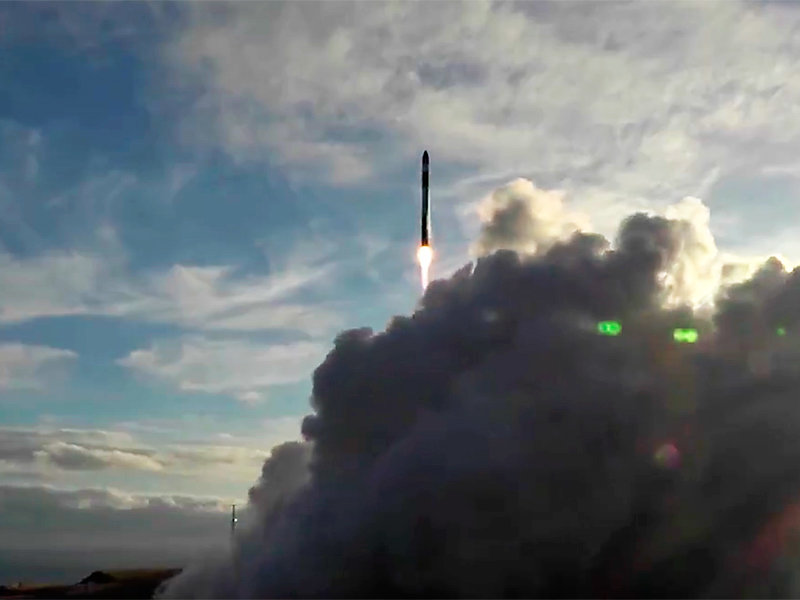
On December 16, the American private aerospace company Rocket Lab has successfully carried out the second commercial launch of its Electron light rocket, during which 13 skibsate satellites were brought into the orbit, Reuters reported. This mission was called this One's for Pickkering in honor of the American physicist and astronomer of New Zealand origin William Pikering. The full record of the launch was published on the company YouTube channel .
This launch of the Electron missile was carried out as part of the company's contract with NASA. The cubes brought to orbit created by students of American universities will be used for different purposes. For example, one of them will measure the levels of radiation in the radiation belt of Van Allen to help better understand her possible impact on spacecraft. Another small satellite will have to test the effectiveness of compact 3D-printed robotic hands, writes Popular Mechanics .
Lift-off from Rocket Lab Launch Complex 1 for the @nasa #Elana19 Mission. Rapid and Reliable Launch for Small Satellites is Geere. #TheWaitisover pic.twitter.com/2myjsyb2gn
- Rocket Lab (@roketlab) December 16, 2018
Recall, Electron is an ultra-light class launch vehicle designed for commercial launches of micro and nanosetics. The length of the rocket, the development of which began in 2012, is 17 meters, and the diameter is 1.2 meters. According to the characteristics, it is able to derive a useful load weighing up to 225 kg to low near-earth orbit and up to 150 kg in a sun-synchronous orbit 500 km high.
The main advantage of Electron is the relatively low rocket launch price. With the help of Electron, the creators of small satellites can take them into orbit separately, and not as an additional load during heavy missile missions, including Ilona Mask Falcon 9 launch vehicle.
The first launch of the rocket took place in May last year and failed - three minutes after the start of the rocket went into space, but the head part with the payload layout did not reach the calculated orbit. The reason for this failure was the mistake of the telemetry system. For the second time, Rocket Lab launched a rocket at the end of January of this year and successfully brought into orbit a useful load in the form of three small satellites, as well as its own bright satellite , who had come down from orbit at the end of March to the joy of astronomers, to which the bright sphere prevented the research.
Initially, Rocket Lab planned to carry out the third test launch of the launch vehicle, but in the end she decided to go to commercial missions. The company announced its intention to carry out the commercial launch of It's Business Time at the end of April or early May, but as a result, the launch took place only on November 11-the launch vehicle brought into orbit six satellites of Spire Global, Fleet Space Technologies, Geooptics Inc and Irvine Cubesat programs STEM, in which California schoolchildren make small satellites.