
Translated material
Pterosaurs had primitive feathers
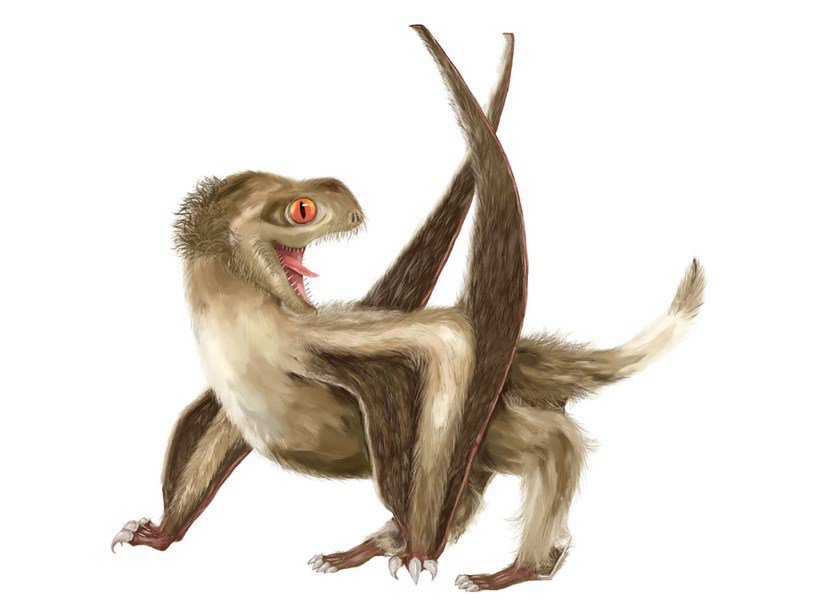
A group of paleontologists under the leadership of Michael Benton from the University of Bristol and Baoyu Jiang from the University of Nankino came to the conclusion that some pterosaurs of hair -like threads on the body turned into primitive feathers. Thus, either feathers during evolution arose twice: independently among pterosaurs and in maniprators (and their descendants - modern birds), or primitive streamlines appeared even among the common ancestor of these groups much earlier than it was believed.
The fact that pterosaurs were covered with threads resembling hair, paleontologists have known for a long time. Such threads (they are called pycnofibers) were awarded back in 1831 by the German naturalist Augustus Goldfuss in describing the Scaphonate ( Scaphognathus Crassirostris ) - one of the jurisian pterosaurs. And the other type of pterosaurs, because of this feature of the appearance, even received the name Sordes Pilosus “Hairy Eden”. Due to the presence of a picnofiber on the head and body, pterosaurs probably got the ability to maintain constant body temperature.
The object of the current study was the petrified remains of two pterosaurs the size of a dove, belonging to the Jurassic biota Yanlyoo in northeastern China. Samples from 165 to 160 million years are now stored at the University of Nanjing and the Institute of Geology of the Chinese Academy of Geological Sciences in Beijing. They attracted researchers with extremely well -preserved picnofibers - according to Michael Benton, they are “exclusively hairy”.
The study under the microscope showed that the picnofibers of these pterosaurs were four types. Among them were hollow short hairs, which made up the most common type of pycnofiber, and thick pointed threads on the neck, and down fibers on the head, and most importantly - bundles of branching threads that covered the wings of pterosaurs. “The correct term for a branching thing that grows from a follicle of the skin is a pen,” Benton says. Therefore, on the wings of pterosaurs there were even primitive, but still feathers.
According to scientists, picnofibers of different types could not only help animals regulate body temperature, but also influenced aerodynamic characteristics, determined coloring, could play a role in touch.
According to Baoi Jiang, if the structures found really represent a type of feathers, this means that they could have a common ancestor of birds and pterosaurs, which means that the feathers did not occur 175 million years ago, as it is believed, but about 250 million years ago. It can also be assumed that in a wide range of dinosaurs, including not directly related to modern birds, there could also be pennies on the skin.
The results of the study are reported in the journal Nature Ecology & Evolution.