
Translated material
"The court cannot charge only on the basis of cards"
Why the publication of the archives of the KGB of the Latvian SSR will not lead to a split in society - historians explain
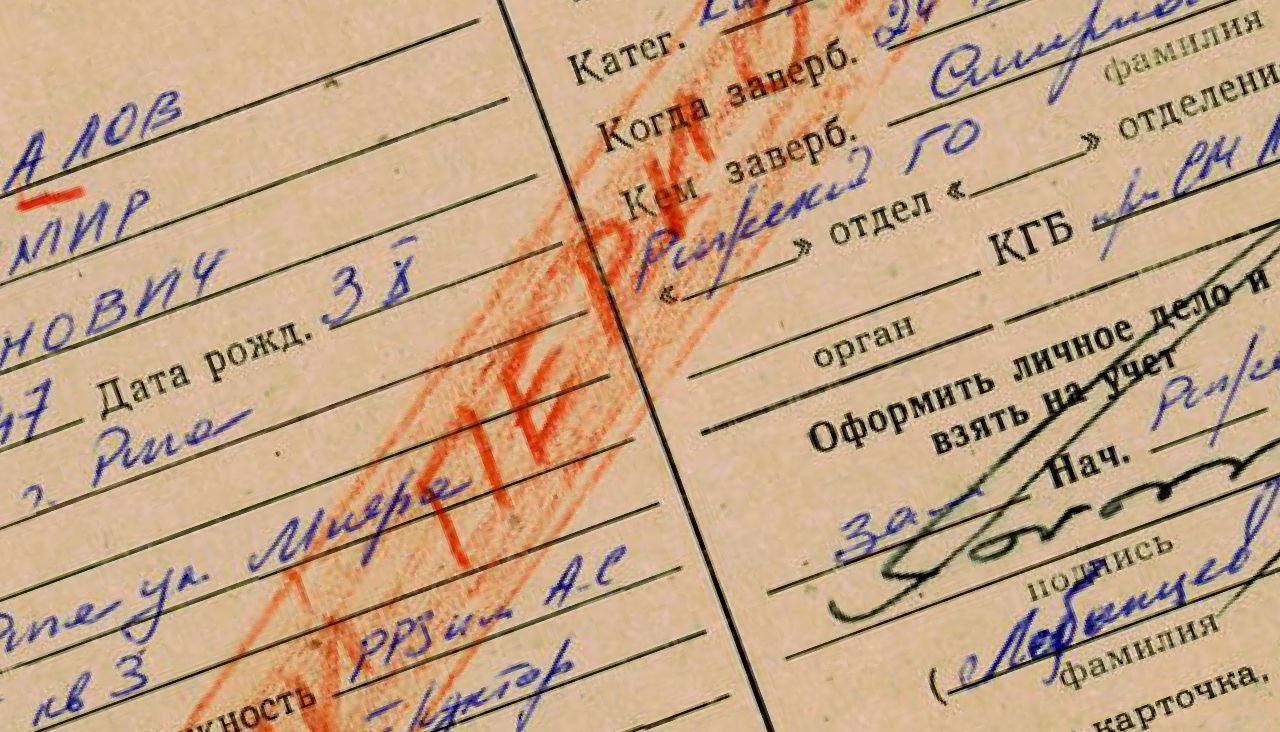
On December 20, the National Archive of Latvia began the publication of the CGB of the Latvian SSR. In total, more than 10 thousand scanned cards have been published. They contain data on agents and informants who worked in the KGB in the 1980s, the names of potential candidates for recruitment, as well as information about persons who planned to go abroad. According to Latvian media, several hundred famous people can be mentioned in published documents; Latvia’s security police opposed the publication of the archive-from fears that because of it, citizens would become less willing to cooperate with the special services. "Medusa" asked Latvian historians to talk about published documents.
Ainars Bambals
Doctor of Historical Sciences, employee of the State Archive of Latvia
Yesterday, after the 28-year-old moratorium, the so-called KGB bags were finally published, in which a card index of secret agents and informants was stored. In Latvia, only these cards with names and surnames remained, personal and working affairs of the agents were taken to Russia back in the late 1980s.
In 1991, after the August coup, the KGB documentation in Latvia adopted several institutions. The Latvian State Archive adopted the criminal cases of the KGB, filtration cases, the operational and reference card file, and other categories of documents-intelligence, special affairs, operational cases, orders of the KGB of the USSR and the Latvian SSR-adopted other institutions, in particular the commission of the Supreme Council of Latvia, the Ministry of the Interior. The Academy of the Police received the KGB library. Then the Center for documenting the consequences of the totalitarianism of Latvia was formed, and these “KGB bags” were transferred there.
Due to the fact that the documents diverged at various institutions, the main principle of archivistry was violated, the principle of projection-according to it, documents of one stock former should be stored in one place. In 1994, the rulers of Latvia said that for 10 years they postpone the publicity, in 2004 the president postponed for another 10 years, and at the end of 2013 the Sejm Latvia decided that they had to be published, but first explored. A commission was created to study the KGB documents, she worked for 3.5 years, and in the fall of this year the commission decided to report documents to publicity. On October 4, the parliament adopted amendments to the law on the maintenance of documents of the former KGB of the Latvian Republic, the use and statement of the facts of cooperation between persons with the KGB. And until the end of 2018, the national archive had to be published. And the center of totalitarianism until March next year must submit all the documents in paper form, since this is a national treasure, documentary heritage. All documents that were not taken to Russia will be transferred to the National Archive. Now, more than 28 years later, they will finally be stored together.
The published cards have data for all the years-there are agents that were recruited by the Soviet resident in Riga in the late 1930s, but mainly the 1960s, 70s and 80s. It was active agents, somewhere around 4.5 thousand names. The fact that these "bags" stores data about famous people of Latvia are discussed in society for a long time. Some of these people previously disputed the accusations, somewhere around four hundred people sued to challenge the fact of cooperation, and the court for the most part justified them, since there were no sufficient evidence of their assistance to the KGB; Now decisions on these cases will also be made public. And today, for the court, there is not enough personal subscription about cooperation that, they say, “I, such and such, give a real subscription that I will cooperate with the state security authorities, that I will not disclose it, choose my nickname or pseudonym-or, as it is fashionable to speak now, nicknames, which I sign.” This document, which is in personal and working affairs, we do not have. The court cannot charges only on the basis of these cards. People whose names got into these file cabinets can only say to what extent they cooperated.
In Latvia, unlike Lithuania, there was no process of lustration, during which the former informers could appear in the special services and admit that they collaborated with the KGB. Therefore, I do not think that there will be some big scandals, say, in Lithuania with [Soviet actor] Donatas Banionis, recruited in 1970. Nevertheless, the opening of the archives caused a stir - this, one might say, is the event of the year number one in Latvia. On the first day, the publication had about 90 thousand views and more than 12 thousand users registered on the website of the National Archive to be able to see these cards. It turned out such a kind of gift to the Latvian people for Christmas.
Caspers Zellis
historian
Earlier, the KGB criminal archives and other documents were already opened, and now only the names of people who collaborated with the KGB of the Latvian SSR have been published. Before that, only some names surfaced in publications. These are people who agreed to work for the KGB voluntarily. But the publication of these data gives little. Of the personal cards, it is not clear what exactly the cooperation was. Only the names - and the documents about what exactly they said must probably be sought in Russia. But I had to work in Russia-there are so many archives are still closed, not only the KGB, but also other departments.
In Latvia, a normal policy regarding archives, but the publication of KGB documents [It seems to me] a little doubtful. In our country, the situation is not fundamentally different from Poland or other European states. In Germany, for example, all archives are open. But there, in order to get the opportunity to work with documents, you need to sign a lot of various pieces of paper. [We have] the mechanisms of combating possible abuse, it seems to me.
It is important to understand that very many cooperated based on professional interests: for the sake of the opportunity to go on business trips abroad or for the sake of promotion. In these archives there are almost no documents dating back to the 1940–50 years, when there was a completely different time when people were forced to cooperate.
At the same time, the KGB in Latvia was little interested in ordinary people who wanted to travel abroad [at work]. They were much more interested in ties with the diaspora - the Latvians who left Latvia during the war, but retained relatives and friends in their homeland. This work [to collect information about those who left] was very widely conducted in the 1960s and did not stop until the end of the 1980s. By the way, the accusations of Latvian participation in the Holocaust were put forward by the KGB based on the information obtained as a result of this work. But in general, there was no difference for the KGB who to recruit - they worked with Latvians and the Russians.
In general, I believe that the opening of archives is the right measure. Because people should know how they lived. But in the case of specifically with the KGB archives, I can only repeat that people will not recognize anything new.
Constantine Benyumov recorded