
Translated material
In Russia in 2018, the population will decrease for the first time in 10 years. Look at the schedule
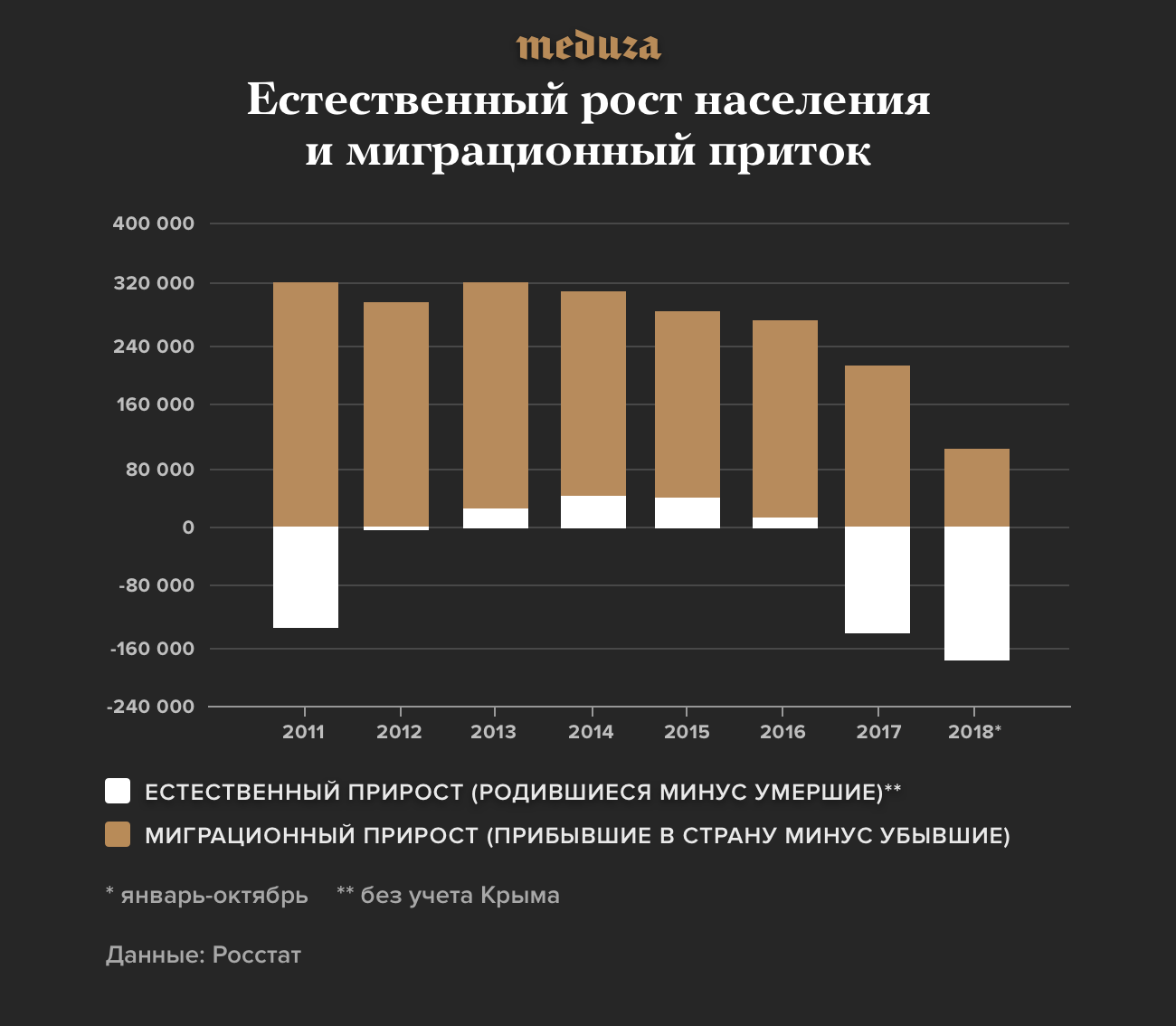
What's happened? Why is the schedule just like that?
The number of dead in 2018 will exceed the number of born more than ever in the 2010s; The migration growth (that is, the number of people who arrived in Russia minus the number of those who left the country) will decrease and will not cover the “natural decline”. At the same time, fewer people die annually in the country (and in 2018 it will die less again than in 2017), but the birth rate decreases even faster.
Two reasons.
Firstly , there are fewer those who could give birth to children-childbearing age reached the smallest generation in history (in the late 1980s and in the early 1990s, very few children were born).
Secondly , after a surge in the birth rate in the late 2000s and early 2010s, women began to give birth less again-of course, not as little as in the 1990s, but significantly. If in 2015 in the country it was born 15% less children than necessary for the reproduction of the population, then in 2017-already 25% less. In 2018, the birth rate decreased again.
In past years, the decreasing population was replaced by migrants, but since 2014, the population of Russia has arrived mainly at the expense of Ukrainian citizens. And the point here is not only in the inhabitants of Crimea, who at the same time increased the number of Russians by 2.5 million people; From a crisis country, especially from the warring Donbass, 100-150 thousand people entered Russia every year than left for Ukraine. But in 2017 and 2018, citizens of Ukraine began to return to their homeland massively.
Dmitry Kuznets