
Translated material
Without a misconduct

The federal government has given a negative feedback on the bill developed by the Supreme Court, which introduces the concept of “criminal misconduct” into Russian law. In the White House, the innovation will not only require budget expenses, but will also increase the load on employees of the penal system.
“It should be noted that the proposed changes regarding the exemption from the responsibility of the person who committed the criminal offense are not consistent with Art. 52 of the Constitution of the Russian Federation, since they do not take into account the interests of the victims, who, as a result of the criminal offense, were harmful, ”the bill was also said in the response to the bill, which was signed by the head of the government apparatus Konstantin Chuychenko.
 Kremlin / duma.gov.ru
The negative review of the government does not mean the automatic deviation of the bill by the State Duma, but, as a rule, the parliament still listens to the executive branch and does not accept such documents.
It is possible that the government gave a negative review under pressure from law enforcement agencies, in any case, such an assumption made a source of “Vedomosti” in the judicial community. The interlocutor of the publication believes that law enforcement officers are afraid of the influence of innovations on statistics, since "it is easier to disclose and report for insignificant crimes."
The Supreme Court introduced his bill on criminal misconduct to the State Duma on the eve of December 21. Deputy Chairman of the Supreme Court Vladimir Davydov said that the purpose of the bill is “the humanization of criminal law by decriminalizing certain acts and the expansion of the sectors of the institution of exemption from criminal liability”. One of the steps in this direction is the introduction of the concept of “criminal offense”.
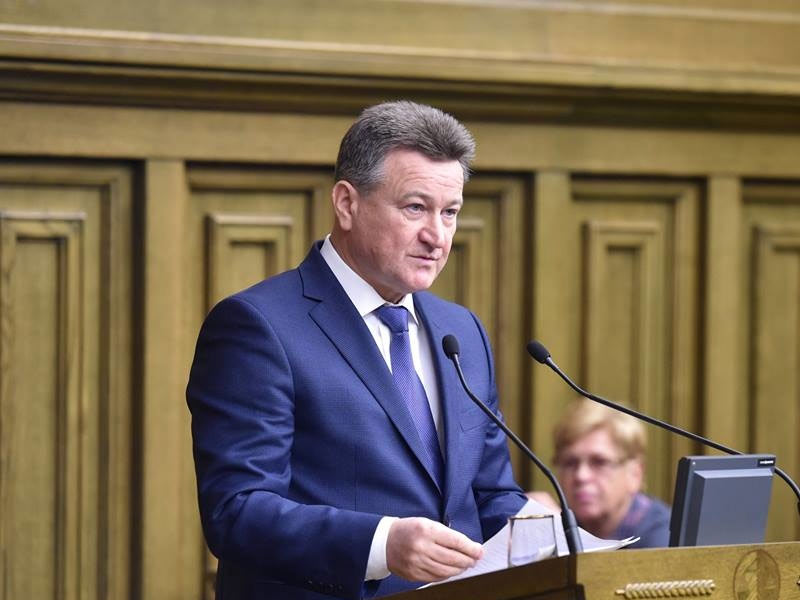 Vladimir Davydov / Supcourt.ru
A criminal misconduct should be an article by acts, which are now qualified as crimes of minor gravity and do not provide for imprisonment. These, according to the authors of the bill, currently include about 80 corpus delicti (among which, for example, illegal entrepreneurship and illegal banking activities without aggravating circumstances), which more than 40 thousand people were convicted only in 2017.
The bill of the Supreme Court prescribes several innovations that are designed to mitigate the responsibility for criminal misconduct in comparison with a crime of minor gravity. In particular, it is possible to stop the persecution of citizens for criminal misconduct by the investigator, the court at the request of the investigation, supported by the prosecutor, as well as the court on his own initiative. In case of termination of the case during the investigation, the investigator can apply directly to the court with a proposal to punish the perpetrator in the misconduct by applying the “criminal law” measures-a fine, mandatory or correctional labor.
At the same time, the bill provides for the possibility for minors who first committed criminal misconduct, complete exemption from liability with the use of enforcement measures of educational impact: the transfer for supervision of parents or state bodies, mandatory compensation for harm, restriction of leisure or other requirements for behavior for a period of a month to a year. In those cases when the perpetrators in criminal offenses are evaded from the penalties imposed on them, their actions can be qualified as a small gravity with appropriate tightening of punishment.
 Consideration in the Basmanny Court / AGN "Moscow" / Photo: Vedyashkin Sergey
The bill also prescribes a reduction in the statute of limitations to a year, and the parole from punishment, according to the authors, is possible after the expiration of a quarter of the period appointed by the court (for the crimes of a small gravity-two years and a third of the term, respectively).
It should be noted that even without the bill of the Supreme Court in Russia, the number of prisoners has recently been constantly reduced. At the beginning of 2018, the Federal Penitentiary Service (FSIN) reported that 602 thousand people were contained in the institutions of the penal system-less than at any other moment of the latest Russian history. At the beginning of 2017, there were 630 thousand prisoners in Russia, five years ago - 701 thousand, and 10 years ago - 886 thousand. As of December 1, 567,789 people were already contained in the institutions of the penal system, that is, the population of prisons and colonies in 11 months decreased by more than 30 thousand people.