
Translated material
How NTECHLAB has learned to recognize the faces of citizens for state needs
It is almost impossible to build a new business in Russia in 2018 without state participation. Money is from state banks, state corporations invest in startups, and the largest contracts in the public procurement system. But working with state money is difficult and dangerous. Is it worth it to contact?
NTECHLAB three years ago became famous for the fact that its technology for recognizing faces turned out to be more effective than that of Google. But instead of growth in the Ycombinator accelerator in Silicon Valley, Startap chose a partnership with Rostec, stayed in Russia and now claims to be Moscow multimillion -dollar contracts for creating a city video system. Sergey Sobyanin is going to spend 7.5 billion rubles on it on it. The Bell learned from the founders of NTECHLAB, why the young company relied on the state and how it managed to find such powerful partners.

Start as in the cinema
“This is a cinema just story, it doesn’t happen in life,” says Oleg Bratishko, co -founder of NTECHLAB. In 2015, an employee of the Samsung laboratory in Moscow Artem Kukharenko was going to move to Switzerland, where he received an offer to work. But his girlfriend did not want to leave Moscow, complained to her friend, and she introduced the engineer Kukharenko with Alexander Kabakov and Oleg Bratishko, the partners of the venture fund Typhoon Digital Development.
Kukharenko has his own, no less cinematic, version: “I had free New Year holidays, I wanted to do something for myself. I thought: there are neural networks, it would be interesting to stuff them on a mobile phone. At that time, it was not a very simple engineering problem, it is now existing whole libraries for neural networks. ” Kukharenko needed to come up with a task for the algorithm, and he came up with a sense of recognizing dog breeds from a photograph. “Over the weekend, I made the application with the [future] wife, it turned out cool, began to show the technology to friends, including the guys from the Typhoon Foundation.”
Kukharenko was lucky - his future partners turned out to be people known for their creative abilities. Alexander Kabakov and Oleg Bratishko-AGENCY 1 Internet agency Partners. Until 2013, he was led by Alexei Gorozlavsky, a former editor of Lenta.ru, and now-the deputy head of the administration in the presidential administration, where he oversees the Internet (in NTECHLAB, Gorozlavsky did not invest). Kabakov, by education, a political scientist, until recently worked as a vice president of Mail.ru Group. In the last presidential election, he was engaged in everything related to their advancement on VKontakte, and his office in the company was jokingly called the branch of the presidential administration. Another person who participated in the creation of the first NTECHLAB product is Maxim Perlin, the managing partner of the BlackLight communication agency. It became famous in 2010, when it published a calendar with half -naked students of the journalism department of Moscow State University for the birthday of Vladimir Putin. In the elections this year, Blacklight was the customer of the scandalous stickers "Election Girl" for VKontakte.
₽7.5 billion
In 2019, Sergei Sobyanin promises to spend on the city video surveillance system with the function of recognizing persons.
$ 10 billion
Explorely, according to Markets and Markets, by 2023 will be the volume of the world market of biometric analytics. Now the entire market is estimated at $ 3.85 billion, according to Oristep Consulting.
105,000
So many cameras, according to DIT, will be connected to the person recognition in Moscow next year.
$ 300 million
So much now evaluates this market segment in Russia by Biolink.
30%
NTECHLAB claims such a share of the domestic market
$ 3.5 billion
So much is evaluated by the Chinese startup for the recognition of Face ++ persons.
In the first six months, the partners invested about 15 million rubles in Kukharenko’s technology - this was enough to buy equipment and a salary of three engineers, including Artem himself.
“We put them in our office, in the farthest room without air conditioning - our secretaries immediately called her“ Botanical Garden ”. There they sawed technology for five months, ”recalls Oleg Bratishko
Six months later, Kukharenko declared his algorithm to participate in the MEGAFACE CHALLENGE contest University of Washington - "Simply to understand where we are." They hoped to get into twenty, and when they took the first place in the main competition, they did not believe it themselves, Brother said. NTECHLAB was then ahead of the development of Google, recognizing 73.3% of people from 1 million photos. “When we announced our product in the United States and said that the algorithm can work on a base of 250 million profiles, the people got up and photographed our presentation,” says Mikhail Ivanov, general director of the company. “Nobody did this at all.”
About the victory “Everyone wrote in general, Bloomberg films about Artem shot,” Bratishko laughs. “And he worried everything, asked how much top media remained in the world, because he was leaving for them all the time.”
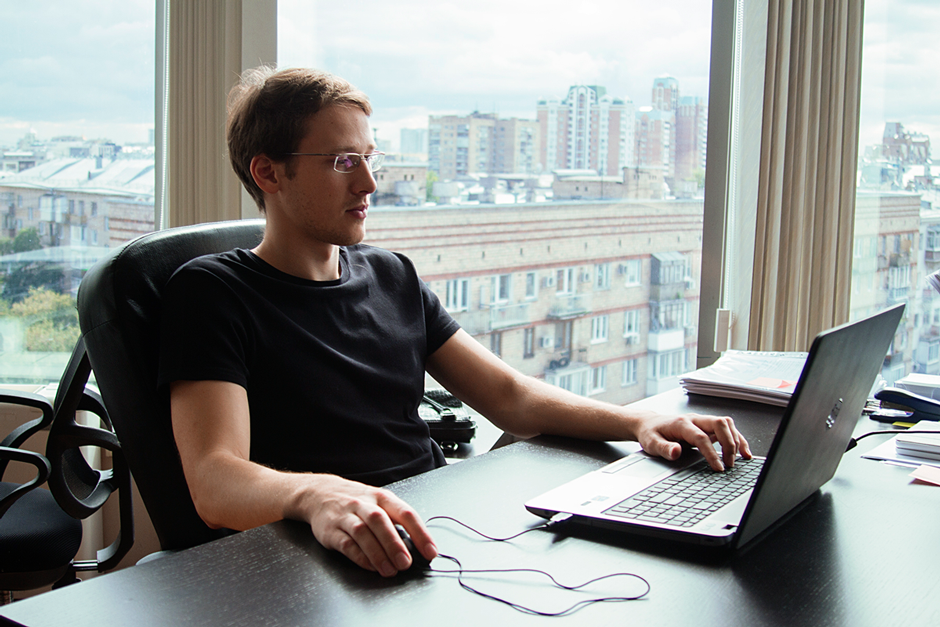
Artem Kukharenko, developer of the person recognition algorithm. Photo: NTECHLAB.
The plan was simple - to show the technology and sell it quickly, as the Belarusian startup Masquarade, who sold his Facebook video images service. But for this it was necessary to show not an abstract algorithm, but a product in which it could be put into practice. “Max Perlin always felt hype topics,” Brother recalls. He proposed to make a service to recognize beautiful girls - “Viusnyak”, will come in well.
In 2016, the company launched the FindFace website and application. With his help from the photograph, it was possible to find a person’s profile in VKontakte in a few seconds. The launch of the “innovative dating service”, as the company initially positioned it, provoked a series of scandals - users deanonymized not only fellow travelers in the metro, but also porn actresses and rallies , even the Bellingcat investigative group used the technology. And then they told about the appendix in the program “Wait for me” on the “First Channel”, and NTECHLAB, as Kabakov said, began to receive “five proposals for cooperation per day”.
Now the founders explain that FindFace was only a showcase that helped to drink technology. With his help, for example, Herman Gref deanonymized his secretary in a second when he got acquainted with the work of the algorithm, one of the acquaintances of Sberbank told The Bell. But in 2018, both the site and the FindFace application were unexpectedly closed. This had to be done because of possible claims, including from VKontakte, says one of The Bell's interlocutors. There was no point in spending time and money on the courts - the founders of NTECHLAB already understood that the money would not be recognized as cute girls.
The first investor
The founders of NTECHLAB failed to quickly sell the company, but after the victory at the competition in the United States, they realized that they "pulled out a trump ace." “The technology is cool, which means that it should be urgently turned into a full-fledged B2B product, and this is completely different investments,” says Bratishko. The founders put their money in the project and went to look for investors. Kukharenko says that his partners initially responsible for attracting investments, and he was for development. “Before the appearance of FindFace, no one believed that by huge bases like VKontakte you can look for and find something, but FindFace proved it-it was not an abstract technology, but a ready-made sample,” he says.
It was his partners who showed the Impulse to the venture fund, which was launched in 2013, including the money of Roman Abramovich. Recognition of persons is a promising direction, and NTECHLAB not only came up with an intelligent algorithm, but also creates the final products in which it can be used, said the managing partner of Impulse Kirill Belov. The Fund, together with the former President of Rostelecom, Alexander Zavotorov, agreed to invest $ 1.5 million in the project. Negotiations with many other potential investors did not give anything with Russian funds in general, the Brother explains: “They make a decision for a long time: how to evaluate the company without proceeds, and what if it doesn’t take off?” In addition, after the victory at the international competition, the company immediately evaluated itself expensive. Officially, the numbers were not revealed, but, according to The Bell, for the first round, NTECHLAB was estimated a little less than $ 30 million.
Having received the money, the company decided that it was necessary to grow quickly in order to bring the technology to the market as soon as possible. “Three new programmers went to work per week, and immediately in battle,” Bratishko describes. Now about 80 people work in NTECHLAB.
The first state contract
“Contracts and contacts, of course, did not immediately come,” the NTECHLAB general director Mikhail Ivanov, the former IT director in Metalloinvest and the TASS agency, shrugs. The team was already large, but there was no revenue, the brother recalls: “Then the first major commercial contract helped us out very much - it was an international acting service, for which we were looking for doubles and just similar people.” But the first truly promising client appeared only in mid-2017-it was the Department of Information Technology (DIT) of Moscow.

Lifehack
How to find a state order?
No special connections and efforts were required, the founders of NTECHLAB assure. Ivanov says that they met representatives of the Department of Information Technologies at the Open Innovation forum, and at first they reacted to their technology very skeptical. “We were told: you can brag everything here, but in Moscow there are such cameras that no algorithm can work normally with them, everyone says: give us supercammers with supercretion, then we may do something,” he recalls. NTECHLAB agreed to an experiment with those cameras that were, and the results, Ivanov claims, “surpassed all expectations” - about 90% of the recognition even on not the most perfect equipment.
The contractor of the Moscow government for a pilot project to recognize persons in the city stream was Rostelecom. The goal of R&D was to check the hypothesis: is it possible to recognize something on city chambers and whether it would be cosmically expensive. In May 2017, NTECHLAB concluded a contract for 11.6 million rubles with Rostelecom - it was proposed to test the technology for 1.5 thousand city cameras. She was practiced during the World Cup in football - at the stadiums of Luzhniki, Spartak and on the site of fans on the Sparrow Hills. Police officers who inspected visitors to the checkpoint issued special smartphones, says a representative of Dit. When faces, similar to portraits from their base, alerts came to the lenses. According to him, during the days of the championship, 98 people were wanted to be detained. During the testing, the city tried the solutions of several developers, they all showed good results, the representative of the department says, without revealing the details. Cooperation with NTECHLAB will be determined next year “based on competitive procedures”. The representative of Rostelecom confirmed that NTECHLAB can become one of the vendors of biometrics in a unified biometric system running this year, where Russians can take images of people and casts of votes for remote financial services (power departments will have access to it).
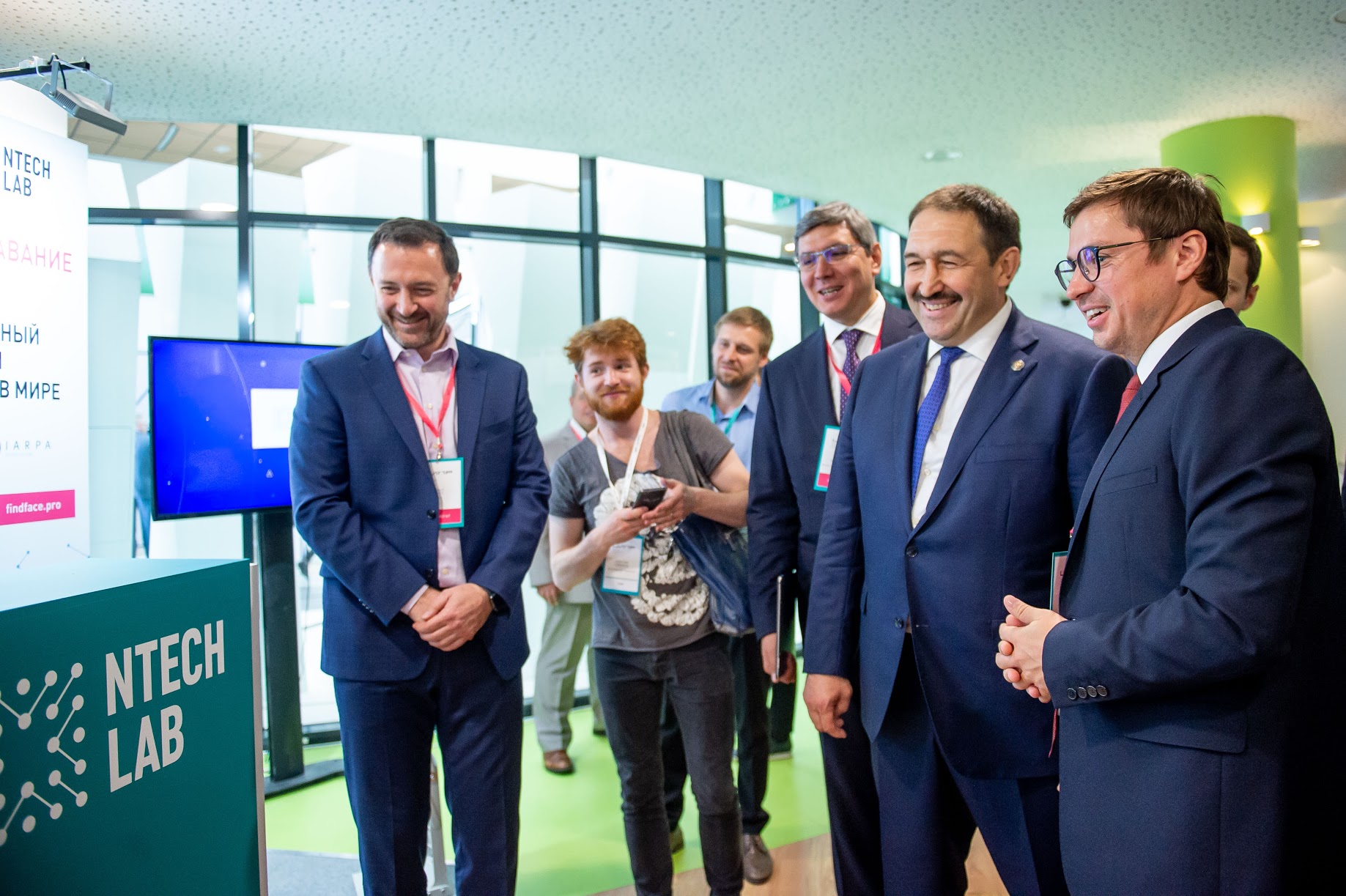
NTECHLAB CEO Mikhail Ivanov (left) with the Prime Minister of Tatarstan Alexei Pesoshin (in the center). Photo from the site "Rostec".
The pace of introducing algorithms for the recognition of persons in Moscow is ahead of similar projects even in China, Ivanov says: “In 2017, the Chinese authorities plans to deploy technology into a thousand cameras, we had already tested it for 1,500 cameras by that time.”
The closest competitor of the company - Visionlabs entered the market with its algorithm three years earlier, in 2012. But there is enough space on the market for everyone, one of the interlocutors of The Bell believes. Visionlabs is now working with a Sberbank on its biometrics system. “The competition is higher in the commercial sector, but we believe that it is currently more promising for vendors,” says Alexander Khanin, CEO of Visionlabs. NTECHLAB relies on Moscow and claims to install its decisions everywhere - from the subway to each entrance. Next year, the city will spend 7.5 billion rubles on a video surveillance system, said Sergei Sobyanin recently. Most will go to buy new cameras and iron, software suppliers - such as NTECHLAB - expect to work according to the signature model (the size of the contracts can be hundreds of millions of rubles a year).
Lifehack
What is needed and what should not be done with the state?
“It is always better to find a big partner to whom you can lean,” says Oleg Bratishko, co -founder of NTECHLAB.
“In the case of investors, do not save on lawyers - every potentially controversial moment should be registered, and it is better not to register the company for reasons of corporate law in Russia.”
“You should have a white company and no schemes under the hood,” he advises. “All mechanics allowed in the commercial sector will turn against you with the state.”
“There is no need to rush with any kickbacks - now there are enough people who work on the civil service in the civil service. No need to offer anything to anyone, then you, most likely, no one will ask for anything. ”
“You need to very formally approach the execution of agreements and contracts and do exactly as it is written in the papers. You can’t be kept on suggestions like: “And let's do it like this with you, and then we will cross and re -quench.” Promises will be forgotten, and the papers will remain, they will ask you from you. ”
“You need to handle state money significantly more scrupulously-and you always need to keep in mind that at any moment the customer will show some new management and will say:“ Well, is that what you arranged here? ”
“The main problem is that often everything happens too long. You can die while something comes to you. ”
The first state partner
In 2017, the founders of a promising startup faced a difficult choice - they received a personal invitation from the most famous Ycombinator accelerator from California. “We were invited to talk about cooperation, and it was clear that such an opportunity fell infrequently,” says Bratishko. But at this moment, the company just began negotiations on partnership with Rostec. The choice was difficult and ended in favor of the Russian state corporation. “We decided that we will reach the strategist and that we also have enough prospects for developing in Russia,” he explains.
In addition, startup again needed money. “After the deal with Impulse, we understood that we need to develop even faster to occupy your niche, and actively increased the team,” says Kukharenko. “At some point, the costs of it at some point have become more than sales income.” According to SPARK, with revenue of 24 million rubles, NTECHLAB losses in 2017 increased almost 8 times - up to 51 million rubles.
“We understood that in Russia we have almost no competitors, and the technology itself is very promising for state order,” says Bratishko. - But for the start it would be good to have a strong partner to which one could lean "
In the summer of 2017, Vladimir Putin instructed state corporations to create his venture funds - by this moment the volume of the venture market in Russia collapsed to $ 400 million against $ 3 billion in 2013. Rostec fulfilled the presidential order in early 2018, registering the fund for half a billion rubles, and already in March the state corporation invested in NTECHLAB together with its long -standing partner Ruben Vardanyan. The transaction is associated with the new innovation strategy of Rostec and the implementation of the president’s order to invest in IT startups, explained in Rostec. The Vardanyan Foundation acted only as a financial investor.
How much Rostec was invested, it was not reported, but within the framework of this round the state corporation bought the share of the Impulse fund and itself became the owner of a 12.5% shares of a startup. Rostec has become a strategic partner of NTECHLAB and in the future can seriously build up its share in the company. Control in it remains with Kukharenko and his partners from the Typhoon Foundation.
“We are satisfied with this investment - excellent profitability,” says Kirill Belov from the Impulse fund (partners do not disclose numbers). In partnership with Rostec, in his opinion, there are many prospects before the company - both in the B2B segment and in working with government agencies.
Lifehack
How to find a "right" partner?
Personal ties helped to agree with Rostec. Alexander Kabakov was well acquainted with the former head of the Apostle Media, and now - the director of the special instructions of Rostec Vasily Brovko (he is now heading the board of directors of NTECHLAB). He spoke about the startup and promising technology, the head of the corporation Sergey Chemezov.
Just in the process of negotiations with Rostec, NTECHLAB won another prestigious competition of persons recognition algorithms - its organizer was an American agency of advanced exploration research (IARPA), which directly subordinates the US National Intelligence Director. NTECHLAB won two of the three nominations, and negotiations with Rostec went even more vigorously.
Now the NTECHLAB order portfolio is approximately equally shared between private and state clients, says Ivanov. The company does not disclose its exact size. In mid -2017, the founders of NTECHLAB estimated the annual revenue of 200 million rubles. By the end of this year, the company expects to get out for self -sufficiency, said The Bell one of them.
Стратегия «прислониться к партнеру» хорошо работает — у «Ростеха» «совсем другие лоббистские возможности», говорит один из собеседников The Bell: в самых сложных тендерах можно по крайней мере добиться, чтобы никому никакие преференции не отдавались.
Кроме Москвы, NtechLab участвует в десятках других пилотных проектов как в России (Татарстан, Рязанская область), так и за рубежом — там компания в основном работает через интеграторов, которые предлагают комплексные решения по всему миру. В работе за рубежом есть несколько направлений, рассказывает Кухаренко, но в первую очередь — это безопасные города или системы городского видеонаблюдения. Сейчас решения NtechLab тестируются в Индии, Азербайджане, Малайзии, Турции, Индонезии, Латинской Америке и т.д.
В перспективе 5–7 лет NtechLab мечтает превратиться в стартап-«единорог» и не считает, что цель нереальна. Глобальный конкурент российских разработчиков — китайский Face++ в декабре закрыл очередной раунд инвестиций на $500 млн. Уже сейчас его оценка превышает $3,5 млрд.
Anton Baev
[data-anim-name=PIjaJYxBLhexapIRaopaW] {<br /> transform: translateX(-30px) ;</p><br /><br />
<p> animation-fill-mode: forwards !important;<br /> }<br /> @-webkit-keyframes PIjaJYxBLhexapIRaopaW {<br /> from { transform: translateX(-30px) ; }<br /> to { transform: none; }<br /> }<br /> @keyframes PIjaJYxBLhexapIRaopaW {<br /> from { transform: translateX(-30px) ; }<br /> to { transform: none; }<br /> }<br />
[data-anim-name=iXSdAHbHMZQMFUFSZSthl] {<br /> transform: translateX(-30px) ;</p><br /><br />
<p> animation-fill-mode: forwards !important;<br /> }<br /> @-webkit-keyframes iXSdAHbHMZQMFUFSZSthl {<br /> from { transform: translateX(-30px) ; }<br /> to { transform: none; }<br /> }<br /> @keyframes iXSdAHbHMZQMFUFSZSthl {<br /> from { transform: translateX(-30px) ; }<br /> to { transform: none; }<br /> }<br />