
Translated material
"We are together while love is alive"
The acquittal in the “poppying cause” is a victory for common sense and civil society. But first of all, this story is about fidelity and love
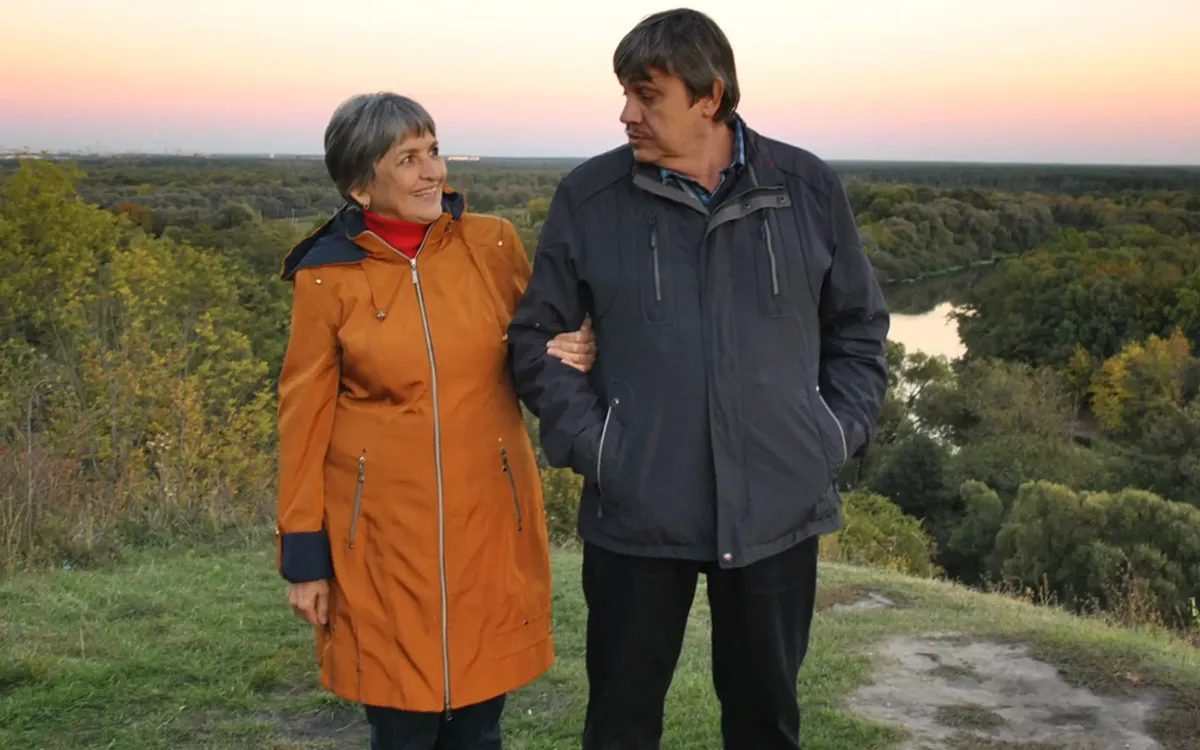
On September 15, 2012, I was sitting on the editorial planner when I received a message from one of the lawyers: Olga Nikolaevna Zelenina, the head of the chemical and analytical laboratory of the Penza Research Institute of Agriculture, was arrested. I tried to remember her face-before we briefly saw each other on some round table dedicated to the anti-drug campaigns of the FSKN.
To be honest, it seemed that we are talking about a misunderstanding.
It was Thursday. The next day there was a little news in the newspaper: “The expert Olga Zelenina arrested the day before went to the hospital: it became bad with her heart. From the guard, the court did not let her go. " Soon it became known: the Moscow department of the FSKN, investigating the criminal case of the smuggling of narcotic drugs, felt for the criminal community of 13 people, among which Olga Zelenina also fell.
Last week, on Thursday, I was sitting on a gligt again when I received a message in one word in Telegram: "I was justified."
According to the indifferent calendar between these events - the arrest of Olga Nikolaevna and her justification - six years and three months. If you move away from absolute numbers, this is about 9% of the average life expectancy of an ordinary Russian. All this time, “New” wrote about this monstrous and absurd business, and finally it was resolved by the acquittal of jury.
The justification of Olga Nikolaevna, as well as 12 of her "accomplices"-is, in general, a holiday with tears in her eyes. But now, in the New Year's issue of the newspaper, I do not want to talk about procedural tricks and Vertukha suits, the pro -Board of the celebration of evil. I want now about something else. I want about love.
Confectionery poppy and life sentence
How did it start? In August 2010, at the Bryansk Customs, the FSKN arrested two parties of the confectionery poppy, which was imported by businessman Sergei Shilov (he had a large grocery company). The poppy, imported into Russia with all the necessary documentation, was declared a narcotic drug, as a result of which a criminal case was instituted to smuggle drugs - up to a lifelong.
This business was quite cunningly arranged.
FSKN took hitch from several bags of the imported confectionery poppy and found in some of them (not all) traces of narcotic substances of the opium group.
Mack by nature is a narcotic plant, but the seeds of opiates do not contain. However, the microscopic amount of these substances can enter poppy seeds in the process of extracting them from the boxes, which are just rich in milky juice. The extraction of substances of the opium group of seeds in practice is impossible - due to the nullity of their percentage content. So, for example, in the Shilovsky poppy, this figure hesitated in the area of the fifth number after aim. But this did not prevent the investigation from changing 0,00069% of morphine and 0.00049% of codeine for the total weight of a poppy of 42 tons and receive about a half -kilogram of severe drugs, which Sergei Shilov allegedly imported into Russia. Customs was ready to produce re -export - since everything was not so glory to God with poppy, but FSKN needed this criminal case.
When the FSKN arrested Mack with Shilov, he was very worried. 42 tons of poppy - a large batch that is expensive. No, he was not afraid of the narcotic articles that the FSKN threatened him, he just had no doubt that he would have filed with them easily. Mack Shilov was most carefully cleaned before importing into Russia, because he knew about a wide campaign against the sellers of a pastry poppy, unleashed by drug control at that time. Own openness and readiness for checks seemed to him an impenetrable shield: he himself invited police experts (and the police in those years competed sharply with the FSKN on the field of narcotic struggle) so that they took his poppy for examination, confirmed its purity. He was mistaken only in one thing: in the assessment of the goals of the FSKN, which aroused a large -scale campaign for planting grocery men. The goal was not to overcome drug addiction. The goal was different. And Shilov did not agree to the solution of the problem proposed to him.
So, along with an intractable businessman, his brother Vladimir and his son Roman involved in family business fell into a criminal case; Following them are the owners of the Teplov, Kotenkov and Sukiasiyan, who traded Shilovsky poppy along with a different bachelor, the storekeeper Spirin, the laurelings from Moscow Simonyan and Karapetyan, exactly the same merchants from Nizhnekamsk - Voronkin, Isoev and Ishonov. All these people, among another grocery products, traded both confectionery poppy, and on this basis were included in the criminal community, although before they were not even familiar with each other.
But how did Olga Nikolaevna Zelenina get into the matter? And very simple.
At the stage when a businessman Shilov was still hoping to get an end in the claims of the Federal Drug Control Service, he wrote a uniform request to the head institution engaged in breeding poppies (it is forbidden to cultivate a poppy in Russia, but you can study it scientifically). His question was whether it was possible to complete poppies from traces of opiates (to which the claims of drug control came down to formally). The leadership of the institute instructed to prepare an answer to Olga Nikolaevna Zelenina, and she prepared. The answer was fastened with bossal signatures and institutions and went back to Shilov.
Later, the investigation concluded that Olga Nikolaevna, who prepared the letter, exceeded official powers and made a criminal community.
The contract continues
She did not sit for long - only 42 days. The rising hype helped, and so I found out what the “scientific lobby” is: in addition to the huge number of Russian media about the “Casus Zelenina” - well, how is it, the scientist was arrested for scientific opinion? - Even wrote the journal Nature, published in London since 1869. The scandal has already switched to an international level. They whispered that the president himself intervened in Zelenina's fate. And therefore - 42 days.
Although what is 42 days in a pre -trial detention center for an intelligent cabinet worker?
I remember very well the day when she was released from the pre -trial detention center: there was a dank rainy October, I saw them two at once, together with my husband, Igor Nikolayevich Zelenin. I was then struck by this pair: thin and swift, some kind of desperate she-and her leisurely, fulfilled by Byronous sadness, husband.
Olga Nikolaevna and I sat and laughed as if the worst test was left behind, and soon all this horror would be completely forgotten. And he gloomily made fun of: they say, do not rush with congratulations of the released prisoner. There will still be!
And he was right.
A criminal investigation was drawn. Olga Nikolaevna was scheduled for non -departure, and the investigator of the Federal Penitentiary Service in Moscow Denis Sagach tied this subscription about the not -to leave Moscow. Now, when so many years have passed, to me, and to all of us, it is clear that the process of investigating the criminal case, as well as the process of considering it in court, is also a variant of the triumph of the system, when it is not different for it to triumph in any way. And then we groaned and gasped about the fact that neither the investigator nor the court for some reason hear that Olga Nikolaevna had neither angle nor work in Moscow. At the same time, she was not invited to investigative actions for months, and all these months she had to live somewhere and for something. So the investigation crushed, smeared their family, tearing it to a start into two halves. He is in the Penza village of Lunino scientists, she is in Moscow, in removable corners. The goal was, of course, that she would give a confession. But there was nothing to admit to her.
And the next six -odd years, Igor Nikolaevich dangled for a thousand miles to his Olga Nikolaevna in common wagons and on regular buses. One trip is minus five thousand rubles from a pension. From work (all in the same Penza Research Institute) Igor Nikolayevich was reduced - I think so, away from sin. From the very beginning of the criminal case, Olga Nikolaevna did not pay a penny. And so Igor Nikolaevich demonstrated the miracles of survival in extreme conditions, in which their family found himself: led the garden, was engaged in preservation, planted potatoes. Even the wine was made of small grapes, which saw the porch of their house: what if joy?
By 2016, joy still happened: Olga Nikolaevna was allowed to leave for Penza. The photographer Anya Artemyeva and I went to Lunino to visit them. It was autumn again, but sunny, bright. He set the table, she cooled. When she told how hard he had to do without her, with the whole household, I saw how she strokes his hand.
We walked in their garden, and Olga Nikolaevna showed us her outlandish herbs, which Igor Nikolaevich did not give an abyss, saved. Then we went to the next village, watch the destroyed church. They, I remember, told me about their last vacation, in 1994, in the sanatorium. And with some kind of rapture, as if he had happened to them just yesterday. She dreamed out loud about Italy and the distant lands, because they had never been anywhere.
And there was a court ahead, and this court had to go in Bryansk, because the Moscow City Court, which initially had to listen to this case, was losing off with all his might - and as a result “at the place of the crime”, to Bryansk.
This meant that their family would be very difficult years old. In Bryansk, they also did not have housing, and one trip in the most modest version got up at 8 thousand rubles.
Soon I received a letter from Olga Nikolaevna.
“Olya, Anya, hello. Today is the first day of court hearings. I'm in a white fluffy jacket.
The lawyer is defended by the appointment of Khvaliev Alexei Valerievich. She wrote her speech herself in the morning, but the lawyer believes that she is more drawn to the last word of the defendant.
I remembered how I sat in SIZO-6. There were several bright moments. One of them-when a lady-operative called me, gave an article in Novaya Gazeta, said that she considers me innocent, and began to give survival advice. The second is when September 12, on the day of the 31st anniversary of our wedding, Igor Nikolaevich came to the pre-trial detention center and said that he loves, and our marriage contract continues. So we do every year, because on September 12, 1981 we agreed that we are together while our love is alive. ”
Why are snowflakes cry
The court lasted more than two years, and these two years were, of course, with a real reprisal. They listened to the case twice a week, and in order not to break away from home and family, many of the defendants came to Bryansk for these two days. Someone was traveling from Moscow, and three defendants got from Nizhnekamsk. First - to Kazan, from there - to Moscow, from there a reserve card to Bryansk. And also - housing, and also - lawyers, road for lawyers. They sold everything, lost everything, went bankrupt.
Several people from among the defendants survived the most difficult operations. Heart attack, tumors. They were dying of loved ones. Olga Nikolaevna’s mother did not wait for her daughter’s acquittal. Her illness and death, I am sure, are directly related to grief that comprehended the family. (By the way, about torture: Judge Tulegenov did not let Olga Nikolaevna go to her mother’s funeral in Penza.)
Or here is the story of Roman Shilov, the son of businessman Sergei Shilov. This is generally a real drama, and continuing even now, after making an acquittal of verdict.
Of the 13 defendants in the “poppyard case” 11 were served at the stage of the preliminary investigation, some of the significant terms. Roman Shilov is among them a record holder, he served for 4 and a half years, while the case at that time had not even received the court. The Russian Code of Criminal Procedure provides for the deadline for detention at the stage of the preliminary investigation: no more than 18 months. And Roman Shilov, of course, repelled his right to release through the ECHR, who recognized the term of his preliminary imprisonment is excessively long. This happened in 2016. But Russia was in no hurry to release the novel, she waited for the case to go to court, and already there, Judge Tulegenov changed the novel a measure of restraint for house arrest, because the case is already not at the investigation stage. In June 2018, the ECHR again made a decision on the excessive restriction of the freedom of Roman Shilov before the sentence - however, this did not make any impression on the Judge Tugenov. Roman still remained under house arrest. And even now, when the jury made an acquittal, the judge did not cancel the house arrest - despite all the explanations of the Constitutional Court, despite the repeated decisions of the ECHR for similar reasons.
What is "house arrest"? This is only a couple of hours a day that the arrested can spend outside the house.
These watches are determined at the discretion of the judge. In the case of Roman Shilov, the judge determined the interval from 12 to 16. On Monday Sergey Shilov, the father of the novel, cried in my phone:
- The eldest daughter sewed a snowflake costume, I will send you a photo, what a beauty. She waited for him in the matinee in a kindergarten, and he could not come, because they had a matinee early. Well, of course, there were tears.
The wife of Roman Shilova Alice is an Australian citizen. After her husband was arrested, she moved to Russia and all these years was cut through the pieces of Russian prohibition legislation to be near her husband, in Russia. And specifically even in Bryansk. A year ago they had a second daughter.
And this is also a real ode of fidelity, I think.
Applause!
The jury read their verdict within two days. These days, the courtroom was very crowded. The defendants everyone came with large bags, ready for the fact that they will be taken into custody right in the courtroom. My wives arrived with everyone, and Igor Nikolaevich was with Olga Nikolaevna.
The jury left their closet with tense, even gloomy faces, and it seemed to everyone that they had to tell the defendants unpleasant news.
The foreman began to read the questions and answers to them. Anxiety hung in the air.
The first in the questionnaire were questions regarding the guilt of Olga Nikolaevna. And when the jury foreman, in response to the question of the provenness of the crime allegedly committed by her, said: “No. Not proven, ” - applause was heard in the hall.
The wives of the defendants applauded. Judge Tulegenov sternly circled the hall with his eyes and asked who violates the order here. The defendant Teplov took over the violation of the order: his judge could not be removed from the hall.
The foreman of the board continued to read the verdict. Following Olga Zelenina, all the other defendants were fully justified - for the unproven that the crime event itself. The jury no longer frowned. Many of them smiled and nodded, as if congratulating the defendants.
Yesterday I was talking with Olga Nikolaevna and Igor Nikolayevich. They are already at home, in Lunin. They are preparing to celebrate the New Year - at home, together, for the first time since 2012.
PS
The Federal Drug Control Service ceased to exist on April 5, 2016, when it was abolished by the presidential decree. Its functions were again transferred to the Ministry of Internal Affairs.
In his speech, shortly before the abolition of the service, its director Viktor Ivanov announced that about 10 thousand cases related to the circulation of confectionery poppy were instituted in the country.