
Translated material
In search of "Endyurans"
On the first day of the New Year, a new polar expedition will leave from the Havani Cape Town. Scientists on the Agulies II research ship have reached the Antarctic Sea of Wedell and, using autonomous uninhabited underwater devices, they will explore Larsen's shelf glacier. The expedition has another goal. Scientists seek to find the remains of the Endyurans ship, which sank in these waters in 1915.
The British naval officer and Anterctic researcher Sir Ernest Shekleton commanded Entyurans. By that time, he was an experienced polar explorer, whose shoulders were two expeditions. In 1901, Shekleton achieved the appointment of the third assistant Robert Scott of the Discovery ship, who went to the first storm of the South Pole in his life. Although at the beginning, Shekletton did not even go through the competition for participation in the expedition and got there only thanks to the recommendation of the chief sponsor of Sir Lewelin Longstaff, with whom he was familiar with personally, during the swimming and preliminary campaigns on the Arctic coast, he apparently managed to make a good impression on Scott, so that he took Hoketon and the doctor Edward Wilson in the same The final jerk on a sleigh to the pole.
Sir Ernest Shekleton in the photo of 1916
Sheklton, Scott and Wilson in 1902 are preparing for a trip to the South Pole
Then the travelers were waiting for a failure. Dogs hardly pulled the sled and died one after another. Wilson suffered from snowy blindness. There were days when Scott led him as a guide of a blind man, and even cocaine did not help from pain in his eyes. Sheklton began scurvy and severe shortness of breath (she was a sign of the heart disease that had not left Sheklton for the rest of his life). On January 1, 1903, travelers were forced to turn north. In their attempt to conquer the pole, they reached 82 ° 11 'south latitude, which significantly exceeded the previous record.
Ernest Shekleton got funds for the next expedition in 1907. Now he has become an independent participant in the “Antarctic race” and a competitor to Robert Scott and travelers from other countries. Sheklton's ship was called Nimrod. The pony, more precisely, the low -growing horses of the Manchu breed, were now used as a dragging force. During the 1901 - 1903 expedition, Shekleton was disappointed in sled dogs, and even such an authoritative polar explorer like Nansen could not convince him.
The expedition participants planted on the Antarctic coast were to be divided into two detachments. One of them, led by Sheklton, went to the South Pole, the second was supposed to reach the southern magnetic pole. Alas, at the cost of enormous efforts, only the second goal was achieved. The extreme southern point to which Sheklton reached was on latitude 88 ° 23 ′ - a new record of antarctic studies. All ponies died in a month of reaching this point. People who dragged the loads on themselves were extremely exhausted, and the movement made it difficult to a strong storm.
Jason Adams, Eric Marshall and Frank Wilde at the line of 88 degrees 23 minutes of south latitude. Photo by Ernest Sheklton
Despite the failure with the conquest of the pole, upon the return of Shekletton and other participants in the expedition were met as heroes. Their fame was deserved. During the expedition at Nimrod, many Antarctica are previously unexplored by the unknown areas, to collect valuable scientific materials. In particular, people first conquered the Erebus volcano. Sheklton was promoted to knights and wrote the book “In the Heart of Antarctica”.
The year 1912 came, when it became known that the expeditions of Ruala Amundsen and Robert Scott reached the South Pole. But this news did not cool the fervor of Shekleton. He said that Antarctica will not be submissive until people manage to go through the entire continent. And he began to prepare a new expedition.
For this trip, the Norwegian Barkentina Polyaris and the Aurora Kitoboye yacht were purchased. Sheklton renamed the Polyaris into Endyurans ("Resistance") in its family motto Fortitudine vincimus ("Posten the defeat", in English by Enduraance We Conquer). The Endyurans was supposed to cross the Wedell Sea and land the shekleton detachment on the coast of the Fayzel Bay. The detachment had to reach the South Pole and then go to the island of Ross. According to the Aurora, according to the Schilton plan, he landed on the island of Ross and prepared the return of the transcontinental group, constructing the stomach warehouses in its way. Eneas Macintosh led this detachment.
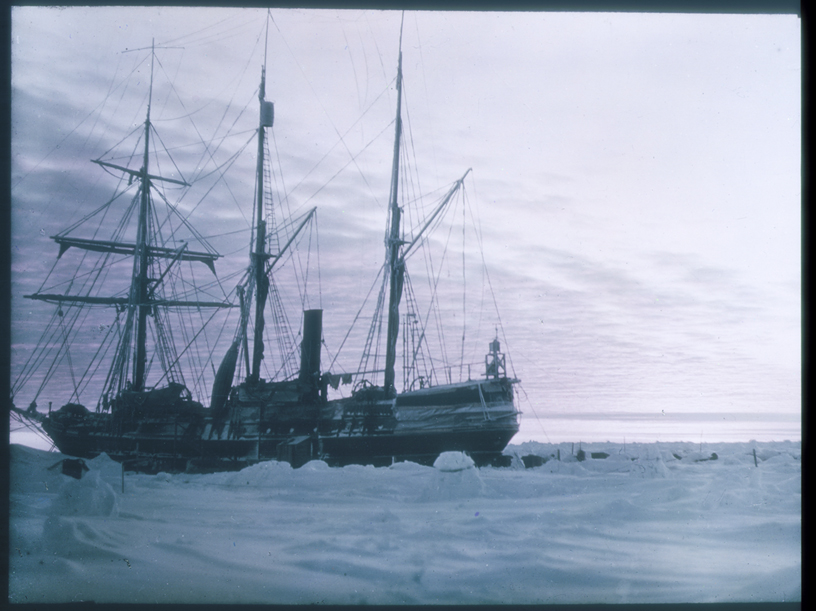
Barkentina "Endyurans"
But happiness again did not accompany Ernest to Sheklton. "Endyurans" in the sea Weddell fell into ice captivity. The south of the point reached by him lay on latitude 76 ° 58 ', then the ice forced the ship to drift back to the north. Several times he got into the compression zones, but the ship kept the hull, while on October 24, 1915, after the nine months of the drift, the pressure of the ice was not so strong that a hole formed in the trim of Endyurans. Sheklton and his comrades tried to save the ship for three days. They continuously pumped out the water from the hold and tried to close up the skin, but their efforts did not bring the result. Endyurans was crushed by ice, but people managed to land on the ice.
Photographer Frank Herli under the Bushprit of Endyurans rubbed with ice
"Endyurans" on a polar night
The death of "Endyurans"
The transantarctic transition after the loss of the vessel was impossible. Sheklton had to save his crew members. The expedition participants had to have a long transition on ice, then three months of waiting in the ice camp until the ice is opened and the opportunity to use the boats. Food reserves melted. Almost six months after the death of Entyurans, the expedition on three boats reached the island of Elephant (on Russian maps usually - the island of Mordvinov) in the Southern Shhetland Islands archipelago. There, one of the boats was strengthened, and Shakeleton with five satellites went on her risky swimming to the island of South George, where there was a whaling base. The rest of the crew waited on the island of Elephant. The expectation lasted almost four months, since whaling ships from South George could not swim among the packs surrounding the island of Elepha, although Shekleton tried to do this three times. Many people on the island were in serious condition, food was running out. The polar explorers were already thinking about the fact that it would be necessary to eat the one who will die first. But Shekleton managed to get a steam tugboat from the government, who helped to pave the way to the island of Elephant, and people remaining on the island were saved. Not a single person died from the Shekleton detachment for the entire expedition.
Frank Herli and Ernest Shekleton in the ice camp
The launch of the boat, on which Ernest Shekletton with five satellites sailed from the island of Elephant to Southern George
The path of the team from the death site of "Endyurans" to the island of Elephant to Southern George
The squad of Aneas Macintosh, acting on the opposite edge of the continent, overcame the greatest difficulties. Although all the dogs were killed, travelers were able to prepare food warehouses, the south of which was at a latitude of 83 ° 30 '. A strong storm tore off the Aurora, along with the ice that had rubbed her and carried it into the ocean, where she began a long drift. There were ten winters on the coast, without the necessary equipment. They were saved thanks to the found reserves of the old expeditions of Scott and Shekleton (for some time they lived in a hut built by sailors from Discovery), and they mined food, hunting for seals and penguins. Only more than a year later, Aurora, who had been repairs in New Zealand, managed to return and pick up the polar explorers. In the Macintosh detachment, three out of ten wintering, including the leader, died.
After the end of the First World War, Ernest Shekletton again managed to organize an expedition to Antarctica, but died of a heart attack on January 5, 1922, when the expedition managed to reach only the island of South George. People managed to cross Antarctica only in 1958. This was done by the transatlantic expedition of the British Commonwealth under the leadership of Vivian Fuchs and Edmund Hillary. They moved along the same route that Ernest Shekleton planned, but used not only dogs, but also caterpillar equipment , and also received ice reconnaissance data from aircraft.
The current expedition, the participants of which hope to find traces of Endyurans, will go to Antarctica on the South African Ice -breeding vessel of Agulies II (the name is given in honor of Cape Igolny). Automatic underwater devices and unmanned planes will help in this search.
Scientific ship "Agulies II" in Cape Town
The expedition also has other tasks related primarily to the study of antarctic ice. Of particular interest is the giant iceberg up to 200 m thick, weighing about 1 trillion. tons with an area of about 5800 square kilometers (about three Luxembourg), which broke away from the Larsen shelf in July 2017. This iceberg is known under the code name A-68. Now he continues to drift to the north, overcoming 45 kilometers in a year. It is necessary to investigate the reasons for its appearance, as well as the influence that it will have on the state of coastal ice. Biological studies are also planned in the waters of the Weddell Sea.
Iceberg A-68. A satellite picture taken in the infrared range July 20, 2017
The director of the Robert Scott Institute of Polar Studies in Cambridge and the Scientific Director of the expedition Julian Dowdeswell said Guardian: “Antarctica is an extremes. You never know what the conditions will be. But if we are so close to one of the most iconic ships in polar research, we must go in search of it. ”
The expedition should last 45 days. Her news can be monitored on the official website and on Twitter .