
Translated material
Peter Brooke and others
Theatrical review of Irina Simakovskaya
Alexander Genis: On the air - the first theatrical review of Irina Simakovskaya this year.
Ira, what did you bring to us from the winter New York?
Irina Simakovskaya: Theater winter New York again turned out to be New York Bastroil. All the most interesting performances were performances brought from England or South Africa.
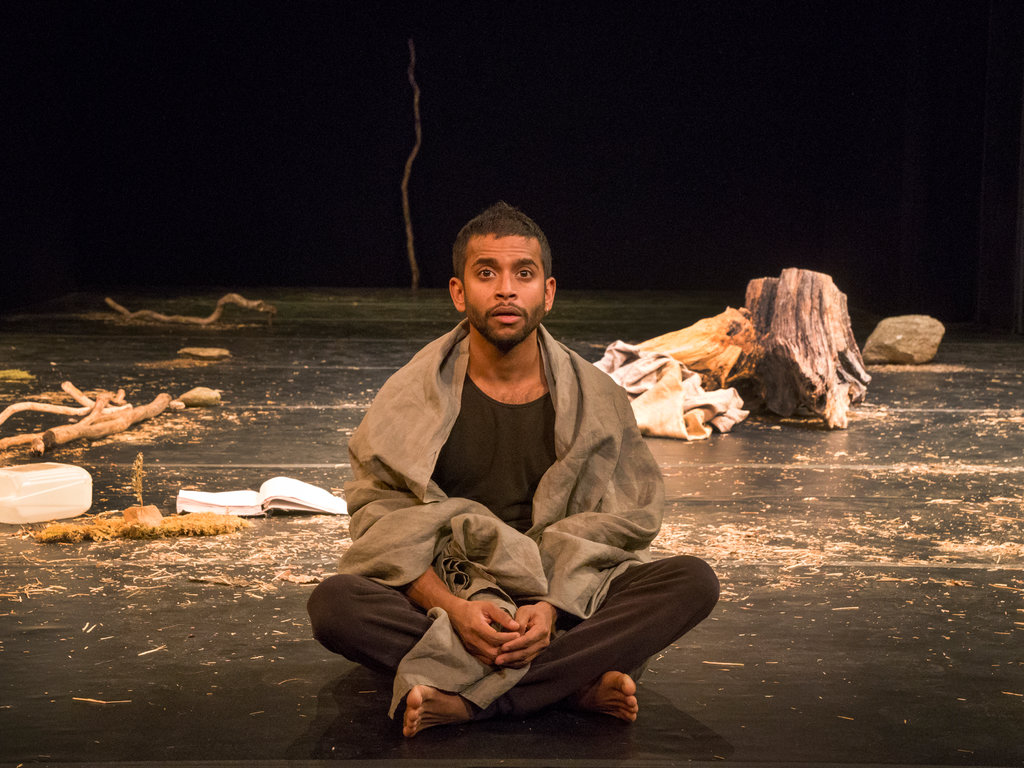
The performance of Peter Brook, who was called the "Prisoner", delivered great joy. At a meeting with the audience at the New York Theater, the new viewer Peter Brook told a ridiculous story about a taxi driver who was driving him. Upon learning that the purpose of the theater, the taxi driver told how he loves Shakespeare, but not in the theater, but to read, because he is always terribly placed in the theater. And Bruka asked if he loves the theater? Brook had to admit that he still loves the theater. Which once again proves his performance, brought to New York.
Alexander Genis: Bruck is lucky for taxi drivers.
Irina Simakovskaya: The new performance of the great Peter Bruka, staged for the first time in his Paris Theater, Buff du Nor, was based on a real story that happened 40 years ago in Afghanistan and then heard by a bar. This is the story of a young man, punished for killing a father not with execution, not a prison conclusion, but on the contrary - staying at large, in the forest near the prison, when the prison all the time in the field of vision. A sort of “crime and punishment” in the oriental way: you are free and can run away, but you are responsible for the crime that you committed, and therefore must leave the punishment. And the prison only reminds you of your inner need to atone for guilt, to cleanse of sin. And you cannot run away.
Alexander Genis: There is something Kafkian in this.
Irina Simakovskaya: Another of the eastern wisdoms, so loved by Brook.
Alexander Genis: But the Kafkian hero also carries a sentence.
Irina Simakovskaya: Kafkian? Agree.
In this performance, we are again an empty scene. And not evenly empty, built by a scena designer as empty, but empty, as it was before Brook arrived with actors. The artists just go on stage, just say words, just leave. But internally, of course, they are filled to the edges by the meaning of this particular mise -en -scene. Each artist knows very well what he does by going on stage. But they hold all their emotions tightly in themselves. Everything is restrained, without unnecessary intonations and gestures. As always, Brooke, of course, showed us the highest aerobatics in the hero’s friendship scene with a rat, which ended in frying the rat at the stake and eating it, but it was also extremely sparingly. The stingy theater of Peter Bruka.
Alexander Genis: I’ll give you, since I was talking about this, how I fell in love with Peter Broka. It was a lot of years ago, when he brought a performance to New York, where there were three actors and two subjects from theatrical props on the stage: a white robe and a chair. It was a performance staged based on the famous book of a writer-writer Oliver Sax "The man who took his wife for a hat." The actors in every episode changed their robes. The one who had a white dressing gown turned out to be a doctor, another - a patient. Then the opposite. There was such a carnival of dressings, such a carousel of larvae that it was impossible not to remember this. Because it was clear how little the theater needed to create stress. And Brooke, of course, is a great master and such an ascetic theater.
Irina Simakovskaya: Well, in the beginning he staged large, long performances.
Alexander Genis: "Mahabharata" in New York was seven and a half hours with a break for lunch.
Irina Simakovskaya: In recent years, Brooke deliberately refuses all the means of theatrical expression. Like the great Gordon Craig, he also became a minimalist by the end of his life. Brooke himself says: “I am like Gordon Craig.” No expressive tool in the theater can be compared with a person. A person is really more interesting than all theatrical biases. And this is what Brooke offers the viewer: to look at the person whom he chooses for us. And this is incredibly exciting. No wonder the 2018 Edinburgh Theater Festival was dedicated to the theater of Peter Brook, the Buff du Nor Theater.
(Sound quote)
Alexander Genis: What else was interesting in New York?
Irina Simakovskaya: The premiere in our famous park Avenue Armori, which we have recently been talking about recently.
Alexander Genis: Because it is a giant platform that allows you to make very interesting theatrical performances.
Irina Simakovskaya: Which not only allows you to make interesting theatrical things, but also does them, which is very nice. They take on a very big risk and make in the theatrical sense, perhaps the most interesting actions that are now taking place in the city of New York.
Alexander Genis: You can be, here you need to explain that we are talking about arsenal. This is a huge building, where once, back in the 19th century, they kept a weapon for a folk militia in case of mass riots-when the crowd rebels. America as a young democracy, who remembered the lessons of French revolutions, was always afraid of an uprising, rebellion, rebellion. That is why in every big city of America there are such ancient, very beautiful and very magnificent buildings in the Roman style. This arsenal has now become a theater platform.
Irina Simakovskaya: There are several arsenals in Manhattan, but only one of them became the theater platform that is engaged in different types of art, installation, painting, and many things. This time it was the performance of William Kentridge, the famous South African artist and director.
Alexander Genis: Which brought us a few years ago opera Shostakovich "Nose". With great success, she went to the "Metro" as much as two seasons. It was an incredible success, it was impossible to get. Despite the fact that it is impossible to understand this absurd Gogolian thing, but nevertheless, he put it in a suitable Dadaist vein, and very successfully.
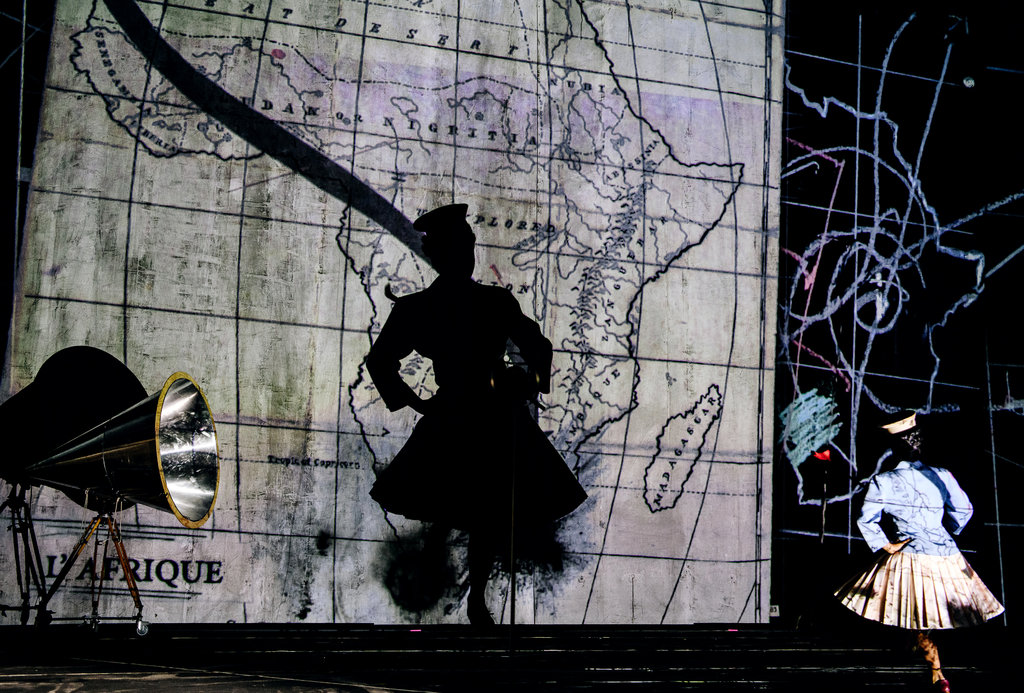
Irina Simakovskaya: The action of William Kentridge is called the "head and burden." First, they put in London with all the South African participants, now he brought the performance to New York. Actually, the centridge is considered the director of the opera, he never worked in the drama theater. But this performance, which we saw in Armory, is neither a opera nor a dramatic theater - this is a synthesis of many art forms in one.
Alexander Genis: And many languages. On the stage they speak English, French, German and in several African languages. This is the Babylonian tower of the theater.
Irina Simakovskaya: Yes, this is true. Despite the fact that the centridge itself is primarily an artist, for him the artistic idea is not an end in itself, it is important for him an artistic statement on the topic that excites him. As a child who had grown up in a family of lawyers who defended the rights of Africans under apartheid, Cantryg considered it important to tell about Africans in the First World War. Few people know that hundreds of thousands of Africans died in the First World War, and many of the names of the victims sunk into oblivion. Having raised the topic, the Cantress decides how he will talk about it.
Here comes the moment to talk about the centridge-artist, for visually this performance is staggering. The Cantryg chooses the style of the Dadaists, just as in Shostakovich’s opera “Nose”. As Dadaism turns any statement into nonsense, so European colonialism is not able to understand that Africa is trying to say to him, the colonialists, colonized by 90% during the First World War.
And on the wide scene-100 meters in width-this complete suffering and the installation-opera-animation that turns the soul is unfolding. A kind of collage of artifacts torn from that era, epic of war in Africa. The libretto is the same collage from different texts and authors of that time, added or rewritten. Tristan Tzara, was translated into the languages of Isisul and Sisvati, and Wilfred Owen - to French and dog barking. Immediately - the sayings of Africa. In the name, by the way, was used a Gan proverb: "Head and burden - trouble for the neck."
Alexander Genis: This is due to the fact that the African participants in the war were primarily used as porters, they endured not only goods, but even one ship was completely dragged on land. That is, first of all, these hundreds of thousands of dead people were porters, without whom the war in Africa could not go, which raged from Morocco to South Africa - throughout the continent.
Irina Simakovskaya: Yes, and from here in the name of the performance this Gan proverb. The music is also eclectic, quite collapse - written by Philip Miller and Thathuka Sibisi, but the opuses of Arnold Schonberg, Maurice Rael and other composers of the same time are also used.
The performance is short -lived, it goes only an hour and a half. But this is an hour and a half of the poetic semi-batteries. We are not able to make out everything in the details - so much at the same time occurs on a long stage. But this view leaves the viewer shocked emotionally and aesthetically. And in the current crazy dispute about whether the whites can speak from the stage about the fate of the blacks - this performance is a significant and affirmative argument.
(Sound quote)
Alexander Genis: What else was brought to our New York?

Irina Simakovskaya: Network play made in the film, which is called "Telecet" in Russian.
Alexander Genis: This is the famous film of the 1970s, I remember him very well. Because there I learned the main rule of television work: when you find yourself opposite the camera, you need to sit on a jacket so that it does not puff. The film was very popular, brought the performer of the main role "Oscar".
Irina Simakovskaya: The film was, I would even say, cult. I looked at him before going to Network on Broadway.
The performance was brought from London, where he was staged by Ivo Van Van Hove in the National Theater. After a stunningly brilliant success of the performance in London, he was brought to Broadway. Now it is very difficult to buy tickets, although it has been going on for a month and a half, the tour was extended until the end of April. And this is absolutely not surprising.
In my opinion, the performance surpassed the old -fashioned film at times at times. Van Hove made a modern Network about American fake and nephew, about the current state of the television industry, about lies for the sake of popularity and ratings, about the hero- the leading news program. He is played by Brayn Cranston, who was drew to lie, and he calls on the TV screen to approach the window right now, during the air, and shout after him: I am angry like hell, I can’t stand it anymore! And the audience shout out the window, as they are tired of everything. Because they really got tired of it. And the cameras, the famous Vanhov cameras, work in the usual mode for his performances. They are ideal for this performance, the action of which takes place in television studio. Brayn Krenston, playing almost the whole performance on the close -up, on the large screen in the scene, is impeccable acting, how impeccable the performance is entirely. It seems that in the end all the audience will rise, leave the hall and go to a demonstration to the White House, chanting "Take a lot, I can’t stand it anymore!" It seems to me that such a silicon performance could even take people out into the streets. The current Van Hove is a revolutionary.
Alexander Genis: Ira, but it does not seem to you that as generals who always wage the previous war, so this performance turns to a half -skirled enemy? Television in the 1970s was indeed the most mass media that ruled the country. But today, when the television has crushed into hundreds of channels and gives way to the Internet, the TV has not so many hot fans left, except for our President Trump. Many simply cut themselves off from the TV and watch news on the Internet, on different social networks. The TV is no longer the powerful force that he was then, except in Russia, but not in America. Don't you think so?
Irina Simakovskaya: You know, there is an excellent answer to this question in the play. The protagonist of Kreston says: in total, readers from the total population of 3%. That is, 3% of people can reach some conclusions and generalizations with their own heads. Everyone else believes the news, whatever they are - from the TV or from the Internet rushing. Everyone reads what is closer to him, and looks at what is closer to him. It would be nice to increase the number of reading people, to make more than 3%.
Alexander Genis: I want to console you and say that, according to statistics, in America exactly half of the country does not read novels, plays, stories and poems. But that means that half is reading!