
Translated material
The Ministry of Education tightens the rules of adoption and guardianship. Orphans will remain in orphanages?
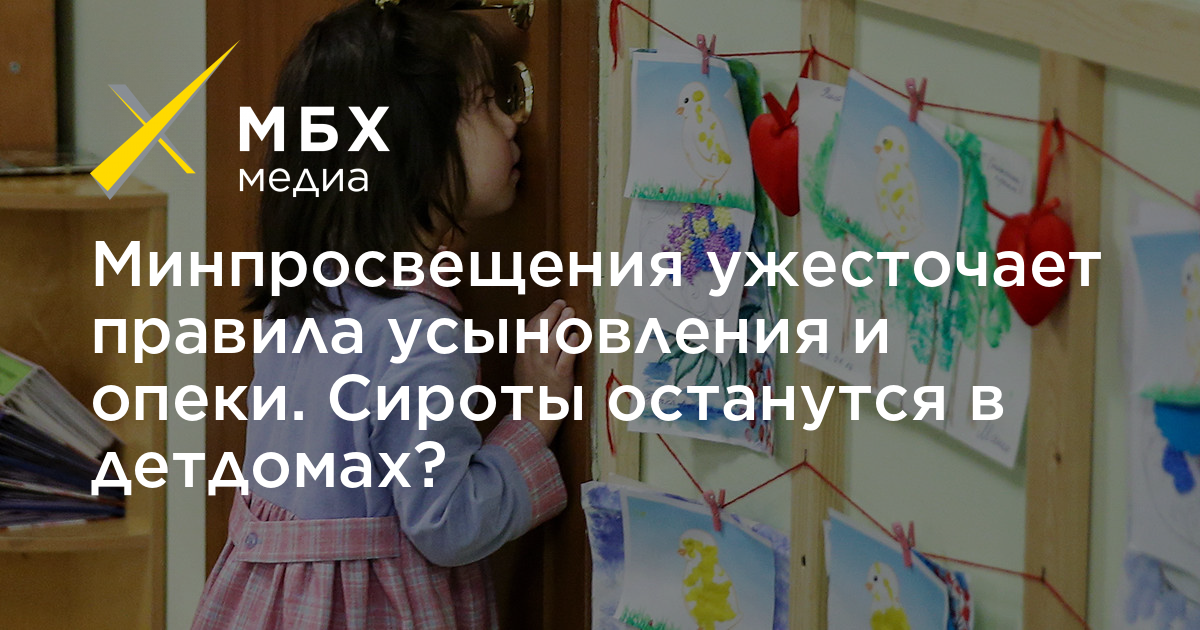
The Ministry of Education has prepared a bill that will tighten the rules for adoption and guardianship of children. In particular, one family will not be able to adopt more a child a year, and in total there may be no more than three children in the family, including relatives. There will be relief-it is planned to remove a tough ban on the adoption of children by people with HIV infection.
Together with the sociologist Elena Yarskoy-Smirnova, we understand how things are in Russia with adoption and guardianship, and what will change if the bill is adopted.
They adopt a lot, return a lot
Over the past ten years, pupils in orphanages have become less than 67.8 thousand people. According to the Ministry of Education, on September 1, 2018, 47.8 thousand data are listed in the Bank for orphans.
In Russia, children can either be adopted or taken under guardianship. In the first case, the child becomes part of the family and loses all benefits. The custody is most often temporary-if parents for some reason cannot support and educate children. In this case, the child continues to receive benefits, as well as the family who sheltered him.
At the same time, according to Yarskoy-Smirnova, most orphanages are adolescents or children with disabilities. Because of this, Russia in Russia-families understand that they are not ready to take care of a sick child, and conflicts often arise with adolescents. Support on the part of the state could improve the situation - there are not enough special centers in the country, consultations of foster parents with psychologists.
So, according to the data from the Ministry of Education and Science for 2017, 4788 decisions were canceled on the transfer of the child to educate the family. Of these, 4430 - on the initiative of adoptive parents.
Moreover, recently, Russian children are most often adopted by Russians. And this indicator has been growing in recent years. According to the Ministry of Education and Science, in 2016, 73% of children from Russian orphanages were adopted by Russian citizens, and in 2017 this figure increased to 75%.
This can be associated with a number of restrictions that exist in the country. For example, US citizens cannot adopt a child from Russia. This follows from the Federal Law No. 272 adopted in 2012 - the so -called "Law of Dima Yakovlev." Citizens of countries where same -sex marriages are also deprived of this possibility, which follows from Article 146 of the Family Code.
“All accidents that occur with Russian children who were adopted by foreigners are swollen into scandals, are used as a political instrument. And such cases when they neglect the interests of the child, show violence for him, a lot in Russia. In Russia, even more than in other countries, ”the sociologist said.
"Will adopt less"
And now the Ministry of Education proposes to tighten the rules of adoption and guardianship.
One foster family will be able to have no more than three children, taking into account relatives. At the same time, it will not be possible to adopt or take more than one child per year per year. An exception can only be made if people want to accept the brothers and sisters to their family, who were left without parents.
It can be assumed that such a measure is associated with fears that guardianship is made out of payment. But the sociologist with this point of view does not agree: “Public opinion has long been directed against foster families, although this is completely wrong. They do not adopt in order to get rich. Often the goal of adoptive parents in life is to help other people, especially children. And the load on them is not comparable with any payments. ”
It is planned to introduce a mandatory psychological examination for all family members, which plans to adopt or issue guardianship. Now it should be held only by potential guardians or adoptive parents.
Families with an adopted child may be prohibited from moving without the permission of guardianship. And until the guardianship does not check the living conditions at a new place of residence, the child will not be able to live there.
There is one relief-the Ministry of Education proposes to remove a hard ban on the adoption of children by guardians with HIV infection or hepatitis C.
The Constitutional Court recognized this ban as illegal as early as June 21, 2018. Then a complaint of the spouses who wanted to adopt a child, since 2015 actually living in this family, was considered.
The spouses themselves could not have children, because one of them as a result of a medical error in a medical institution infected HIV infection and hepatitis C. Since 2012, the family brought up a child’s sister. The blood mother refused him, and it was not possible to adopt or issue custody due to illness.
The sociologist associates this ban with the attitude to HIV-infected and patients with hepatitis C in Russia: “ This was due to the fear that the parent can somehow infect or infect the child. Although everyone knows that HIV infection is not transmitted by airborne droplets, through a towel or cup. This is an absurd ban. ” She also noted that she also considers the ban on the adoption of children, if the family has already taken an HIV-infected child. True, they are not going to cancel it.
According to Yarskoy-Smirnova, after tightening the rules of adoption and custody of children from orphanages, they will take less often. However, she is sure that everything is not so bad: " Those who want to adopt will still adopt, despite the strict rules."