
Translated material
Review: How is the new church of Ukraine created
How the property with the Russian Orthodox Church will be divided and whether the Belorusskaya will follow the Ukrainian church - in Kiev and in Minsk, the correspondent of NT found out
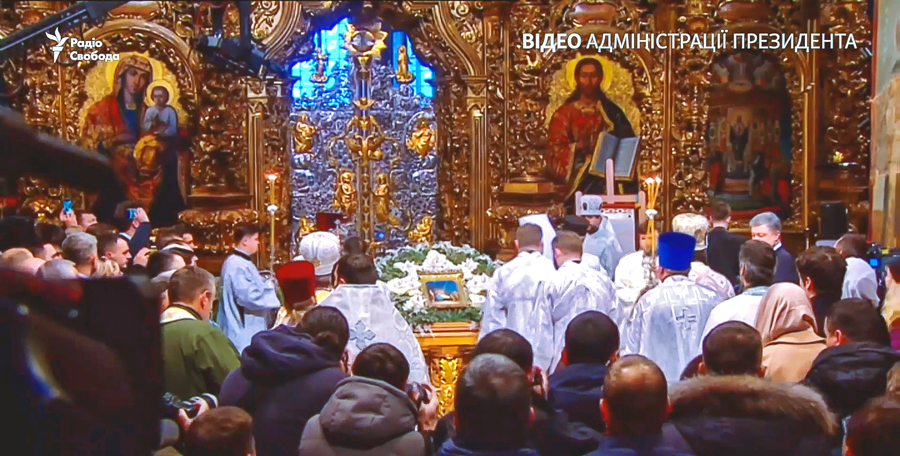
Kiev celebration
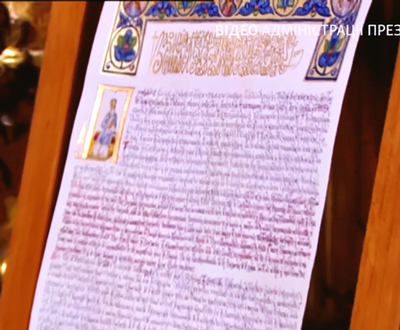
On January 7, more than 150 thousand people came to the center of the capital of Ukraine, to the oldest cathedral of Sofia Kyiv. A huge queue stretched through the entire Sofia Square. Among the Christmas carnival surrounding them are believers (including a correspondent
NT ) stood in order to look at the Big Parchment Leaf, dotted with scribbling in Greek, in the refectory temple of Sofia of Kiev - Tomos (Tomos - from Greek “cut”, “divide” - the rector’s decree on the important issue of the church structure. -
) on autocephaly of the Orthodox Church of Ukraine (PCU). In the presence of the president of the country and the entire political elite of Ukraine, Metropolitan Epiphanius served in the Kiev Cathedral of St. Sophia the Christmas Liturgy - the first as a full head of the local church recognized by the Ecumenical throne.
According to Patriarch Kirill, the act of Bartholomew “will testify against him at the Last Judgment”, and 250 million Orthodox Christians will be in a state of fratricidal schism all over the world
Three weeks before, December 15, in the Church of St. Sophia (Sofia Kiev), the unification council of Ukrainian Orthodox churches was held, on which the Orthodox Church of Ukraine was created and its Primate - the Metropolitan of Kiev Epiphanius (Dumenko) (about how it happened, read here ).
In Moscow, the unification cathedral was called "not having canonical power by an autonomous gathering." According to the leadership of the Russian Orthodox Church, the UOC -MP, the Ukrainian Orthodox Church of the Moscow Patriarchate, remains the only canonical church structure. The last desperate attempt to stop the process of the Russian Orthodox Church made the New Year's Eve: the Patriarch of Moscow and All Rus' Kirill wrote a letter to the Ecumenical Patriarch Bartholomew, which categorically demanded not to give the Ukrainian church autocephaly. According to Patriarch Kirill, otherwise Bartholomew’s act “will testify against him at the Last Judgment,” and 250 million Orthodox Christians will be in a state of fratricidal schism around the world.
However, in Constantinople, Moscow was not paid much attention to the demarcity of Moscow. “The devout Ukrainian people waited for this blessed day for seven centuries ... Today, Prince Vladimir and St. Olga celebrate with us,” Patriarch Bartholomew said, signing a letter of autocephaly.
However, the newly created Ukrainian church has yet to be recognized by other local Orthodox churches, which will have to make a difficult choice between the Patriarchate of Constantinople (canonically dominant) and the Moscow Patriarchate (the most large and rich). This choice is not obvious. Thus, the Elladsky Orthodox Church began the process of recognition of the new Ukrainian church, and the Polish Orthodox Church, on the contrary, said that she would not do this under any conditions .
## struggle for parishes
The Vinnitsa diocese of the Orthodox Church of Ukraine claims that this is far from a complete list of those who wish: the transition process, as the representative of the diocese said to journalists, is inhibited by legal issues, as well as pressure from the hierarchs faithful to Moscow. But in the east of Ukraine, not one of the Orthodox communities subordinate to the Moscow Patriarchate has yet announced her desire to go to the Ukrainian church.
By the end of 2019, the Moscow Patriarchate will lose half of its parishioners in Ukraine. If we take into account that Ukraine is from a quarter to a third of all parishioners of the Russian Orthodox Church - then the loss is significant
So far, the UOC MP retains 12 thousand parishes and, thereby, remains the largest in the country. The Orthodox Church of Ukraine has about 6 thousand parishes. However, few in Ukraine doubts that over the next year or two, the ratio will change to the opposite (about the motives of the Orthodox communities choosing between Kiev and Moscow, read here ).
“The data on the number of their parishioners, which will be published by the same church, differ so much that it is better not to take into account them at all and come to terms with the fact that there are simply no similar data,” said Anatoly Petrovsky, Ukrainian philosopher-religious philosopher. -So far, the only adequate assessment says that by the end of 2019, the Moscow Patriarchate will lose half of its parishioners in Ukraine. And Ukraine is from a quarter to a third of all parishioners of the Russian Orthodox Church. ”
On January 7, the head of the Department of Religions and Nationalities of the Ministry of Culture, Andrei Yurash, explained the procedure for the transition of communities from the UOC MP to the Orthodox Church of Ukraine. “There is a religious community. If inside this community there is a desire to get out of the subordination of some religious center, a meeting should be held. What the majority in this community will receive an advantage, this will be the fate of this community, ” said Yurash. He noted that under Ukrainian legislation, every religious organization is an independent legal entity and "decides its fate itself, including property."
If there will be less than half those who want to go to the new Orthodox Church of Ukraine, they can raise the question of alternate ministry in the church. “The temple is never used around the clock. It is easy to give this temple in a turn, ”Yurash explained.
The question of property
The financial capabilities of the Church are directly related to the number of parishes. Today, even if you do not take into account unofficial injections from Moscow, the parishes controlled by the Russian Orthodox Church are much richer than the newly formed church. The most profitable temples and monasteries remain in the jurisdiction of the “Moscow Orthodox” - those in which there are large flows of pilgrims.
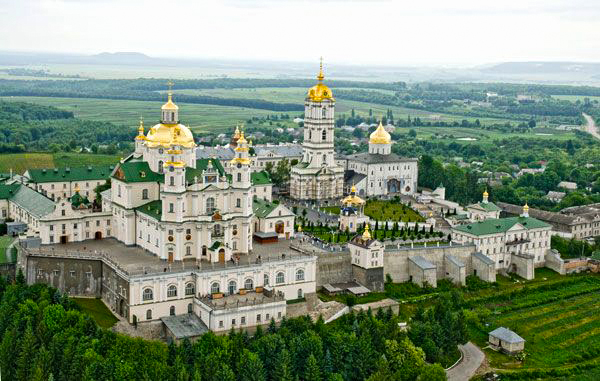
Now passions are boiling around the Kiev Pechersk Lavra and the Pochaev Lavra, which are not only the most significant spiritual centers of Ukraine, but also sources of large incomes . According to various estimates, the income they bring are calculated by tens of millions of dollars a year.
The Kiev-Pechersk Lavra is the residence of the Metropolitan of Kiev, Onufry (recognizing the religious supremacy of Moscow) and the whereabouts of the temporary cathedral of the UOC MP. The Holy Uspenskaya Pochaev Lavra is the largest Orthodox temple complex and monastery in Western Ukraine and the second in Ukraine after the Kiev Pechersk Lavra. Until November 23, 2018, the Pochaev Lavra belonged to the Ternopol and Kremenets diocese of the UOC-MP, but the Ministry of Justice of Ukraine canceled its 2003 decision on the transfer of the complex and returned it to the Kremenensky-Pochaev State Historical and Architectural Reserve.
Passions are boiling around the Kiev-Pechersk and Pochaev laurel, which are not only the most significant spiritual centers of Ukraine, but also sources of large income. According to various estimates, the income they bring are calculated by tens of millions of dollars a year
At the end of December, the administration of the President of Ukraine instructed the leadership of the Museum of the Kiev-Pechersk Lavra and Kremenensky-Pochaevsky Reserve to prepare claims in administrative courts to terminate the lease of this territory by the UOC MP.
As the head of the department for religions and nationalities of the Ministry of Culture of Ukraine Andrei Yurash, Kiev-Pecherskaya and Pochaev Lavra are objects of national significance, and for this reason “no property are transferred to anyone”. However, there is an agreement on the transfer of the Lavr for the lease of the UOC MP, and this agreement may be revised.
“The lower part of the Kiev-Pecherskaya and Pochaev laurels were transferred for 50 years to the UOC of the Moscow Patriarchate. If it is clear that there were violations during the transfer of the laurel for rent, this may become the basis for revising the contract, ”he explained.
Such violations have already been identified. The recent inventory conducted by the Ministry of Culture showed that many different cultural and historical values disappeared from these temple complexes (presumably to Russia).
In turn, a spokeswoman for the Orthodox Church of Ukraine Eustratius Zorya said: the new Ukrainian Church expects that the Kiev-Pechersk and Pochaev lavra will be transferred “without violence” .
Even earlier, Petro Poroshenko signed an agreement with Patriarch Bartholomew, in which the Monastery of Transfiguration in the Mezhigorye near Kiev pledged to subordinate to the subordination to Constantinople.
Today, the list of objects that the state disposes and which it is ready to transfer to the new church includes, in particular, the Kiev-Brand Epiphany monastery, the Holy General Frolovsky Monastery (Kyiv), the Church of the Assumption of the Blessed Virgin Mary (Lviv), the Holy Troitsky Koretsky Stavropigial Convent (the Rivne region), the Savior-Personal Monastery (Chernihiv region), the Monastery of the Nativity of the Blessed Virgin Mary in the Glinsky desert (Sumy region), the Cross-Western Convent (Poltava) and the Holy Pantelimon Monastery (Odessa).
The process has already been launched. The largest Minsk public of the VKontakte social networks conducted a survey about whether autocephaly needed the Belarusian Orthodox Church. More than 74% of the participants answered yes.
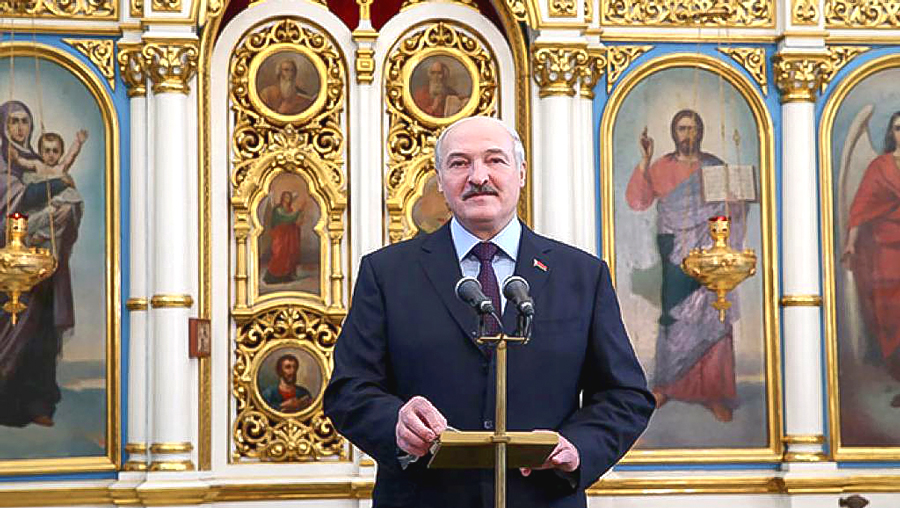
President of Belarus Alexander Lukashenko in the cathedral of the Belarusian Orthodox Church.
New Front of the Holy War
The Kyiv media began to discuss a new issue - about the appearance of foreign parishes in the Orthodox Church of Ukraine. Most likely, except for the Ukrainian diasporas in the USA and Canada, the first foreign parishes will appear in PCU in Belarus. There, the Orthodox perceived the events of recent months with great enthusiasm, a wave of conversations about the autocephaly of the Belarusian Orthodox, which was quiet in the late 1990s, again rose.
So far, the hierarchs of the Belarusian Orthodox Church (the Belarusian exarchate of the Moscow Patriarchate) in numerous interviews declare the full and unconditional support of the Russian Orthodox Church and, after Moscow, accuse the Patriarch of Constantinople of the split of world Orthodoxy .
However, the process has already been launched. The largest Minsk public of the VKontakte social networks conducted a survey about whether autocephaly needed the Belarusian Orthodox Church. More than 74% of the participants answered yes .
And the Belarusian Autocephalous Orthodox Church (it exists rather formally, has only a few parishes in the USA and Canada) invited Christian-lands of the Belarusian Autocephalous Orthodox Church (BAPC) and friends for festive worship on the occasion of the birth of Christ. It is noteworthy that this service took place in Minsk - although in Belarus the BAPC has no parishes.
Since Moscow was recalled by a Tomos to the management of the Kyiv Metropolitan, Belorussia ceased to be its canonical territory. Since in the XVII century the Polish -Lithuanian and Kiev Metropolitan Commonwealth almost entirely included the current territory of the Republic of Belarus
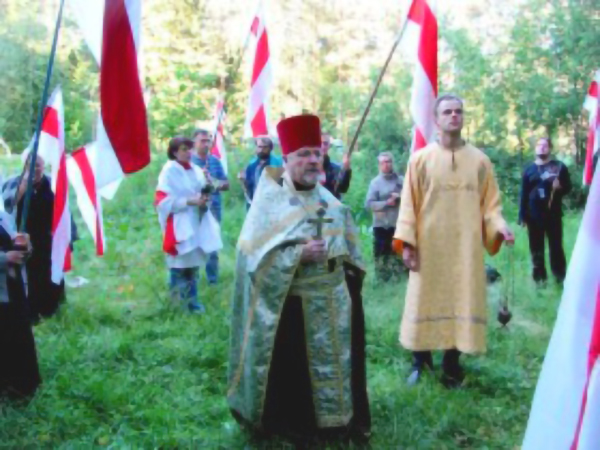
who want to obtain independence from Moscow. “Today, Belarusian Orthodox are really discussing (even more at the level of“ kitchen conversations ”), to whom to obey them: the Moscow Patriarchate, Kiev, directly universal or even create his own autocephaly,” said Mikola Stefanenko in a commentary for NT .
In October 2018, the Ecumenical Patriarchate decided to terminate his own decree of 1686, to which the Moscow Patriarchate was given the right to appoint Metropolitan of Kyiv. A “min” was laid here, on which in the fever of a dispute with Ukraine they did not pay attention to Moscow. From the point of view of church jurisprudence, since Moscow was recalled by a Tomos to the management of the Kyiv Metropolitan, then Belarus ceased to be its canonical territory. Since in the XVII century the Polish -Lithuanian and Kiev Metropolitan, almost entirely included the current territory of the Republic of Belarus.
Purely formally, from the point of view of church law, the Belarusian believers suddenly found themselves in the subordination of the Kyiv Patriarchate. And this logic is now ready to accept the Ecumenical Patriarchate. To the opportunity for the Belarusian Orthodox, to move from Moscow to the Kyiv Patriarchate was indicated on November 2 to the representative of the Patriarch of Constantinople under the World Council of Churches Archbishop Job (Gesha). In an interview with the Air Force, he did not exclude the possibility of providing autocephaly to believers of Belarus - if they ask for a church and the state.
A similar situation with the Moldavian Orthodox Church, which today has the status of a self -governing part of the Russian Orthodox Church. However, in Moldova, the Romanian Orthodox Church is very serious for the Orthodox believers with Moscow and Kyiv.