
Translated material
Light hacker
For the publication of personal data, thousands of German officials and journalists stood a high school student from Hessen
On January 4, it became known that Germany was subjected to a large -scale hacker attack: personal data was posted on the network - mainly email addresses and phone numbers - 949 politicians and journalists, including the Chancellor Angels Merkel.
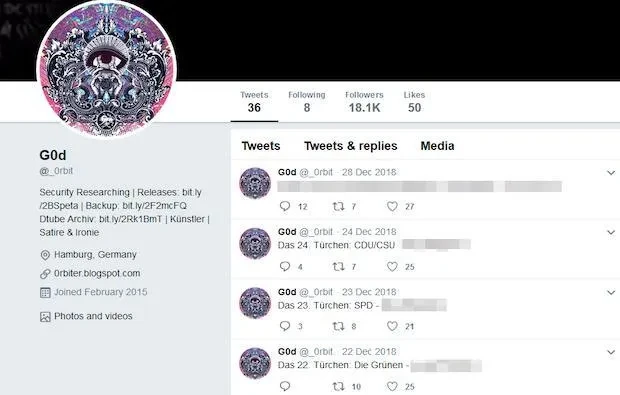
In fact, the story began a little earlier-personal data of individual politicians began to appear on the Twitter account of the user 0RBIT in December. They were decorated in the form of a Christmas calendar: every day the owner of the account opened a new portion of data.
Until the beginning of January, publications were not attracted to much attention. As the Minister of Internal Affairs Khorst Zeehofer said during a press conference on Tuesday, the Federal Criminal Office intensified on January 3-after the call of representatives of the Social Democratic Party, who discovered leaks on several of its members on the Internet. After that, the investigation began.
It turned out that in addition to the data of Angel Merkel, the personal data of many high-ranking politicians got into the network: German President Frank, Frankish-Walter Steinmeier, former Foreign Minister Zigmar Gabriel, the Chairman of the Green Party Robert Khabeke, as well as journalists ARD and ZDF and some public and cultural figures-for example, rappers from the Berlin group of K. The contact details of the “victims” were mainly published, however, in 50-60 cases, credit card numbers, letters and family photographs also got on the Internet.
Representatives of almost all parliamentary parties fell into the “calendar”: the data of 204 Christian democrats, 90 social democrats, 47 members of the Left Party, 31 members of the Green Party and 26 free democrats were posted. Only representatives of the “alternatives for Germany” - the ultra -right party, whose members advocate a strict migration restriction and are known for their nationalist statements were not injured. This led to certain thoughts about a possible customer.
According to the Bild newspaper, law enforcement agencies also worked out the version of foreign intelligence - primarily Russia or China. Although during the investigation, none of the German officials openly expressed accusations against Russia, numerous cybersecurity experts said that this is very similar to Russian handwriting. “Although it is well known that it is very difficult to establish the performer, the primary indicators indicate that behind these violations there is a hacker group Turla (also known as Snake, Venomous Bear, Waterbug and Uroboros),” Forbes quotes in the article of Krisa Dawson, a researcher from the American cybersecurity company for cyberseches. Proofpoint.
Many remembered the 2015 hacker attack on the Bundestag: with the help of the Trojan virus, the attackers entered the internal computer system and gained access to some confidential documents. In May 2016, the German counterintelligence reported that Sofacy is behind the attack, which, according to their data, obeys GRU.
Since then there have been many incidents of which Russian hackers have been accused, and it is not surprising that the glory of the main hacker has firmly entrenched in Russia in recent years. But this time - and this is the official version - Russia has nothing to do with it.
However, the plot from this turned out to be no less exciting: only instead of a spy scandal is a personal protest story. It’s not completely against which - the personality of the hacker is not disclosed, according to Minister Zeehofer, the young man during the interrogation explained that he was “annoyed by the statements of politicians, journalists and public figures” who became his victims. Zeehofer also said during a press conference that investigators checked the possible connections between the accused and the “alternative to Germany”, but found nothing.
Little is known about the hacker: he is 20 years old, he studies in high school, lives in the federal land of Hesse, in the house of his parents - the last circumstance was especially noted by all German media. According to the Criminal Code, this kind of crimes threatens up to three years in prison or a fine, however, criminal law for minors is still applied to the twenty -year -old - therefore, most likely, he will escape several days of arrest as a warning measure.
The most interesting thing in this story (and sad for cybersecurity services) that
A 20-year-old student of high school is not a professional hacker, moreover, he does not even have a specialized education.
During the interrogation, the accused said that he had learned some hacking techniques from articles and videos available on the Internet. It is known that the young man hacked part of the electronic boxes, simply choosing passwords: some officials protected their mail with the digital combination of 12345 or the phrase of I Love You. So the main conclusion is perhaps banal: when coming up the password, show at least a little ingenuity.