
Translated material
Why do 53% require government resignation?
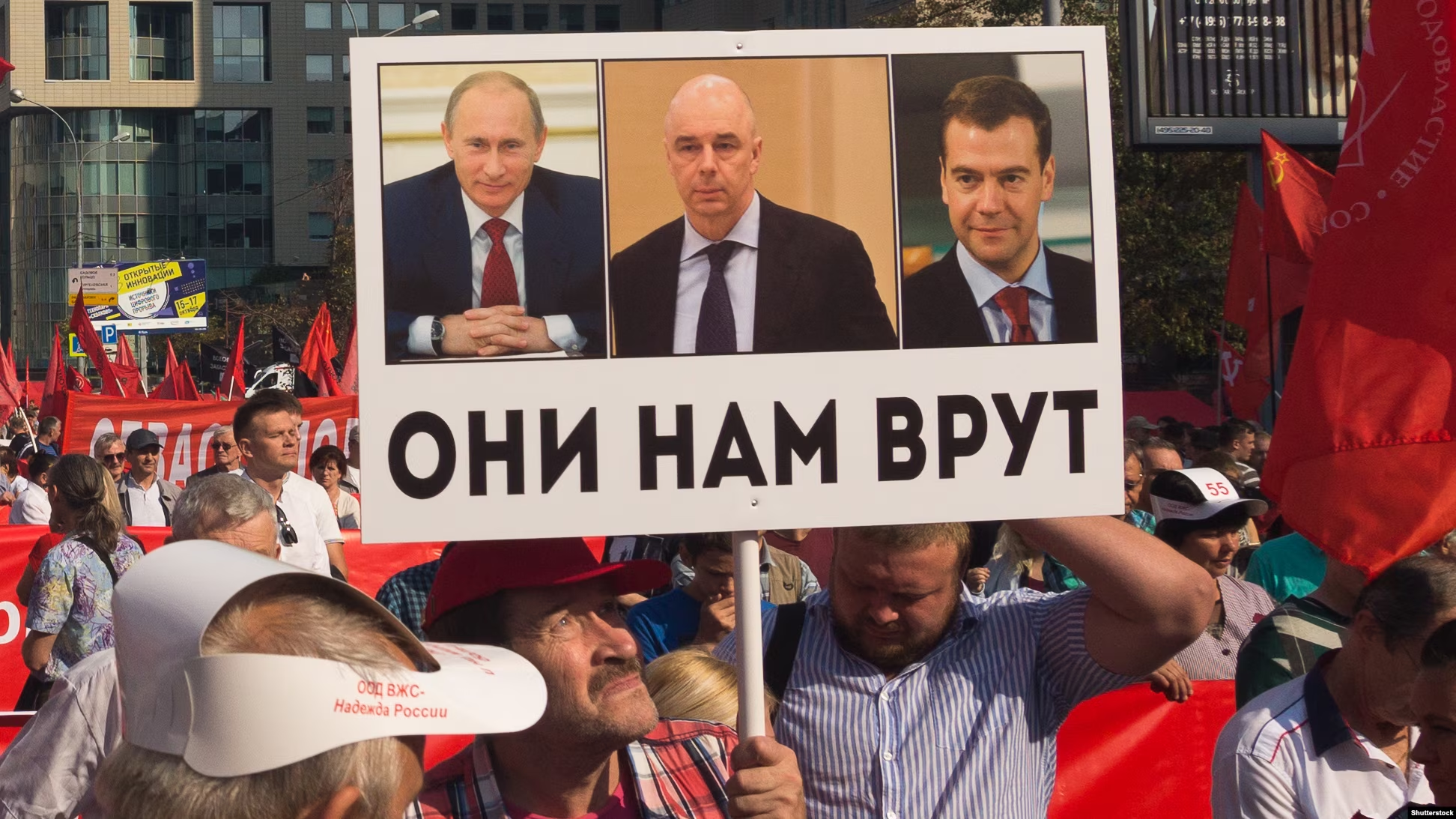
According to the December survey of Levada Center, 53% of Russians surveyed want to resign the Government of the Russian Federation. The ratings of trust in President Vladimir Putin and Prime Minister Dmitry Medvedev also fall.
In the survey, the first three claims to power is as follows: “cannot cope with the increase in prices”, “with the fall of the population’s incomes, provide people with work, does not care about social protection of the population, is corrupt”, “acts primarily in its own interests.”
Prime Minister Dmitry Medvedev managed to speak out against the long New Year holidays, and at the Gaidar forum announced how to "solve the problem of an economic jerk." The prime minister promises to "reduce the load on entrepreneurs."
Why did the Russians stop loving power, although in the spring they triumphantly re -elected Vladimir Putin? Discuss the Doctor of Economics Director of the Institute of Strategic Analysis of the FBK company Igor Nikolaev , director of the Levada Center Professor NIU HSE Lev Gudkov . Mikhail Sokolov is broadcast.
Video version of the programMikhail Sokolov: Let's start with a general question, which is clear to the beginning of the year, after all, what fundamental changes have occurred in the socio-economic system of Russia for the previous year?
Igor Nikolaev: There were no fundamental changes, if we evaluate, say, the dynamics of economic growth. As for the changes that we entered into the current 2019, they, of course, are significant. The most important thing is, of course, pension reform. Although, of course, it should not be called a pension reform - an increase in the retirement age, which will begin to be implemented from this year. And other unpleasant changes. This is a fairly serious increase in the tax burden, this refers to the increase in value added tax rate from 18 to 20%, the introduction of tax on self -employed and so on. These, in my opinion, are two main points in the socio-economic policy that I would allocate, concerning them both last year 2018 and the coming 2019: raising the retirement age and strengthening the tax burden.
Mikhail Sokolov: In your opinion, could you do without it, without this set of measures to cut the population?
Igor Nikolaev: You can, of course. Moreover, this question arose naturally. When the government reported at the end of last year, how much additional money he had, that the 2018 budget surplus - I only call one of the reasons why it was possible to get by - exceeded two trillion rubles. In the same way, in the trillion dimension there will be a surplus as the government plans, and this year. You say that there is not enough money, you increase the retirement age, increase taxation, a more or less favorable oil foreign economic conjuncture, oil prices were quite decent, money is enough, more than two trillion rubles, that is, the excess of income over expenses in 2018. This is the answer to the question, was it possible to do? Yes, it was possible to do. But it was necessary to do for other reasons. It was not only possible, but it was necessary to do when you have four years in a row, in 2018 we have no statistics yet, but in 2017, the real incomes of the population are reduced, against such a background a decision to increase the retirement age is impossible-this is contraindicated. No wonder 80–85% of the population opposed this, exactly the same percentage, I am sure, if not more, it will be in the future. It was possible and necessary to do without these decisions.
Mikhail Sokolov: I would ask Leo Gudkov to tell about this survey that has now appeared. Dynamics, for example. Do you have observation since 1999?
Lev Gudkov: Since 2002, the first polls. Usually, the average readiness to resign the government was about a third of about a third.
Mikhail Sokolov: That is, this is a stable figure?
Lev Gudkov: This is a stable figure, but it rises in situations of the crisis. It reaches at the end of 2012 amid mass protests to 38%, next year to 39%, then after Crimea it fell. This year she jumped up to 53% - this is the first time such a result. Moreover, more categorical statements, that is, definitely “yes”, jumped in two years from 11 to 23%, that is, doubled. We must see who acts and against what background stands for resignation. More sharply, more categorically, more educated layers engaged in the private sector are more sharply, are more categorically, that is, these are experts, managers, entrepreneurs, people with higher education and Muscovites. An interesting discrepancy, because tension and discrepancy are stronger in the province, in medium-sized cities, in small cities, in industrial Russia. We are ready to speak out about the resignation of the government, complete rejection-this is still the capital, more educated, more independent from the power of the population group. It is interesting that the workers follow the readiness and radicality of their requirements for the more educated population.
Mikhail Sokolov: Are they still?
Lev Gudkov: Where will they go?
Mikhail Sokolov: They tell us all the time - deindustrialization occurs, enterprises are closed, especially in the province.
Lev Gudkov: In comparison with the Soviet time, of course, it has sharply decreased, but still it is still a model group. Until now, everything is measured in the workers, they act as such a norm of human needs. All the demagogy of the leadership still goes, appeals to them. Uralvagonzavod you remember.
Mikhail Sokolov: But he did not come to Moscow to restore order, as one figure promised.
Lev Gudkov: This, of course, is a high figure, but it is partly ambiguous. Because the readiness for active actions is low, although she also jumped. In the summer, after announcing an increase in the retirement age, before Putin refused to reject this law, it also amounted to 53%, the willingness to speak. Since the sterilization of all the possibilities of active actions was performed, arrests, propaganda, spoilers of all kinds, then people have the sensation of the impossibility of expressing their opinion quite much, to 30%. This irritation is nowhere, dissatisfaction has not taken place, it is preserved. According to December measurements, 52–53% believe that a very difficult crisis awaits us ahead, that we have the most difficult times ahead, that is, pessimism and economic and psychological dominates. The feeling of acute injustice of current policy.
Mikhail Sokolov: Still, people feel this lie? You can sociologically identify what Igor Nikolaev said about, on the one hand, the government increases taxes, fees and so on, and on the other hand, the state has quite large funds that go into reserves?
Lev Gudkov: He is primarily associated precisely with a change in attitude to foreign policy, militaristic, and military policy of the foreign. Why is such a sharp indignation about pension legislation, because people really understand that the state has money, but it spends it on its needs, or they are simply plundered, or most of it goes to re -equipment of the army, for the purchase of officials of officials, the costs of the police, the security service, etc. But mainly it is on Syria, for war. People hear that the state does not have enough money for this. In principle, they are not against such foreign policy and the restoration of the status of a great power, but "not at our expense." Therefore, a change in the retirement age is perceived as a complete robbery, as the fact that the authorities climb into the pockets of citizens.
About half of the population is going to continue to work for about another five years. Five years approximately - this is additional income to the family. 70% of people live from salaries to salaries, there are no special savings. And then an additional source appears, which allows you to slightly increase the strategic resources of the family, some kind of acquisitions, and somehow expand consumption. It is this that the authorities are attempting, they take these opportunities. This is extremely acutely felt by people, not the pensioners themselves, but precisely people of pre -retirement age or a little younger.
Mikhail Sokolov: I still suspect that people have a pretty decent, perhaps they also counted on this money to pay off consumer loans and so on.
Igor Nikolaev: We have the growth of Zakreditiy, he reached peak values by the end of 2018. I would add another reason why it was painfully perceived so painfully, purely humanly I would say so, for many years people heard that this would not, the authorities promised not to increase.
Mikhail Sokolov: You never know what they promised. By 2020, they promised 2700 the average salary in dollars.
Igor Nikolaev: It’s one thing to promise to double the GDP for 10 years is something abstract and not directly related to people. And this so vividly concerns very many, here the feeling of acute injustice, of course, manifested itself in such a reaction.
Lev Gudkov: Power, bureaucracy and the population perceive a pension differently. The authorities, as in Soviet times, applies to this as compensation for disability, as some social support, a guarantee of complete poverty. And the population believes that this is their money simply spent through the state.
Mikhail Sokolov: That is, the deferred payment?
Igor Nikolaev: The deferred payment, warranty for old age is their money earned. Therefore, it is just seizure, robbery in its pure form.
Mikhail Sokolov: They make such ridiculous PR-shirts as Mr. Peskov says that he does not know what kind of pension is Vladimir Putin, who is in our retirement age, by the way, a working pensioner-president. It is not difficult to find out - more than 500 thousand rubles he has a pension at the moment. So everything is fine with him. Maybe he perceives from this position, from his pension, the salaries of even the official 750,000.
Lev Gudkov: There were talk about the early pensions of the security forces.
Mikhail Sokolov: But they were not injured.
Lev Gudkov: They were declared. The contrast between this privileged group and the population, of course, causes both envy and indignation.
Mikhail Sokolov: What can be said about the thesis with which people live - the hardest times ahead? How is it from the point of view of the economy, really the most difficult times ahead, given that the excise taxes are increasing, import duties increase? People used purchases in China, they ordered something by mail, now it is overlapping. Special recycling fees appear. A new payment appeared for garbage in many regions increased, even some corporation was created-this means that again the prices for housing and communal services will increase. Really dark times will be for a citizen?
Igor Nikolaev: There are simply facts, you have already said about some, to some extent I will repeat. We entered the New Year, the retirement age has risen, prices are growing, they received new payments, tariffs for housing and communal services are growing, a new fee for separate collection of garbage, parking and those in Moscow lifted up prices so that the fines for this were 5 thousand rubles without any reality. That is, such a financial oppression that it will not seem enough. The authorities are disapproving, as you know, we relate to the "dashing of the 90s", but I have the impression, which is the difference between the present time and those. Then people were given the opportunity to survive, the authorities could not give them much from the point of view of income, salaries, but they did not increase the retirement age, they did not introduce tax on self -employed and so on. Here they really interfere with simply surviving. This financial oppression is seriously intensifying. From this point of view, it is necessary to evaluate the prospects of the socio-economic situation of people, where does optimism come from? Therefore, fair assessments from the point of view of people.
From the point of view of the authorities, the opposite should look. As you know, we have declared an economic breakthrough, a breakthrough in socio-economic and scientific and technological development, we must enter the five largest economies in the countries of the world, ensuring the growth rate of the economy above the world. I do not think that these prospects will be realized. The economy is waiting for difficult times, because the key problems that are and which predetermined the position in which we are, they are not solved. The same increase in taxes, tax loads are what is strictly contraindicated in the period of unstable economic development. They say that everything will accelerate, and at the same time realize measures that lead to slowing down, to the opposite result. Moreover, this is proved by both world economic experience and our own experience. They increase the retirement age and calculate, they say: in 2019, raising the retirement age will give 0.1% to GDP growth, and by 2020–21 0.2-0.3%. And I would like to ask: from the point of view of people's motivation, you evaluated how motivated by people to the high -performance work that you are counting on to get increased GDP? Therefore, alas, the most difficult times, apparently, are still ahead.
Mikhail Sokolov: Lev Dmitrievich, I want to return to your survey, there is a second part about the claims that people express to the government. Have these claims changed somehow compared to the previous period?
Lev Gudkov: I would say that nothing has changed in structure there. These are mainly complaints about the government, that is, purely paternalistic expectations that the authorities cannot provide an increase in income, cope with the fall, more precisely, income, prices, cannot provide people with work, does not care about social protection, reduces the costs of medicine, education, and so on, that it is corrupt.
Mikhail Sokolov: I would note that there is a rather decent growth in corruption over the years, that is, about one and a half times.
Lev Gudkov: All indicators jumped up about one and a half to two times. Generally speaking, this indicates dependence on the authorities.
Mikhail Sokolov: If 70% of the economy is state -owned, then people understand who to make claims to.
Lev Gudkov: In a sense, these are hopeless complaints, because people know that you can complain, you can wait, you can demand, but the state will still deceive them. This is a very stable attitude. There are no other ideas, because all the possibilities of their own activities, their own earnings are suppressed. From here, as many say, the shadow sector, shadow employment is growing, but this is still a low-paid, low-skilled form of employment.
Mikhail Sokolov : I would like us to listen to the representative of the authorities. Dmitry Medvedev performed at the Gaidar forum, such a long, not very substantial performance. The most substantial in it was when he spoke of different requirements of the overstated, which are presented to all organizations, business and so on.
I even read one: “When preparing an omelet, the mixture of eggs with other components is poured on a baking sheet or portioned pan-greased with a layer of 2.5-3 centimeters, put in a frying cabinet with a temperature of 180-200 degrees for 8-10 minutes, otherwise it is impossible to fry. There are plenty of such absurd requirements, and we must do something about it, ”said Dmitry Medvedev. And then he gave an answer, in fact, what to do.

Width PX Height PX
The url has been copied to your clipboard
No Media Source Currently Available
0:00 0:01:57Mikhail Sokolov: You see, by February 1 of the next year, scrambled eggs and omelet can be frying without special instructions. Is this really the most important thing in the modern Russian economy-some excessive supervision, controllers, and so on?
Igor Nikolaev: This is an important problem, of course, not the most important. Today I specifically when I heard this, I took out my own report, he is 2003, on this subject, “Administrative barriers”, there are links to the Gref program. 20 years ago, the so-called Gref program, the program for 10 years, 2000-2010, said almost the same about the need to restore order in licensing, generally about the regulation of the economy.
Mikhail Sokolov: What did they do for 15 years?
Igor Nikolaev: Almost 20 years have passed, now we have heard a new Prost name, in my opinion, unsuccessful, associations here all sorts of arise. The most important conclusion that we then made 15 years ago: you know, you can put things in order here, reduce the functions, but if you do not change the most important thing, and most importantly, this is the motivational mechanism of bureaucracy, then you will get out in another.
15 years ago, this was manifested in the fact that we reduced the number of licensed activities, and invented the regions, for example, passporting of enterprises. This is not licensing, but now we will pass them. Because the motivation remained the same. These words did not sound today, and this is the main thing that we need to change if we want us to really go through the economy.
Therefore, even this important problem is actually, but with this approach - we will see, review what will remain, and be happy - this is not a solution to the problem.
There is no understanding of the most important thing, why after 20 years we have these problems of regulatory nature, why administrative pressure on business is excessive.
Mikhail Sokolov: I noticed that the law on the freedom of gathering a lobby was adopted, after which several regions adopted their laws, or by -laws on how to collect a lounger. In some regions, you need to get preliminary permission, in some you need to contact somewhere, in some, on the contrary, it is possible to arrange it, when you collected it, present it to the foresters, and somewhere it cannot be collected with the help of a saw. That is, the bureaucracy will bypass this guillotine, come up with something new.
Igor Nikolaev: You know what else the favorite reception was: the state bodies do not do this, then it is instructed to do this to some subordinate or created gopa or mop. Instead of Rosalkogolreguli, which is now the company, without a piece of paper from this enterprise, you cannot do anything. It turns out that at the level of the authorities everything is fine, we do not perform the functions. If you do not change the main thing, everything remains.
Mikhail Sokolov: Probably your sociologists with business also communicate, which actually worries people who could develop the economy and who, in fact, developed it in these “damned 90s” years?
Lev Gudkov: Business surveys, if we take our directed research, they show rather gloomy business moods. The feeling of a dead end, the rejection of long -term investments, the calculation only for very short projects. In general, in anticipation, mixed with very gloomy moods, in anticipation that something will happen, either a crisis, or power will change.
Mikhail Sokolov: And so it seems in the crisis.
Lev Gudkov: Our culture is generally characterized by a catastrophic consciousness, and here a slight tendency to this judgment "tomorrow will be worse." These are very understandable things. Returning to the previous topic, I would emphasize that our political leadership does not understand what opposite effect it has.
Because if you constantly talk about an increase, that Russia gets up from the knees, that it has become a great power, the question is: where is the money, Zin? Why don't this money go to the population? The answer that the population gives itself to this unnecessary question: it is clear that they steal. Here, in fact, this undermines the legitimacy of power. But this was no longer included in the plans of the most bossy demagogy. Plus, still very important things are increasing irritation from increased Crimea, Chechnya.
Mikhail Sokolov: How is this revealed?
Lev Gudkov: This is mainly on focus groups.
Mikhail Sokolov: I saw that there are many people in other surveys, it seems, Dmitriev, they say that too much power is engaged in foreign policy.
Lev Gudkov: And this is very felt. But mainly this is an unfair nature of the redistribution of national income. Too much goes into special zones, like Chechnya, Crimea, I'm not saying whether it is fair or not, there is an opinion that this is wrong. We have a fairly deplorable situation somewhere in Voronezh, in Arkhangelsk, in the Vologda region, and we would need this money, not to Syria, but for our needs, for roads, for social expenses, for medicine, but this is not.
Mikhail Sokolov: More than half of the houses in rural areas of Russia are not provided with sewage. Rosstat, data of the end of 2017. Very impressive.
I.
Igor Nikolaev: We have different businesses, a business that has been attached to the state, to the regional or federal authorities, and for those more or less nothing. We said, a favorable foreign economic situation on raw materials, there is money, something is falling to them. They, it seems to me, have not yet lost optimism. Many have such an alarming state, because the high uncertainty of the economic situation.
For the economy, this is very bad. Because if it is not clear what will happen next, how can I invest? I take a waiting position. One of the most powerful factors to reduce entrepreneurial activity is just what is happening with an understanding of the situation. Now the uncertainty of the economic situation is very high, of course, it restrains many.
As for indicators such as the outflow of capital and so on, last year it grew two and a half to three times compared to 2017. This also indicates that bad processes are developing here.
Lev Gudkov: If we talk about survey of entrepreneurs, then still a rather large percentage of production managers indicate falling demand in the population, respectively, a reduction in production.
Mikhail Sokolov: I saw data that the average check decreased by a hundred rubles, and this is decent.
Lev Gudkov: One way or another, but still over four years of the Crimean rise, the incomes of the population, according to the most modest estimates, fell by 11-12%. This is partially compensated by the growth of loans, and small loans, not the poorest, but the lower and middle layer of the population, which is trying to solve the falling standard of living through the climbing of consumer small loans.
Mikhail Sokolov: Citizens, when they talk about distrust of the government, do they distinguish Putin and Medvedev? That is, relatively speaking, they perceive the government as the Putin government, where Medvedev was an executive person, when for the resignation, means for the resignation of everything, or do they suppose Medvedev want to change, and leave Putin?
Lev Gudkov: Until recently, until the summer, such a mechanism for transferring responsibility from Putin to Medvedev approached the summer, so the government for quite some time, for the last three years, say, in minuses, with extremely low trust, rather distrust, like a deputy corps, and others.
Putin was outside of this, he was responsible for foreign policy and so on. After he approved the bill on raising the retirement age, he thereby assumed responsibility, his rating, as you know, fell by 15%. In recent months, it lasts at this level, it does not fall further.
Mikhail Sokolov: Let us listen to citizens then too. We are not a sociological survey on the street, maybe he will tell us something.
Poll on the streets of MoscowMikhail Sokolov: 90% voted on the site for the government’s resignation and 10% would leave them to work. But it seems to me that the most interesting moment here that sounded is the words “What in return?”. Indeed, is there an opportunity in return?
I will use the data of Alexander Kynev, he wrote an interesting article where he analyzes what is happening at the governor's level. Over the past couple of years, almost two -thirds of the governors have changed, the so -called young technocrats, actually appointed, and a certain number of security forces, who Putin Oblain, came to the majority.
In my opinion, we do not see any special successes at the regions level, and the author of this study says that from the point of view of the socio-economic situation there is nothing good, only some conflicts with local elites that are being intensified. Still, in return, is there anything or not?
Igor Nikolaev: We have a large country, a lot of talented people, but this does not mean that these people can expect that they will suddenly find themselves in the government. Because competence, unfortunately, professionalism is not the most important criterion. Loyalty is unconditional.
For me, by the way, I am an indicator, I’m now about the economy, we have professional economists at the highest level, it is also obvious to them that if you do not solve the problem of sanctions, then there will be no jerk. When you do not say that all this is unattainable, if the problem remains, you say: yes, and a jerk is possible. Where is your professional conscience, responsibility? With such people, we probably have a shortage. Those who could say this are not needed in power, they will never be appointed.
Therefore, theoretically, there are such people, it is almost unlikely to be there those who really, if not the whole truth, at least more this truth could say, would not be afraid to be responsible for what he does.
Mikhail Sokolov: Lev Dmitrievich, and you have any feeling, you are conducting some personal ratings too, suppose there is the “sun of Russian politics” Vladimir Vladimirovich Putin, and there are some people who either shine with the reflected light, or have some kind of their own rating. Do you have a set of candidates for the place of the same Medvedev?
Lev Gudkov: No. Not a single figure is gaining, with the exception of two ministers Shoigu and Lavrov, they do not gain more than 4-5%.
Mikhail Sokolov: That is, they are according to the power and foreign policy.
Lev Gudkov: I must say that they lost about the same as Putin, the same 15% of the fall, starting from the summer. This suggests that the bet on symbolic achievements in the field of world politics, where everyone respects us, because they are afraid, it weakens and loses its strength.
As for the personnel, either conscience, or loyalty, something one. I think that at the middle level of managers, a little below even there are many people who are quite competent, who know the problems of the population, could solve them. But they have no chances to rise or hold their own line.
There is a negative selection in power, vertical control in the selection of personnel. There are completely obvious negative trends, as they select the least competent. Siloviki can be good for everyone, but not as managers.
Mikhail Sokolov: They have a priority, as I understand it, security, even if they do not steal and do not roof, security, not development.
Лев Гудков: Стабильность, контроль, а не развитие. Они не умеют и не понимают этого.
Игорь Николаев: Это не их вина, а их беда. Они просто учились другому, они умеют другое. Кто-то, кстати, искренне пытается поднять свой уровень. Но понятное дело, что ему просто это сложнее. Действительно критерии профессионализма, компетенции у нас, к сожалению, далеко не на первом месте при отборе кадров.
Михаил Соколов: Я с Гайдаровского форума утащил вопрос из какой-то дискуссии: «Россия по всем индексам человеческого капитала находится на высоком месте. Означает ли это, что экономический рост в России будет в ближайшие годы высоким?». How will you answer this?
Игорь Николаев: Я, во-первых, не соглашусь с первой частью, что на высоком уровне. Так как есть опыт общения и с чиновниками, и со студентами, которые в скором будущем станут теми же самыми чиновниками, я не скажу, что у нас такой высокий уровень.
У нас, к сожалению, большая проблема и с подготовкой кадров, и с квалификацией. Поэтому я просто не соглашусь с тем, что у нас высокое качество человеческого капитала.
Потенциал мы еще не полностью растеряли — это да. Не просто так мы обсуждаем эти решения про пенсионную реформу, про налоги — это же тоже свидетельство непрофессионализма властей. Эти решения готовились в том числе на уровне чиновников средней руки.
Михаил Соколов: Мне кажется, они обсуждались, критика такая звучала, которую вы сейчас произносите, все эти слова, о том, что это будет так, а не по-другому, а их не слышали.
Игорь Николаев: Там, где это готовилось, в недрах министерств, в подведомственных организациях, какие-то околовластные экспертные организации, они тоже делают по принципу «чего изволите». What do you need? Вот это надо? OK. Здесь идут соглашения со своей совестью, к сожалению.
Поэтому недостаток профессионализма, компетенции, конформизм, на мой взгляд, недопустимы. Это приводит к тому, что у нас появляются такие решения.
Михаил Соколов: Может быть, дело в том, что слаба самоорганизация общества, гражданская активность, протестная? В случае с той же "пенсионной реформой" они не смогли добиться, предположим, принципиальных изменений. Люди недовольны, все говорят друг другу, какую гадость сделала власть, и что?
Лев Гудков: Это не новость – это чрезвычайно устойчивая часть нашей политической культуры. То, что власть тотально коррумпирована, об этом говорят 80-85% населения. То, что власть занята только своими интересами самосохранения и обогащения, – это тоже говорит больше половины населения. А на вопрос, готовы ли вы участвовать в общественной деятельности, в политической деятельности, те же 80% говорят – нет, не хотим.
Mikhail Sokolov: Why? У них есть объяснение?
Лев Гудков: Во-первых, дается: я ничего не понимаю в этом, политика грязное дело, я не хочу в ней участвовать.
Михаил Соколов: А страх?
Лев Гудков: Страх – это не актуальный страх того, что последуют какие-то неприятности, это окаменевший с советского времени страх, выраженный в том, что туда лезть не стоит, это неприлично в каком-то смысле, это табуированные зоны.
Михаил Соколов: Типа, что и судиться тоже нехорошо.
Лев Гудков: Вообще лучше заниматься своими делами, не лезть туда.
Михаил Соколов: Проблема в том, что государство сейчас не дает заниматься своими делами очень многим, а активно начинает вмешиваться все глубже и глубже, уже до личной жизни граждан доходя, и до интернета, и до каких-то закрытых сообществ. То есть оно само начинает возбуждать людей, вот в чем дело. Оно заскучало, возвращается к авторитаризму, даже каким-то тоталитарным практикам.
Лев Гудков: Абсолютно точно, советские практики репрессий, контроля, идеологические тоже убеждения. Все-таки не надо недооценивать демагогию и риторику возвращения к традициям, консервативные ценности, антизападные, антилиберальные выступления.
Михаил Соколов: Медведев сегодня высказался за дедолларизацию и прочее, проклинал американское господство везде и так далее. Все ритуальные слова были сказаны нужные.
Лев Гудков: Если учесть, что это непрерывно идет, идет поношение лидеров оппозиции и дискредитирование любых фигур, которые не во властной обойме, то у людей ощущение, что нет лидеров, нет партий, нет возможности представлять их интересы.
Михаил Соколов: А как же Навальный, Явлинский, они же существуют на политическом поле?
Лев Гудков: Явлинский практически нет. Навальный существует, но отношение к нему довольно сильно изменилось, пропаганда действительно сумела дискредитировать его не столько даже как уголовника и мошенника, хотя и это тоже, сколько как провокатора, возбудителя всякого рода неприятностей. Я участвовал в одном митинге против мусора под Москвой, власти активистам, организаторам говорили: как хорошо вы, правильно ведете себя, только не связывайтесь с этим красно-коричневым. А кто красно-коричневый? Тогда шепотом говорили – Навальный.
Михаил Соколов: Есть такое мнение, что система сейчас немножко сжалась в силу санкций, проблема, ее задача с повышением налогов и стрижкой народонаселения в том, чтобы собрать как можно больше средств, передать под видом национальных проектов крупным корпорациям, обеспечить корпорациям и их бенефициарам тот же самый уровень доходов, потребления и так далее. Есть такая тенденция, на ваш взгляд?
Игорь Николаев: Я думаю, это вполне имеющее под собой основание мнение, взгляд. Я бы его еще расширил. Потому что это естественный вопрос: а зачем деньги? Если Фонд национального благосостояния достигает величины более 7% от ВВП, то расходовать эти деньги, которые будут сверх того, уже необязательно направлять в фонд, их можно направлять на разного рода проекты. Значительно проще. У меня впечатление, что эти триллионы нужны, чтобы скорее законодательную норму выделить, тогда эти деньги, эти триллионы можно распределять, как надо распределять, правильным людям. Естественно, это не афишируется, но когда задумываешься, а зачем до 12 триллионов Фонд национального благосостояния через два года нарастить, одновременно повышая пенсионный возраст, увеличивая налоги.
Михаил Соколов: Может быть, они кризиса боятся, что все рухнет, нефть не будут покупать, санкции будут такие, как против Ирана.
Игорь Николаев: Поэтому надо обеспечить финансовую подушку, что фактически и делается. В такой период кому-то тяжелее становится, а кто-то не только сейчас хорошо себя чувствует, но и на годы вперед обеспечил свое финансовое благополучие.
Михаил Соколов: Люди осознают, что существует привилегированная группа крупного бизнеса, друзей Путина, детей начальников, которые начинают их замещать в коммерческих структурах? Есть ли тогда запрос, предположим, если есть олигархия, значит, есть антиолигархическая какая-то тенденция? Нам кто-то прогнозировал, что это будет левый поворот или какой-то запрос на более социал-демократическую политику. Это есть или нет?
Лев Гудков: То, что население гораздо трезвее понимает особенности нашего режима, особенности нашей системы, – это бесспорно. Власть, Путин опирается на силовиков, спецслужбы, на ФСБ, на бюрократию, на олигархов и выражает их интересы. Это люди четко выражают, совершенно не боясь и открыто. Но они считают, что изменить это нельзя. Жить трудно, но можно терпеть – формула такая.
Михаил Соколов: Но они осознают, что это диктатура, определенная форма диктатуры?
Лев Гудков: Нет, этого нет. "Так было всегда" – это некоторое представление, что так было всегда, так было в советское время, начальство жило по своим законам – народ жил по своим законам. Для чего накапливается? Я думаю, что, во-первых, власть переоценивает свою стабильность. Во-вторых, задним умом она накапливает ресурсы, в случае вспышек социальных волнений, чтобы выкинуть туда, выдоить приближенных олигархов, используя их как губку в случае необходимости. Потому что других ресурсов она не имеет, не доверяет никому, так строит свою политику.
Игорь Николаев: Вообще существует такое убеждение, что деньгами все проблемы можно решить.
Михаил Соколов: На этом мы и закончим. Отставки правительства мы не ждем. Это такая одноразовая акция, подозревают, что это будет к думским выборам.
Полный текст будет опубликован 16 января.