
Translated material
The German intelligence service began checking the Alternative for Germany. In the post -war history of the country, such investigations have not yet been conducted
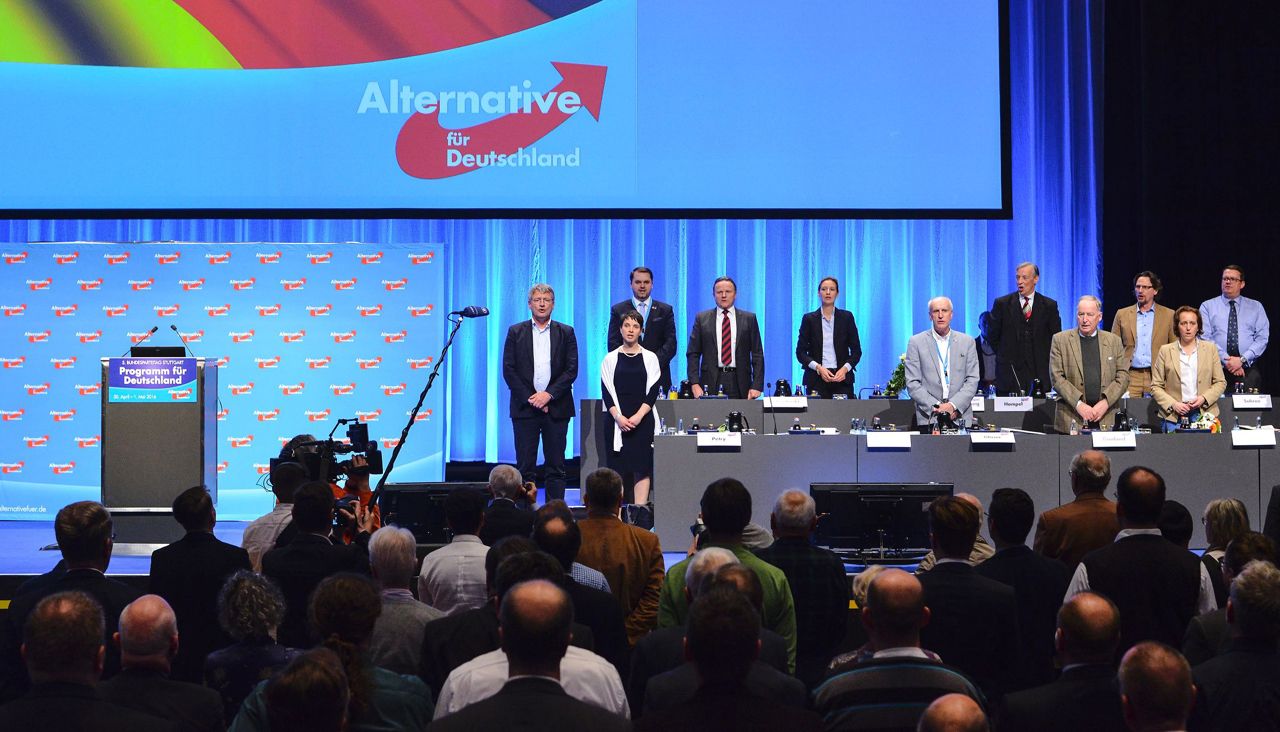
The German Federal Service for the Protection of the Constitution (SZK) began to study the “grounds for investigating” the “alternatives for Germany” (ADG). This is the first case in the post -war history of Germany, when a political force is subjected to verification of such a high level, which was elected simultaneously in the Bundestag and in all regional parliaments. Previously, such a check affected several members of the most radical party of the opposite flank - the “left”, but not the organization as a whole. The youth department of the ADG, as well as the King faction, uniting the most radical party members, are declared “suspicious”.
According to the chief of the department Thomas Haldenwang, at his disposal "there is the first serious confirmation that the ADG policy is directed against the democratic constitutional order." According to him, the statements of individual party members and some party functionaries are offensive to human dignity. The official mentioned nationalism, Islamophobia, intolerance to various ethnic and other minorities. The conclusion was 450 pages.
The German press writes that by his decision the head of the special services entered his name in history
Haldenwang led the SZK only in November 2018, but, as the Tagesspiegel newspaper writes, “he has already entered his name in history,” because he did the fact that “it was impossible to imagine half a year ago.” His predecessor Hans-George Maasen was suspected of sympathies to the ultra-right. He was dismissed after a large scandal that began when he doubted that the right -wing radicals had a hunt for immigrants during mass performances in the city of Hemnitsa, who followed the killing of a German in a mass fight. Before his appointment, Haldenwang was deputy Maasen.
At a press conference in Berlin, the head of the special services noted that the certificates “are not enough to verify using special tools”. The agency will not receive access to closed intra -party documentation, working correspondence and personal data of ADG members, and will also not have the right to introduce its own agents into its ranks.
The phones of some members of the ADG will be listened to, their mail will be able to read
The restrictions for investigators, however, do not concern the "youth alternative", as well as the "wing", which are recognized as "suspicious". The first Haldenwang accused of "indefinition of immigrants" because of the characteristics like "lovers of stabbing" and "obsessed with testosterone." According to him, the young members of the ADG regularly show disrespect for the exclusive law of the state for violence and its legal justification. As journalists note, saying this, the official did not hide indignation.
The leaders of the radical “wing” are accused of approximately the same, as well as “constant attempts to incite the crimes of Nazism”. The leader of this faction, the former school teacher from Thuringia, Bjorn Hawke, in particular, called the monument in memory of the victims of the Holocaust in Berlin, the “monument to shame”, saying that he was not in the very center of the capital of the country.
The other participants in the “wing” have long been opened by dossier due to membership in neo-Nazi organizations. Someone is suspected of "spreading Hitler's portraits and attempts to discredit the process over the" National Socialist Union "-a terrorist group responsible for 10 murders. Among the suspects, Frank Magnitz is a member of the ADG from Bremen, who was brutally beaten on January 11. The party believes that he became a victim of “red-green haters”, but officially this version is not confirmed .
In relation to members of these groups, special services can apply the entire arsenal of “spy” means, including, for example, the introduction of agents, wiretap and access to mail. Since many of the “wing” functionaries, as well as the “youth alternative”, actively participate in the work of the party as a whole, it will largely also be under control.
Some politicians started talking about a possible ban on the party. But this is unlikely
The leaders of the ADG called the decision of the special services “political persecution”, noting, in particular, that they themselves are actively engaged in the cleansing of their own rows from former radicals and extremists. At the same time, most German politicians, as well as journalists, on the contrary, approved the decision of the SZK. They believe that there are no political motives in it, because, otherwise, the special services could have long gone to such pressure on the party. At the same time, less than a year ago, officials found no reason to investigate. Therefore, journalists of the German television company NTV believe, the reason for the audit is exclusively in radicalization of the ADG itself.
Some analysts, however, believe that with right -wing radicals it would be worth fighting in a parliamentary field. On the other hand, the hopes are also openly expressed that in the end it will come to the ban on the party. It is extremely difficult to do this in accordance with German law. Throughout the history of the post-war Germany, only two political forces were prohibited-the socialist imperial party, the direct heiress of the Nazi, and the Communist Party-both back in the 1950s. In recent decades, attempts have been made several times to eliminate the National Democratic Party, which is considered the most radical of the legally acting, but the German Constitutional Court denied this. The only thing you managed to do is to deprive the batch of state funding.
At the end of May 2019, elections in the European Parliament were scheduled, and in the fall - in local legislative meetings, mainly in the east of Germany. Everywhere, ADG, according to surveys, should increase its representation. On the one hand, the audit begun by the special services can identify the negative facts related to the activity of the ADG. On the other hand, according to German journalists, in the eastern lands this can only strengthen its image of a “persecuted” political force.
Dmitry Kartsev