
Translated material
Memory. Pavel Florensky
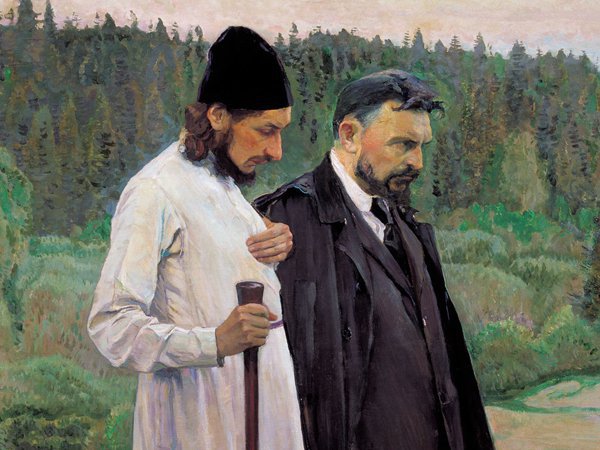
On January 21, 1882, Pavel Florensky, a religious philosopher and scientist, was born.
Personal business
Pavel Alexandrovich Florensky (1882-1937) was born in the town of Elizabethpol province (now Azerbaijan). Father Alexander Ivanovich Florensky, despite the fact that his family came from the Russian clergy, himself was a secular educated person who lost his connection with the church. He worked as an engineer on the construction of the Transcaucasian Railway. Mother - Olga (Saloma) Pavlovna Saparova belonged to the old and noble family of the Karabakh Armenians. Paul had two brothers and four sisters. The family was loved to read Pushkin, Lermontov, Dickens, Shakespeare, Goethe. They listened with enthusiasm for the music of Bach, Haydn, Mozart, Beethoven, Romances of Schubert and Glinka. “Only this is real music,” has been fixed in me since childhood, ”Florensky recalled.
The family developed a very specific religious situation: his father belonged to the Russian Orthodox Church, and his mother-to the Armenian-Grigorian Church, in connection with which, in order to avoid conflicts, religious and church issues were not raised and were not discussed. As Florensky himself recalled, "we have never said a word about religion, neither for, nor against, nor even narrative."
The boy found the exceptional abilities for mathematics very early. During his studies at the 2nd Tiflis gymnasium, he became interested in physics, geology, astronomy, mathematics, foreign languages. He started the notebooks “Experimental Research” (as Faraday did) and brought observations on nature, geological, mineralogical and archaeological information, his experiments and thoughts. He independently studied the laws of Newton, theories of relativity and magnetism, while he himself made tools and devices for experiments.
After graduating from a gymnasium with a gold medal, Florensky in 1899 entered the Physics and Mathematics Department of Moscow University. Even in the years of student, his interests cover philosophy, religion, art, folklore. He enters the circle of young participants in the symbolist movement, makes friendship with Andrei Bely, and through him with Bryusov, Blok, Balmont, Merezhkovsky and Hippius. In student times, the first scientific works of Florensky appear - “On the symbols of infinity” (1904) and “On one prerequisite of the worldview” (1904), published in the symbolistic magazines “New Way” (No. 9, 1904) and “Libra” (No. 9, 1904) - work, simultaneously affecting both the philosophical and scientific - mathematical spheres of knowledge whose unification will become united One of the most important principles of the unified philosophical system built by him in the future.
Despite the fact that Florensky was brought up outside the religious tradition, in his youth under the influence of Lev Tolstoy's articles he had an interest in Christianity. In his student years, he became interested in the teaching of Vladimir Solovyov and Archimandrite Serapion (Mashkina). As a result, at the end of the university, Florensky rejected the proposal to stay at the department of mathematics, and entered the Moscow Theological Academy.
During the period of study at the Academy, Florensky takes an active part in the activities of the “Christian Brotherhood of the struggle” - together with V.F. Ernom, A. V. Yelchaninov, V. A. Suntitsky, S. N. Bulgakov, A. Volzhsky, I. Brikhnichev. In March 1906, in the temple of the Moscow Theological Academy, he pronounces the text of the “Blood of the Blood”, in which he condemns the death sentence to Lieutenant P.P. Schmidt and the unleashing of mutual bloodshed. For this sermon, Florensky was arrested and briefly imprisoned in the Tagan prison.
While studying at the Theological Academy, he has the plan of the book “On Spiritual Truth. The experience of Orthodox Theodica ”is capital labor, most of which he completes by the end of training in 1908. This work became his master's thesis. In it, in particular, on the basis of linguistic research, Florensky deduces the Russian word “truth” from the verb “there is”: “Truth -Testine”. Then he builds the verb “eat” to the verb “breathing” and comes to the conclusion that truth is a “living creature”. Understanding the translations of the word “truth” into different languages, Florensky notes that the Slavs perceive the truth ontologically, the Hellenes are epistemologically, the Romans are legally, and the Jews are historically, which reflects the four aspects of truth.
The first publications of the book were published in 1908 and in 1912; The dissertation defended in 1914 was published in augmented form. Subsequently, it was transformed into a treatise “Pillar and affirmation of truth. Experience of Orthodox Theodics ”(1924). Labor was approved by the church-educational administration. This work of Florensky was immediately perceived as a significant literary and spiritual phenomenon, and caused numerous responses and polemic-from enthusiastic recognition to rather strict criticism. He was awarded to her prestigious Makariyevsky Prize.
In 1910, Florensky married Anna Mikhailovna Giacintova - a girl from the Ryazan province, who studied at Moscow female courses. After graduating from the Academy, Florensky remains in her as a teacher of philosophical disciplines, and in 1911 he accepts the priesthood. In 1912, he was appointed editor of the Academic Journal "Theological Bulletin".
Since the same 1912, he began to serve in the Church of the shelters of the sisters of the mercy of the Red Cross in the Sergiev Posad.
In these years, Florensky actively communicates and collaborates with the brightest representatives of the “Silver Age” era, including S. N. N. Bulgakov, V.F. Ern, E. N. Trubetskoy, M. A. Novoselov, V.V. Rozanov, F. D. Samarin, L. A. Tikhomirov, A.F. Losev; He takes an active part in the work of Moscow philosophical Orthodox circles - “Society for the memory of Vl.S. Solovyov” and “a circle of looking for Christian education”, better known as the “Novoselovsky circle”.
Florensky perceived the revolution as evidence of the approach of the Apocalypse and in this sense metaphysically welcomed it, but philosophically and politically, he was increasingly inclined to theocratic monarchism. At this time, he gets closer to Vasily Rozanov and becomes his confessor, demanding a renunciation of all heretical works. Rozanov called him "Pascal of our time" and "leader of the young Moscow Slavophilism."
When the Soviet government began to take away its property from the church, Florensky tried to act in defense of key Orthodox churches, including the Trinity-Sergius Lavra. He tried to convince the authorities that Lavra is the greatest spiritual value and cannot be preserved as a dead museum. Florensky entered a commission engaged in the protection of art monuments to the Trinity-Sergius Lavra. He holds the position of the scientific secretary of the commission, becomes the main keeper of the sacristy of Lavra, and also develops a special methodology for aesthetic analysis and description of ancient art. Thanks to the work of the commission, which included several more eminent priests and experts in culture, a huge fund of the artifacts of the monastery was described. The commission also did not allow the national and church treasure stored in the Lavra.
Despite the hardships caused by the revolution and the civil war, Florensky continued to write new theoretical works. In 1918, he graduated from the Essays on the philosophy of the cult, in 1922-the “iconostasis”. The last work was written due to the fact that in the early 1920s a campaign began in the country to destroy icons and opening relics. Florensky tried to resist this barbarism. In the work “Iconostas”, dedicated to the deep metaphysical and ontological content of the icon, he described in detail the spiritual connection between the relics and icons. Similar in meaning was the publication of the “reverse prospect”. In these works, the theologian defended the general cultural superiority of icon painting over secular painting.
In 1921, the Church of the Shelter of the Sisters of Mercy of the Red Cross in the Sergiev Posad, in which Florensky served, was closed.
Florensky, who had a physical and mathematical education, becomes an employee of several Soviet research institutions and makes a number of serious scientific discoveries. In 1920, in connection with the Goerlo plan, he was involved in research work in the Glavelectro Supervisor System, where he became a senior researcher at the USSR Electrification Committee and a member of the Carbolic Commission of the Supreme Economic Council.
In 1921, he was elected a professor at the highest artistic and technical workshops (VKhutemas) according to the department “Analysis of space in artistic works” at the Faculty of Permot and Grandum, where he lectured on the theory of prospects from 1921 to 1927.
In 1924, Florensky issued the fundamental scientific work of “dielectrics and their technical use”, which has important scientific significance, and since 1927 it has become the editor -in -chief of the “technical encyclopedia”, for which about 150 of its own articles prepares. His scientific activity was supported by Leo Trotsky , which perhaps played a fatal role in the fate of Florensky.
In the same period, he writes the books “Expliance in Geometry” and “The Water Water Thoughts”.
The scientific and philosophical work of “imagination in geometry” with his own illustrations Florensky publishes at his own expense in 1922. In this book, with the help of mathematical methods, he tries to explain the structure of the world and its philosophical substantiation. The study is aimed at solving not so much mathematical as worldview problems. Referring to Dante's Divine Comedy, Florensky is trying to refute Copernicus heliocentric ideas about the structure of the solar system and confirm the geocentric picture of the world in which the sun and planets turn around the Earth. Commenting on the special theory of Einstein's relativity, he concludes that the non -physical “that light” begins outside the limit of the speed of light. After the release of this book, Florensky was severely criticized, in particular for the fact that he “in the wrong way” interprets the theory of relativity.
From the first years of the revolution, denunciations were written in Florensky. Back in 1918-1920, during work in the “Commission for the Protection of Monuments” of the Trinity-Sergius Lavra, they tried to teach his activities as a counter-revolutionary attempt to create a powerful Orthodox center. During work in VKhUTEMAS, he was accused of creating a mystical and idealistic coalition with V. A. Favorsky. Also, the philosopher was accused of creating a forbidden monarchist circle.
In 1928, in the Sergiev Posad, after a series of publications, denouncing the dominance of the “Black Socialists near Moscow”, a large -scale operation was carried out to arrest most of priests and laity, including Pavel Florensky. Without the charges, he was sent to Nizhny Novgorod, where he conducts scientific work in a local radio laboratory. Soon, thanks to the troubles of the wife of Maxim Gorky Ekaterina Peshkova, he is returned from exile and give the opportunity to emigrate to Prague, but Florensky decides to stay in Russia. He continues to work in GEEI, and then becomes an assistant to the director of the All -Union Electrotechnical Institute for the Scientific part.
In the early 1930s, a campaign in the Soviet press with articles of a devastating and informational nature was unleashed against Father Paul. Throughout all the post -revolutionary years, Florensky not only never refused his religious beliefs, but also did not take off his priestly dignity and went in a cassock. In this regard, the phrase of V. Mayakovsky "in Vhutemas Florensky in the cassock" became winged.
On February 26, 1933, he was arrested and after 5 months was sentenced to 10 years of forced labor camps under the 58th article, paragraphs 10 and 11-“propaganda or agitation containing a call to overthrow, undermine or weaken the Soviet regime ... as well as the distribution or production of literature of the same content”.
Florensky was transferred to the Far East to the East Siberian camp "Free" and is determined to work in the research department of the Bamlag Office. In 1934, he was sent to Skovorodino to an experimental permafrost research station, where he conducted a number of most important research, which later formed the basis of labor “eternal permafrost and construction on it”. In the fall of 1934, Florensky was transferred to the Solovetsky special purpose camp, where he continued to conduct scientific work at the iodine industry camp, in the laboratory of which he was engaged in the development of technology for the production and production of iodine and agar-agar from seaweed and patented more than ten scientific discoveries and inventions.
On Solovki, Florensky spent three years. In November 1937, he was taken to Leningrad, where on November 25 the special three NKVD of the Leningrad Region was sentenced to the highest degree of punishment and executed.
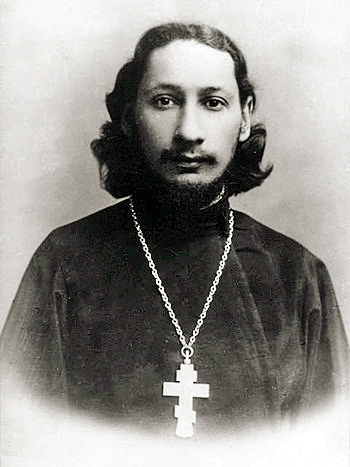 Pavel Florensky Bogoslov.ru/wicimedia Commons
What is famous
Pavel Florensky is one of the most outstanding representatives of the domestic theological, philosophical and scientific thought of the beginning of the 20th century - the era of the Silver Age. Contemporaries called him “Russian Leonardo da Vinci”-he was a master of theology, a professor of philosophy, a professor of painting, a mathematician, physicist, an electronic engineer, an astronomer, a chemist, as well as an art historian, a poet and a musician. In addition to theological and philosophical works, Florensky left behind the works of engineering, physics, mathematics and other sciences.
However, it is most known precisely as the theologian. His work “Pillar and affirmation of truth. The experience of Orthodox Theodica ”is considered one of the most serious and famous philosophical and God-word works of Russian philosophy of the 20th century.
“During the years of Soviet power, the church was so isolated and destroyed that it actually became the church of grandmothers. The intelligentsia was infinitely far from religious searches and due to the conjunctural considerations, and by virtue of education. One of the few books that connected the intelligentsia and the church was the composition of P. A. Florensky "Pillar and the affirmation of truth." I know the whole generation - my generation and a little older - which Florensky led to the church. In this sense, he played a very large role in the 1950-1960s and became a symbol of an educated, enlightened priest, ”writes his grandson, doctor of geological and mineralogical sciences, Professor Pavel Vasilievich Florensky.
Weight and contribution of Florensky to science. The analysis of its spatiality in artistic works has become widespread. His "iconostasis" walked in the hands of Samizdat. It is alleged that his concept of “reverse perspective” was transformed by Soviet art history. And the natural-scientific work of the Florensky “dielectrics and their technical use” was devoted to the study of semiconductors.
What you need to know about
Nikolai Berdyaev called Paul Florensky "a refined reactionary."
In 1913, the so-called “Beilis process” was held in Kyiv-on the falsified charges of Jew Menacham Mendel Beilis of the ritual murder of a Christian boy-a 12-year-old student of the Kiev-Sofia Theological School of Andrei Yushchinsky. Florensky greatly interested this scandalous process. Without doubting the existence of the practice of ritual murders among the Jews, he published anonymous articles on the truth of the accusation and the reality of the use of Christian babies by Jews. In particular, he sent V.V. Rozanov for anonymous publication of the article “Prof. D.A. Khvolson about ritual murders ”and“ Jews and the fate of Christians ”. At the same time, the views of Florensky evolved from Christian anti -Judaism to racial anti -Semitism. In his opinion, “even an insignificant drop of Jewish blood” is enough to cause “typically Jewish” bodily and spiritual features in whole subsequent generations.
In March 1933, being in Butyr Prison, Florensky wrote the work “The alleged state system in the future” - anti -individualistic utopia in the traditions of the “state” of Plato and the “City of the Sun” Campanella. In it, he deduced his ideal of Russian statehood. Florensky represented it in the form of a pyramid, rigidly controlled from above.
The ideal “state of the future” from the point of view of Florensky is a totalitarian dictatorship with the organization and control system, completely isolated from the outside world. This state requires its citizens devotion, subordination and service to the "whole", taking care that the aspirations and needs of the new person (bred taking into account the laws of the Eugenics) are in accordance with the needs of society. Individual human rights in this case are abolished as obsolete. At the top of the power pyramid, a leader set by the sky himself will stand, whom Florensky represents as a brilliant and charismatic superman: “As a surrogate of such a person as a transitional stage of history, figures like Mussolini, Hitler, etc. Historically, their appearance is advisable, because it weanes the masses from the democratic image of thinking, from party, parliamentary and parliamentary and parliamentary. Similar prejudices, because it gives a hint how much will do a lot. But there is still no genuine creativity in these faces, and, we must think, they are only the first attempts of humanity to give rise to a hero. Будущий строй нашей страны ждет того, кто, обладая интуицией и волей, не побоялся бы открыто порвать с путами представительства, партийности, избирательных прав и прочего и отдался бы влекущей его цели. Все права на власть <...> избирательные (по назначению) — старая ветошь, которой место в крематории. To create a new system, which must discover a new period of history and the corresponding new culture, there is one right - the power of genius, the power to create this system. Право это одно только не человеческого происхождения и потому заслуживает названия Божественного. И как бы ни назывался подобный творец культуры — диктатором, правителем, императором или как-нибудь иначе, мы будем считать его истинным самодержцем и подчиняться ему не из страха, а в силу трепетного сознания, что пред нами чудо и живое явление творческой мощи человечества»
Direct speech
О религии (1933 год): «Православная Церковь в своем теперешнем виде существовать не может и неминуемо разложится окончательно. Как поддержка, так и борьба против нее приведут к укреплению тех устоев, которым время уйти в прошлое, и, кроме того, задержит рост молодых побегов, которые вырастут там, где их менее всего ждут… Когда религию навязывают, от нее отворачиваются, потому что для восприятия предметов религии требуются соответственные условия. А когда религии не будет, тогда начнут тосковать. Тогда выживут не старые и безжизненные религии, а вопль изголодавшихся духом, которые сами без понукания и зазывания создадут свою религиозную организацию. Это будет лет через 10–15».
О вере: «Я научился благодушию, когда твердо узнал, что жизнь и каждого из нас, и народов, и человечества ведется Благою Волею, так что не следует беспокоиться ни о чем, помимо задач сегодняшнего дня».
Сергий Булгаков о Павле Флоренском : «О. Павел был для меня не только явление гениальности, но и произведение искусства: так был гармоничен и прекрасен его образ … Самое основное впечатление от о. Павла было впечатление силы. И этой силой была некая первозданность гениальной личности… Духовным же центром его личности, тем солнцем, которым освещались все его дары, было его священство. Настоящее творчество о. Павла — не книги, но он сам, вся его жизнь, которая ушла безвозвратно из этого века в будущий»
5 фактов о Павле Флоренском
- Один из братьев Флоренского, Андрей, стал конструктором вооружений и лауреатом Сталинской премии.
- В 1918 году отец Павел участвовал в изъятии от святых мощей честной главы Преподобного Сергия Радонежского и осуществлял ее дальнейшее сокрытие ради сохранения от возможного надругательства. Как стало известно много лет спустя, на протяжении долгих лет место укрытия главы сохранялось различными священниками, и лишь в 1946 году, уже после открытия Лавры и возвращения Мощей Преподобного монастырю, честная глава была передана Святейшему Патриарху Алексию I, который и благословил возложить ее на место - в раку Святого Преподобного Сергия.
- В 1934 году, когда Флоренский уже был в лагерях, поступило ходатайство правительства Чехословакии о его освобождении и переезде с семьей в Чехословакию, но это прошение правительство СССР отклонило.
- Семье Флоренского сообщили фальшивую дату смерти, которая была также указана в «Большой советской энциклопедии» – 15 декабря 1943 года. На самом деле отец Павел был расстрелян в числе одного из Соловецких этапов (509 человек) 8 декабря 1937 года. Большинство исследователей считают наиболее вероятным местом его погребения Левашовскую пустошь - ныне Левашовское мемориальное кладбище, место захоронения многих тысяч жертв сталинских репрессий. По оценкам экспертов здесь захоронены тела 40 тысяч человек.
- У Павла Флоренского было пять детей, двенадцать внуков и двадцать четыре правнука.
Материалы о Павле Флоренском:
Богословы России. Pavel Florensky
Путь «Утверждения Истины» священника Павла Флоренского
К годовщине расстрела Флоренского
«Новое Средневековье» Павла Флоренского
Статья о Павле Флоренском в Википедии