
Translated material
"Without a fight, Maduro will not give power"
Researcher of Latin America Tatyana Rusakova - about why the riots in Venezuela arose right now and whether Russia can intervene in them
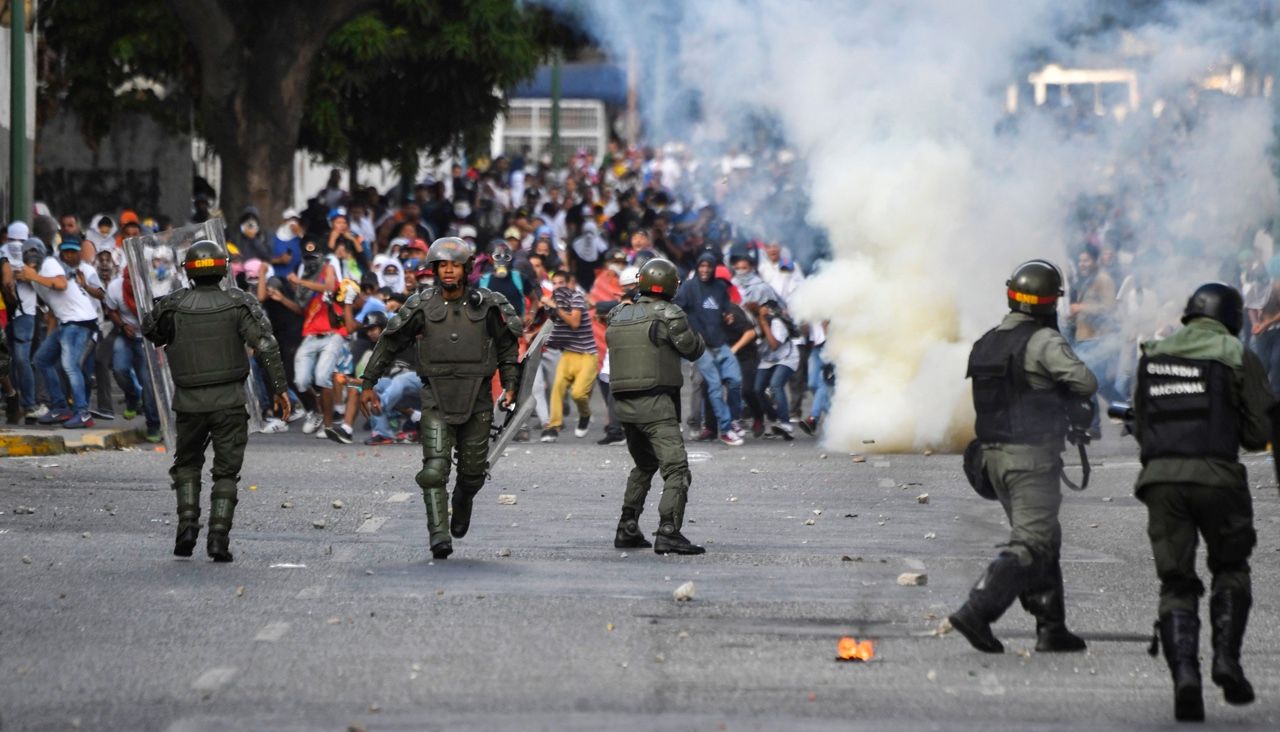
In Venezuela, a civil conflict and dual power continues for several days that arose after the country's parliament declared illegitimate President Nicholas Maduro, and appointed his chairman Juan Guydo. The candidate of political sciences, a researcher at the Center for the Study of Crisis Societies Tatyana Rusakova told Medusa about whether Maduro could stay in power after his enemy was recognized by the United States and Latin American countries.
- The Russian Foreign Ministry supported Nicholas Maduro and hinted that the events in Venezuela were organized by the United States. The Americans are really involved in this?
- It is difficult to talk about direct American participation. But how quickly, almost instantly, the United States and members of the Lima Group recognized Juan Guydo as a legitimate temporary president, suggests that the opposition did some preparatory work. She for a very long time searched for the least painful ways of transition of power from Nicholas Maduro, and, of course, some negotiations were held. I would not talk about influence, but about the coordination of actions. And rather, on the initiative from the inside, and not outside.
- In many of the Latin American countries that you mentioned, in recent years the right leaders defeated the left -wing politicians. Can they stand behind the struggle against the socialist regime of Maduro?
-The fact that the political pendulum has a lot of where in Latin America swayed to the right is, in my opinion, still a coincidence in time. Venezuela went to this crisis for a very long time, without any help from foreign right.
Moreover, this, rather, Venezuelan politics affects neighboring countries and makes them support a change of power. Because the problems of Venezuela became so serious that they affected them too. The huge waves of people running from Venezuela from hunger and disorder are the first to revenge to the border states of Brazil, to Ecuador, to Columbia - to those countries where the fugitives manage to break through. There, too, social tension and political dissatisfaction are growing there, because small border cities cannot cope with such a stream of desperate, poor people who have nowhere to go. You need to do something with them, but no one knows.
- It turns out that internal factors are significantly more important?
- Yes, and the first signs of problems in the socialist project arose, even when Hugo Chavez was alive, nothing was yet known about his illness, and the left turn experienced golden times. Chavez did a lot for the poor layers, gave them large subsidies, created social programs. Then the oil was expensive, and it was possible to spend income from its sale on “social missions”, as he called them. Housing was built. People were treated. Citizens were put into daily policy, creating communal advice. The government suggested that citizens would directly participate in political life, solve their issues themselves and thereby help the authorities. At one time it even worked there.
But even then it was clear that this is a dead end of distribution: production was not created, the percentage of imports increased all the time. Even the fact that Venezuela had previously produced herself now imports, because it was during the period of the largest heyday that many industries were destroyed. In addition, Chavez was sure that private companies, including foreign ones, were setting “unfair” prices, introduced its “right” ones. But the business does not really want to trade at a loss, and then either curtailed or stopped supplying certain products. Thus there was a shortage. You can’t do this.
Now the problems there are very serious, and they concern all the spheres of life. Inflation - several thousand percent. The crime rate is comparable to the countries that are involved in military conflicts: about 130 killed for 100 thousand people - the figure is as if there was a small war. A terrifying level of healthcare due to a lack of medicines. Venezuela even ceased to publish statistics on children's mortality, because among children under five years she grew up very much. Due to the lack of products, they are very exhausted, any infection kills them.
- Then why did everything flare up only now?
- I think that the opposition was just waiting for the moment to tell the world that she has a temporary president, more legitimate than Maduro. The fact is that the last large riots occurred in Venezuela in 2017. Then the opposition tried to take the regime, as they say, by great. From March 29 to July, daily, not missing a single day, they just peacefully went outside with posters. They hoped that either Maduro would surrender, or the world community would demand that he leave. This strategy was unsuccessful, they were dispersed .
But, when this happened, Maduro, instead of correcting economic miscalculations, decided to simply rewrite the 1999 Constitution. However, Chavez claimed his constitution with the help of a referendum, that is, he asked the consent of citizens, and Maduro did this simply by a presidential decree.
The world community really did not like this, and as a result we have what we have. A lot of countries do not recognize Maduro legally re -elected president for a second term. They just consider legitimate power the national assembly - a parliament, elected in accordance with the old constitution. The opposition boycotted the presidential election because there was only one opposition candidate. And then very conditionally - the former ally of Chavez. Thus, Maduro himself gave reason to accuse himself of usurpation of power.
- Maduro - really a real dictator?
-I would not hang some unambiguous label on this regime. This is something like such a hybrid regime, because you can’t call it democracy either. Yes, elections are held there, international observers even came to the latter, however, not from the USA, European countries or from Latin America, which did not recognize them, but, for example, from Russia. But the fact is that democracy must first implies the replacement of power. And here, in fact, the power is concentrated in the hands of one person, even if this is covered by a democratic facade.
- And does he suit the repression and persecution of dissenters?
- At the moment, we can draw conclusions about the degree of cruelty of his regime only by open sources. Nobody will tell you, and Maduro himself will never admit that he ordered to beat the participants in a peaceful manifestation, provoke them, and then disperse. Naturally, no, but in Venezuela the problem is not even that. There were no special repressions under Chavez, but he began to create parallel structures of power and violence. This began after an unsuccessful attempt by the 2002 coup, when he realized that he could not completely trust the armed forces.
So the “collectivos” arose - in fact, these are armed gangs from the poor areas that they were given to them, so that they follow the order there. In practice, it was they who became, perhaps, the main source of this incredible growth of crime. Because in those areas that they were given to “feeding”, maybe order, but for others they make real raids. And so even then it was clear that Venezuela could threaten not only the economic, but also the domestic political crisis.
Only the armed forces and official law enforcement forces should remain a monopoly on violence. If parallel structures appear, then this entails both the internal political crisis and human victims, and to the fact that Western sources begin to be more willing to consider it dictatorship, even accusing the regime of crimes against humanity and massacres. Moreover, in 2017, the “collectivos” was attracted to suppress opposition performances. Their participants themselves say that their task is to “protect the revolution”, and they are ready for any scenarios.
“But everyone says that the one for whom the army will be won.” Is that so? And who will she support?
- A lot will depend on the army. And while the opposition does not manage to contact the military, although Guydo promised an amnesty to those who cross his side. While the position of the army is that Maduro is a democratically elected president. In principle, this is understandable, because the military are placed on all key posts, up to the management of the state oil company, that is, the only existing one. Nevertheless, the army did not say the last word: it does not suppress yet, it is waiting.
But even if the army suddenly crosses the side of the opposition, the “collectivos” quite actively support the Nicholas Maduro regime, because many benefits have from it, and are ready to go out into its defense.
I can say one thing: Nicholas Maduro will not give power without a fight. Venezuela has been living under sanctions since 2005, and new years are introduced every few years. He himself admitted that there was a humanitarian disaster. The isolation of the country is growing. And even this does not force him to abandon the authorities. It is very difficult to predict who will win such a situation, because there are too many nodes, and it will definitely not be painless. In any situation, there will be inevitably victims. And, by and large, if you admit this, then the only real task for both sides is to do everything in their power so that these victims are as few as possible.
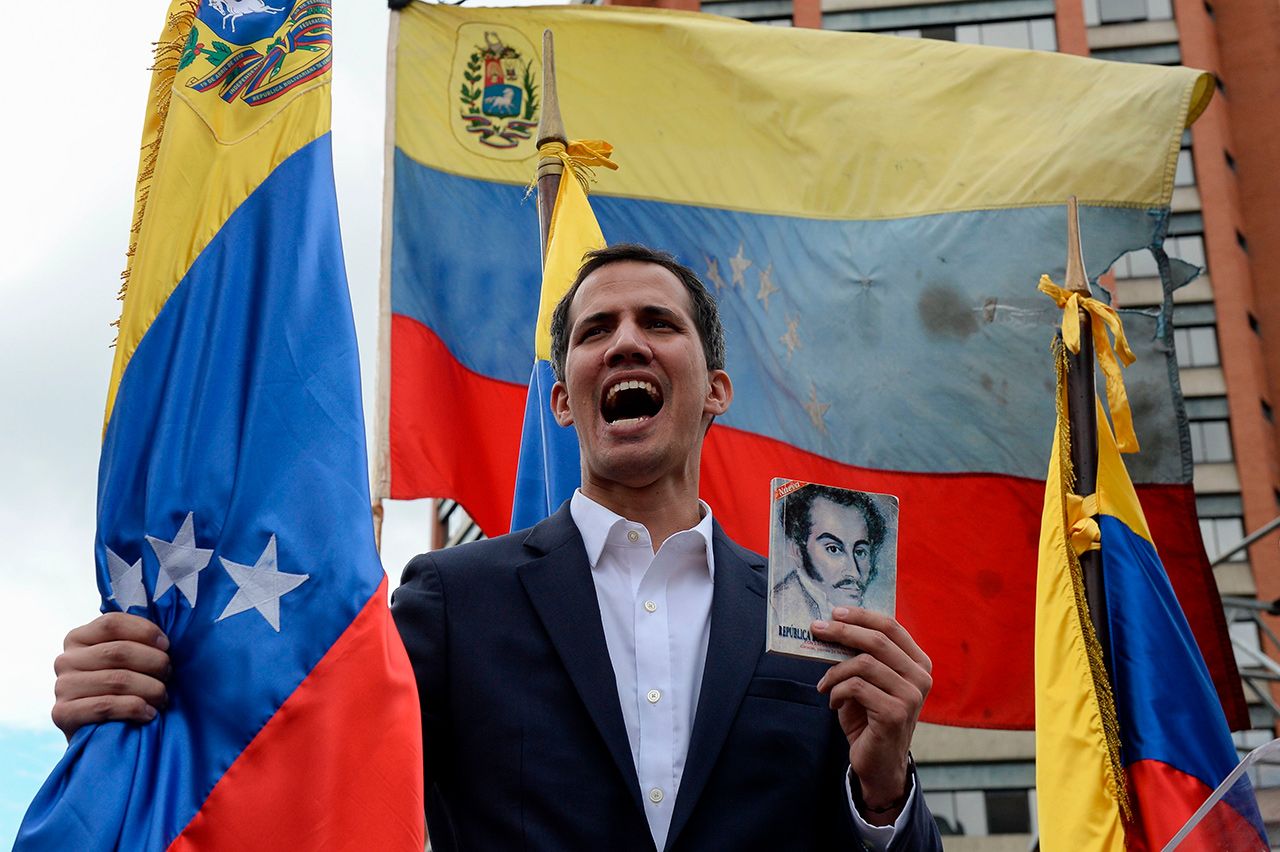
- Who is Juan Guydo, temporary president according to parliament?
- Guydo in politics for a long time, even though it has been known to anyone so far. In 2009, the opposition channel was closed, and Guydo was the leader of the student movement, which protested against the closure of this television channel and against censorship in principle. He was remembered since that time, later he studied in the USA. Promising figure: young, energetic.
The fact is that the opposition has since the time of Chavez a deficit of leaders. Even if there were any attractive figures, they all looked pretty faded compared to Chavez, which could be condemned and hated, but he left no one indifferent. After the death of Chavez, Maduro cleaned the political field and got rid of all opposition politicians. Leopoldo Lopez, also a young politician who had high hopes for, was imprisoned on charges of incitement against the authorities, then transferred under house arrest. Another oppositionist, Enrique Caprichee, is prohibited from engaging in political activities. It so happened a scorched field on which it seemed that nothing would grow up. But here appeared Guydo, who was chosen just a couple of weeks ago by the head of the National Assembly.
It is not the fact that Guydo will become a permanent president. In accordance with the constitution, he will have to hold elections within 30 days, and if popular political prisoners are released, then perhaps he will remain a temporary figure.
- Does the opposition have a clear program?
“The only task that they declare is the restoration of democracy.” Their refrain "there will be democracy - there will be investments, we will live as before." It is quite difficult to classify the opposition, because the opposition in Venezuela is a very large and wide coalition of all who are against Maduro. There are really a lot of pro -American politicians, they are tuned to rapprochement with the United States, to introduce market mechanisms and to attract foreign investments. That is, on everything that is absent in today's Venezuela, and painfully hit the economic position of the country.
Nationalization occurred, Western investors went away, new ones come reluctantly, fearing that they will invest in business, and then they will suddenly nationalize it, and maybe expropriately, as it was even under Chavez. From all this, they promise to save the country.
- How serious is Russian interests in Venezuela? And is Russia ready to intervene in the conflict on the side of Maduro?
- It is clear that we have interests there, and they are diverse: these are oil, weapons contracts, and loans that we issued to the Venezuelan government. On the one hand, this, of course, can all be at risk if the regime is replaced. On the other hand, if the contract is concluded, it is very difficult to break it unilaterally, to say "everything, no longer necessary." Fines and penalty are necessarily prescribed there, and probably they are very large. Therefore, I doubt that if it happens, Russian companies will have to leave there. This, if it happens, is gradually when other investors return when new transactions are concluded.
Venezuela opened us potential opportunities in Latin America. But it has always been much more a political project, so Maduro’s defeat will be more painful for us from an image point of view, because purely pragmatically Russia is not very profitable to cooperate with Venezuela: she puts much more than she receives. We are very far from each other (perhaps that is why we are connected by such sympathy: at such a large distance we simply cannot threaten each other). And something incredible should happen so that we get there. Or it should be someone's very powerful political will. But objectively Latin America, with all my love for the continent, is exotic, far and, frankly, not very promising for us.
- Is the US invasion on the side of the opposition is possible?
- I can say that the opposition is sharply against the entry of foreign troops into Venezuela. She wants to achieve the transfer of power exclusively by diplomatic measures. They need support from outside, but not in a rigid version. Something extraordinary must happen so that they ask to introduce other people's troops.
Dmitry Kartsev