
Translated material
What is Becketry silent about
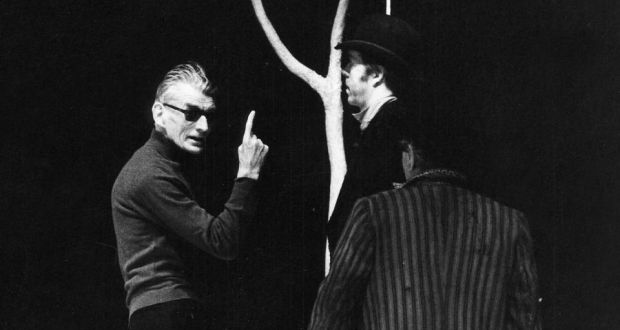
Conversation with Vladimir Gandelsman
Alexander Genis: 70 years ago, in January 1949, a play was written, which was revolutionary in the theater. In terms of influence, it can only be compared with the coup in the literature that caused the publication of the novel by another Irish, James Joyce Ulysses. Of course, I am talking about the play by Samuel Beckete “Waiting for Godo”.
Today, marking this fateful date for the entire Western culture, we - in the framework of our archival section “On the Life of the Day” - recall the conversation with Vladimir Gandelman.
Beckett was a great writer - and no less a great recluse. That is why the publication of his letters caused real excitement among fans of the writer. Today, Vladimir Gandelsman and I will make a tour of the epistolary heritage of our beloved author.
Vladimir Gandelsman: Sasha, if we had now played the play by Beckett “Waiting for Godo”, then your first replica would be a “gystical business”. If you remember the beginning of this superconscious play ...
Alexander Genis: Yes, but why, one wonders, would it be my replica, and not yours?
Vladimir Gandelsman: Because I would play the role of my namesake, more naturally, - Vladimir, and you are a stage.
Alexander Genis: Okay, agreed. In addition, the stage is also culinary, which means that I am close to me. By the way, Vagrich Bakhchanyan in connection with these names has its own Becket theory. He believes that he brought Mayakovsky near Vladimir, and under the stage - Pasternak, also a garden surname. Becket was really interested in Russia. In the 30s, he even had a nickname-“Oblomov”, as he was called by Peggy Guuggenheim, but the rest was on the conscience of Bakhchanyan. Let's get back to the play.
Vladimir Gandelsman: From the very beginning and throughout the entire first scene, the stage is trying to remove the boot, but to no avail. So he says: “A hypertension.” You know, Samuel Beckett, who mutters the constantly “gystalous business” mutters like this, is very clear to me, and he continues him steadily. I see how he plays the performance of his life, in which he, the writer, writes as if I can’t, but writes. In which the assertion itself that the text needs to be reduced to a minimum, to the disappearance (“I try to cross out as much as possible,” he spoke about his things), is absurd and mocking, because it is precisely it that continues this text, which, in his opinion, must be stopped.
Alexander Genis: And this confirmation is that thick volume of Becket letters that we are now discussing.
Vladimir Gandelsman: That's right. We add that this is also only the first Tom and that our “in anticipation of Beckett” will continue until three volumes come out. So. “Letters of Samuel Beckett (1929–1940), 800 pages, Cambridge University Press. It’s hard to believe, but evidence before us: Samuel Beckett, the most tacitable writer of the 20th century, a person who said that“ every word is an worthless violation of silence and non-being, ”he was a continuous and verbose. correspondence.
Alexander Genis: What are the first impressions?
Vladimir Gandelsman: Becket letters are not only gentle and cordial, but often very piquant, sometimes rude, sarcastically witty and obscene - and this is the biggest surprise. The letters were sent from different cities: Paris, Dublin, London, Dresden-from everywhere where Becket lived (and he lived for a long time-he was born in 1906 and died in 1989). He often visited the only one and lonely, but there were many friends, including James Joyce, Peggy Huggenheim, artist Jack Batler Yates, brother of William ... Letters connected Beckett with the world. He responded perfectly politely and neatly to almost every letter, ending “always yours”, “all the best” or “God bless you”. Sometimes just “Sam”. Preparation of Beckett's letters for publication is a difficult task. He wrote them in three languages: English, French and German - and they are teeming with neologisms and puns on a mixture of all languages. In addition, according to the expert, he had the worst handwriting in the 20th century, when compared with all the authors in the world. The surprise was the fact that 4 years before his death, Becketted their publication. And he accompanied the sanction with an aphoristic mark: “To print only those letters that are related to my work.”
Alexander Genis: Theoretically, it is clear what he had in mind, but what does this mean in practice? There is no Beckett, to whom to determine?
Vladimir Gandelsman: Naturally, the editors considered that almost everything is related to his work. Nevertheless, these are more selected places from correspondence than a complete meeting. Beckett also asked the editors to do without comment. To which they answered-albeit without comment, but the context should be-the background on which the correspondence occurs. As a result of the context, sometimes it turned out more than the text.
Alexander Genis: Volodya, everyone knows the literary achievements of Beckett, he is a 1969 Nobel laureate, his things became fundamental for the 20th century literature, for the theater of absurdity and so on. And this is not about today. It's about letters. Let’s root in the published correspondence to give examples of what was a surprise: some of his aphorisms, sarcastic or rude remarks found in letters.
Vladimir Gandelsman: Of course. He was very alive, after all, the Irishman, we will not forget about it. He writes in one of the letters: “Miss Costello told me:“ You won’t hear a good word from you except losers. ”Becket adds:“ I think this is the best that is said about me over the past hundred years. ”
Alexander Genis: This could be said about Dovlatov. And he would like Beckett's answer. By the way, they had a common literary agent in America. But, we will continue the tour by letters.
Vladimir Gandelsman: His aesthetic views are always interesting. “The ballet bothers me because the music plays an auxiliary role in it.” Or: “Serious music has no practical purpose.” His negative judgments are so funny and charming that it is impossible to get rid of the impression of some kind of played out. The leitmotif of his early letters, figuratively speaking, this is a “gystal business” from which we started a conversation. He seems to be practiced in nothing. Nothing happens. I can't write. And in the future - a lot about health. About heartbeat, cyst in the throat, about bouts of depression. Another quote: “I am in such a depression, which can only be a head of cabbage (it would seem that you can stop, already expressively, but Becket continues), extended by slugs.”
Alexander Genis: At the same time, women loved this head. He enjoyed great success with the ladies.
Vladimir Gandelsman: He is very handsome.
Alexander Genis: No wonder Brodsky said that he would dream of being like Beckett in old age.
Vladimir Gandelsman: Please note that a lot of his photographs have been preserved. Here is not an unconnected, modest, and how many photographs!
Alexander Genis: Because he had a face like a geographical map, - Brodsky also said. And love letters?
Vladimir Gandelsman: Alas (or thank God), there are no letters regarding love affairs. So lovers of strawberries have nothing to do here. There are many, I repeat, funny and absurd. In one of the letters, for example, he expresses the desire to be a pilot on commercial flights, imagining the inscription on board the Air Beckett aircraft. In another letter, he turns to Eisenstein with a request to accept him at the Moscow Institute of Cinematography. He, in the past, was very drunk, pulled to Russia.
Alexander Genis: Rather, to Eisenstein. After all, Joyce was a hot fan of the director. He watched “Potemkikn” close to the screen, the last edge of an sighted eye. By the way, there is something about Joyce, because Becket was his secretary and enthusiastic reader, although he was writing in a writer's multiple experience of Joyce. Where Joyce has a plus, Beckett is a minus.
Vladimir Gandelsman: One mention is very funny. Becket helped Joyce in his work on the “Finnegan Wakes”. So Joyce flickers in the correspondence - here and here. Here is a quote: “Joyce paid me 250 francs for 15 hours of work on the correction.” And he adds: “Then he reimbursed the underpayment with an old coat and five ties. I did not refuse. It is easier to be wounded than wounded.” Like this. Of course, our conversation today is a little frivolous. But Tom is written about the work of Beckett, but the conversation only begins about his letters.
Alexander Genis: What is the point for you in writing letters?
Vladimir Gandelsman: You know, Vasily Rozanov said that over time, literary criticism will all be reduced to unraveling the personality of the author and authors. And then the letters of the authors, posthumously collected and printed, will gain unusual interest, significance and attractiveness.
Alexander Genis: He said that the author’s works are what he wanted to seem, and his letters are that he is.
Vladimir Gandelsman: Here I do not agree. I think that Beckett in letters has been a player. And in creativity - on the contrary, he was extremely frank and unusually deep. But this is another conversation. You know, when Beckete received Nobel, he thanked the Swedish Academy for his honor, but did not go to the ceremony and hid from persistent fans. One of the fans, however, moved him: a Parisian named Jacques Gododo sent a letter to the writer with an apology, which made him wait a long time. And I won’t be surprised if in the 4th volume of the meeting of letters, in the latest letter of Beckett, we will find an appeal to us, readers of his letters: “Sorry to make you wait long. Always yours, Becket”.