
Translated material
Low tax fairy tale
Two -thirds of the consolidated budget revenues provide not subsoil, but citizens
The personal income tax rate of 13% of the salary, which in Russia is obliged to pay an employee with any income level, creates a harmful illusion of the autonomy of the state budget from the cash contribution of citizens. Officials willingly support this delusion, constantly emphasizing that the state takes away a penny from individuals - unlike Western countries, where the maximum income tax rate exceeds 50%. From this it is concluded that the Russians are arrogant when they demand accountability from the state in the expenditure of taxpayers.
Interestingly, recently the Russian authorities have headed to increase the financial literacy of the population. In the regions, centers for consultations of citizens are created, relevant disciplines are introduced into school programs. The deputy chairman of the Central Bank, in this regard, even suggested that the roots of financial problems are in traditional Russian culture: fairy tales about the goldfish and Ivan Durak, sitting on the furnace in anticipation of “freebies”, do not contribute to the development of labor ethics. The plot of these fairy tales, Swvetsov said, must be changed.
It is clear that the task of the authorities is to force the population to work more and more efficiently, to save themselves to retirement and in every possible way get rid of "paternalistic attitudes." But the main financial myth, which should be dispelled as soon as possible, is distributed by civil servants themselves. Every now and then they argue that the state budget of the Russian Federation is formed literally “by pike command”, namely, it is extracted by state -owned companies directly from natural subsoil, bypassing the wallets of citizens.
It is necessary to start with the fact that by world standards, Russians pay to the budget much higher than average. According to the dean of the Faculty of Economics of Moscow State University, Alexander Auzan, backed up by the PriceWaterhouseCoopers consulting company,
From each ruble we have earned, the state takes an average of 48 kopecks.
The real tax rate in Russia is higher than in the USA, and approximately corresponds to the level of Northern Europe. For comparison: in Central and Eastern Europe, the average tax burden is only 34.2%.
The peculiarity of Russian taxes is not in low rates, but in the indirect or hidden nature of payments. VAT, imported duties and excise taxes are laid in the prices of goods, and personal income tax and 30%insurance contributions formally pays the employer, although in fact they are directly deducted from the employee’s salary. Due to this design of the tax system, many people do not even realize that they spend a third of their working time in unpaid work for the state (about so much time is needed to pay for all taxes from salaries) and almost every transaction from the money earned finance the Russian budget.
After 2016, when Vladimir Putin announced a two -year moratorium on raising the tax burden, this trend only intensified:
In order not to violate the indication of the first person, officials focused on hidden taxation technologies.
The number of quasinalog payments (fees, contributions and other forms of non -reliable seizure) by 2019 grew to such an extent that in the State Duma they began to discuss the need to codify them and include them in the Tax Code.
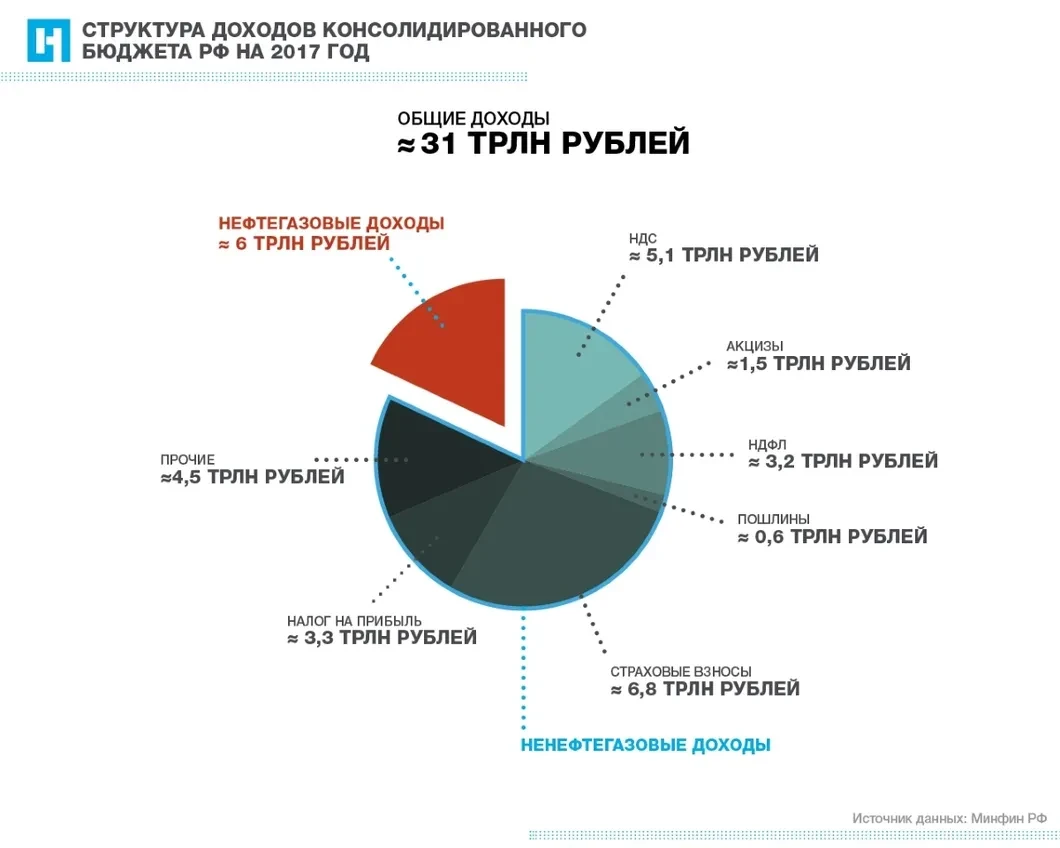
In disputes about where the state comes from, it is important to consider all levels of the budget system. In the consolidated budget for 2017 (includes the federal budget, regional budgets and contributions to compulsory social insurance), the share of oil and gas revenues amounted to less than 20%. This indicator varies depending on the global situation: as soon as oil prices fall, the share of raw materials revenues of the budget also decreases.
The authorities begin to report on the release from the “raw material needle”, with the other hand increasing the fiscal load on the population. According to the Ministry of Finance, tax exemptions in 2016 amounted to 29.2% of GDP, and by 2017 they grew to 30.8%.
It turns out that 80% of the total income of the state is not related to natural resources. 17.2 trillion (55% of the consolidated budget) is paid by citizens - in the form of VAT, specifies, personal income tax, duties and social insurance premiums. If we add to this amount property taxes, transport and income tax that the owners of private companies de facto pay, it will turn out that
Citizens are responsible for two -thirds of revenues to the budget system of Russia.
There are 4.5 trillion rubles of “other income” and 6 trillion rubles, which in the form of a tax on mining and export duties pay oil and gas companies - both state and private. But even these funds, according to the Constitution, are a national property. In order not to accidentally forget about the final owners of natural rents, developed raw materials, such as Norway, credit oil money to personal pension accounts of their citizens.
“Your taxes do not solve anything” - this is the most harmful fairy tale that causes the financial literacy of Russians much more damage than all the folklore combined. But it is unlikely that the educational campaigns of the authorities will go so far.