
Translated material
What are algorithms capable of? Machine learning opportunities
Machine Learning, ML, the head of Amazon , Jeff Bezos, laconly described : “Over the past decades, computers have automated many processes that programmers could describe through accurate rules and algorithms. Modern machine learning techniques allow us to do the same with tasks for which it is much more difficult to set clear rules. ”
Twitter taught the neural network to publish images so that the center was the most important and interesting element in the center. Apple Watch intends to recommend the playlists from iTunes who will take into account the heart rate of the owner of the gadget. Siri, Cortana or Google Now virtual assistants have long been helping in solving everyday issues, for example, which movie to watch.
The secret is simple: based on your assessments of other paintings and by comparing your preferences with the tastes of other users, the system recommends the most relevant options. These particular cases of machine learning are only one drop in the ocean of technological capabilities. What else are cars capable of?
Crisis response
Technogenic disasters, search and rescue missions, outbreaks of diseases-in such conditions you need to act as quickly as possible. The task of “smart machines” is to predict the situation, for example, the dynamics and territory of the spread of forest fires. This will allow rescue services to prepare and direct the main forces to where the help is needed most of all. In addition, the risk of error due to the human factor will decrease.
New prospects for agriculture
With the development of technology, a new model of agriculture has recently arose - accurate agriculture. Russian experts teach robots to analyze the data obtained from 2D and 3D cameras, and predict the growth of plants of any kind. At the same time, 3D images are enough to get only once, and then you can use the most ordinary cameras.
Another topic: how drones help solve environmental problems in Russia
The Belarusian Oneesoil project allows you to control the condition of plants and the work of machine operators directly from the office. Programs analyze satellite images, recognize shadows, clouds, snow, highlight the boundaries of fields with an accuracy of 5 meters, calculate the norms of fertilizers. This not only saves money (at least to maintain land), but also reduces the harmful effects on the environment.
Solving environmental problems
Already, robots help to fight the depletion of natural resources and environmental pollution. The RainForest Connection service using audio -cens (the developers called them “keepers” ) records the sounds of the forest and loads them into a cloud server in real time. And artificial intelligence analyzes the data and is looking for suspicious noises: the sounds of chainsaws and working trucks.
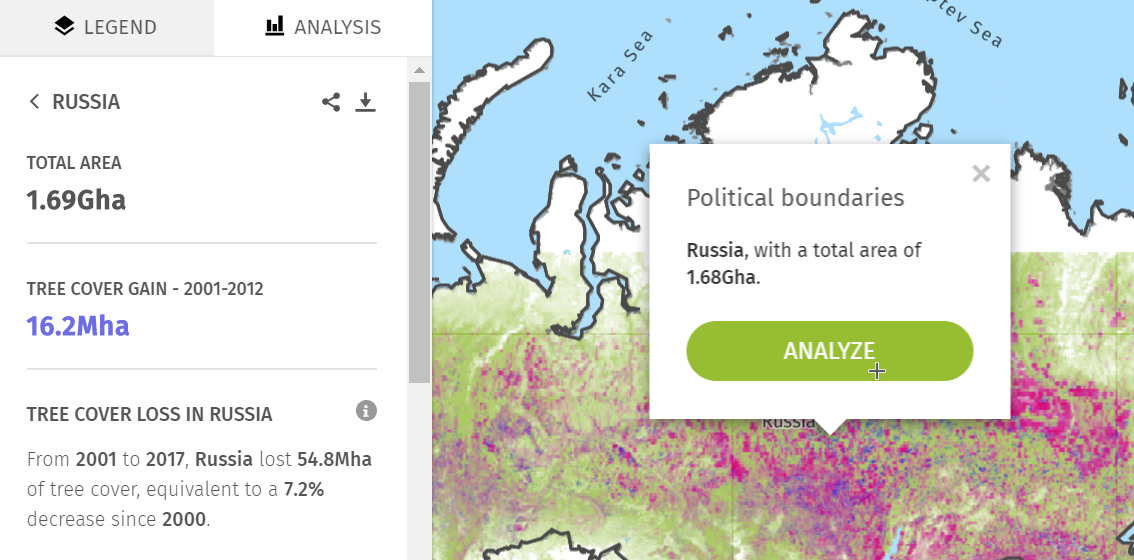
According to the expert of the civil initiatives committee , Sergei Ustinov , machine training is now most in demand in such global projects. “The Global Forest Watch service uses satellite data to track illegal deforestation. That is, cars compare the places of deforestation with permits for such work, ”says the specialist.
With the help of this service, for example, you can find out that from 2001 to 2017, Russia lost 54.8 million hectares of wood cover, which is 7.2% less than in 2000. The strongest loss of wood cover is observed in Buryatia: 16% compared to the average in the country 4.3%.
Health and medical care
IBM Watson , which the company's representatives called the "enhancer of the human natural intelligence", accelerates clinical examinations. He analyzes records from the stories of the disease of various patients and, based on successful treatment statistics, selects the most effective therapy in each particular case.
“ML technologies associated with the diagnosis of cancer, Alzheimer's disease and other diseases are now enough. These are large -scale projects and an extensive topic for study, ”comments on the founder and head of the Open City Foundation Vitaly Vlasov . - The sphere of social services of citizens is also promising. It seems to me that I need to work on expert systems. That is, there is some information at the entrance, and at the exit, on the basis of some kind of formed knowledge base, specific results. Chat bots can act, for example, in the role of virtual assistants. The same Alice station from Yandex can be adapted to the needs of the disabled. ”
City infrastructure management
Modern technologies allow you to create more comfortable and safe living conditions. The greenhouse has already written about the St. Petersburg project of the AntiddP , which became the winner of the Hakaton of Teplitsa in 2018. The service allows you to identify foci of accidents, coordinated by local residents and experts, to develop reasoned requests for changing traffic schemes in specific areas.
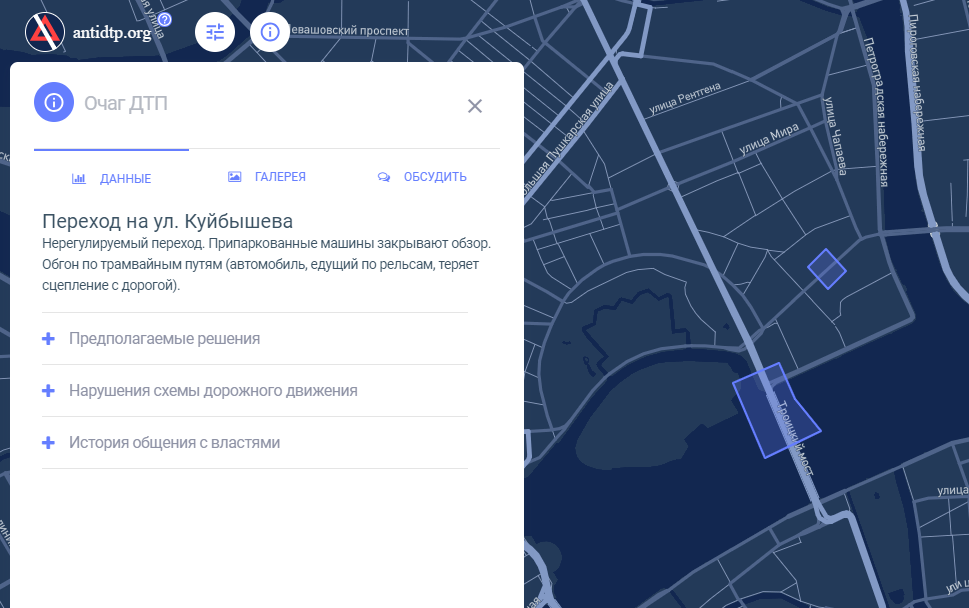
“We are still at the beginning of the journey,” says Lev Krylenkov , the project coordinator. - The traffic police has data on accidents where the victims were. They are not always complete and often inaccurate, but this already makes it possible to somehow use ML. If a different number of accidents occurs at two identical in many ways of the intersections, what is it connected with? Suppose accidents occur in the dark. So, it makes sense to see if everything is in order with lighting. ”
Solving the problems of equality and inclusiveness
Artificial intelligence is able to help in adaptation to people with disabilities. For example, to recognize and interpret emotions in autistic spectrum disorders. The Emotion Ai Summit 2018 summit has proved that the “emotional intelligence” is a key condition for trust and machines.
In Russia, the Smooth project is known - the St. Petersburg project, which became the winner of the Hakaton Open Data Hackathon in 2014. It allows you to build a route around the city by public transport or walking, taking into account the availability of transport and pedestrian zones for people with limited mobility.
“From the point of view of implementation, this is a fairly simple project, but in terms of technology, the guys solved very complex problems. The bottom line is that we have low -floor buses suitable for people moving in strollers. However, not all routes are equipped with them. Using open urban data about where and when these buses run, the route base is formed. In addition, people independently add information about obstacles on the roads, signs, and high cutters. Thus, the system, using different sources of knowledge, based on those algorithms that were laid in it, paves the most convenient routes, ”comments Vitaly Vlasov.
Solving social problems
The fight against terrorism is one of the priority areas of the use of modern technologies. In the USA, Trapwire , a global tracking system with the face recognition function. It was created to detect potential terrorists photographing “important objects” (High Value Targets (HVT), such as metro stations and city squares. As soon as someone makes a photograph of an important object, the system draws up a report on suspicious activity and registers it in the general database. The following are the coincidences by personalities, numbers of cars and other similar incidents.
In Russia, according to Sergei Ustinov, there is a development of a project that will allow analyzing prisoners and crime data in order to predict the possibility of relapses.
It is still difficult to say how wide the possibilities of ML and artificial intelligence are in principle. Is the supremacy of the “supreme algorithm”, how and what will the “think” of the future of the future will be coming? The greenhouse offers to think about it together - share your thoughts in our social networks.