
Translated material
How to build a new lecture: professionals' tips
In the light of discussions on social networks with a discussion of the advantages or disadvantages of certain popular science lectures, we turned to the best lecturers of Russia with a request to share stories about how they are preparing for performances before the audience.
By the way, the Arkha Cultural and Educational Center holds a competition of novice lecturers “The First Department” .
At the end of the semester, sometimes I start to fare
Alexander Markov , Paleontologist, Laureate of Prize Enlightener and Fidelity of Science
- How often do you prepare a new lecture?
- I rarely cook completely new lectures from scratch: just a few times a year. Typically, the materials of existing lectures are taken as a basis, because I have three large lecture courses (introducing into evolutionary biology, human evolution, life history on Earth). But I constantly update these materials, each time I think everything over again, I am looking for new articles on the topic, I change something, I add something. For the autumn semester (September-December), I read a total of 35–40 lectures in total. These are open lectures and lectures at Moscow State University for students (for me these are not different genres, because I tell the public almost the same as students, except for a little more simple words).
- Do you spend a lot of time preparing a new lecture?
-On average, somewhere around half of the working day it takes to prepare one lecture, if this is not a completely new lecture, but an update of existing materials. If completely new, it takes two to four times more time.
- What is the most difficult thing to prepare such a lecture?
- Take it up to prepare it. Time is always not enough. And the process of preparing a lecture itself is interesting and brings me pleasure. Although at the end of the semester sometimes I start to fare. For pleasure, I would have given three times less lectures than I give.
“ Do you drive a new lecture on someone?” Are you advised with someone?
- Rarely. As a rule, I have enough scientific articles.
- What tips for preparing a new lecture would you give beginner enlighteners?
- Well, you ask questions! For the first time I myself began to popularize, only having worked in science for fifteen years, protecting the candidate and doctoral. If I started earlier, the devil knows what kind of nonsense it would be, probably. But people are all different, and everyone has different talents. There are definitely good scientific journalists who are able to read interesting popular science lectures without working in science at all. How they do it, I do not really understand, and I can hardly give them advice. Apparently, the experience of participating in all summer schools, olympiads, conducting school circles in student years, etc., helps here.
Of course, you should have a higher education in the specialty in which you are going to give popular lectures. Although in fact, there are occasionally unique ones that manage without a specialized education to become not only popularizers, but also respected scientists. But these are extremely rare cases.
I can also advise the “School of Lecturers”, organized by the Evolution Foundation 1 . Another advice: consult with specialists, that is, with competent scientists, and ignore the notebooks who are now divided in social networks. They themselves do nothing useful and only pour mud on those who are trying to do. A rather meaningless audience with a low level of scientific competence, which compensates for the sharpness of criticism, the lack of their own achievements.
-Does it make sense to create some expert council of lecture on lectures or is each lecturer himself can create one if necessary?
It is difficult for me to answer this question, because I myself am not a great activist-public, frankly. I think that talented lecturers who are not professional scientists in the area that they are going to talk about in a popular lecture is extremely useful to consult with professionals. And really run a lecture if there are such professionals who are ready not to regret their own time for this. And in some special expert councils on a voluntary basis I do not really believe. But maybe in this I am wrong, just since childhood, I do not like communist subbotniks and all other unpaid public burden.
Never prepare lectures on popular science sources

Photo by A. Paevsky
Sergey Popov , astrophysicist, laureate of the Prize "For Fidelity of Science"
Small preamble. Below I discuss only “status” lectures designed to give an adequate idea that in fact, modern science thinks to itself on a particular issue. Neither a meeting like a “book circle in the library” (or other types of gatherings with friends), nor stories for children of primary school age, nor a very basic cultural light (like “why there are eclipses”), nor obviously entertainment events.
- How often do you prepare a new lecture?
-The formal answer is “a few a year” (although now it is more likely one or two times, not counting the traditional results of the year, and once it was five or six, if not more), but the question is not quite correct, since the pace depends on current employment and external discoveries (important discoveries or other events in close areas), and on the “period of popularization”. I will explain the last point. Lectures can only be done on those topics in which you are well versed (ideally - on topics in which you work in one way or another). And this set is final. Therefore, over time, the theme is significantly exhausted (there is a more recess than the expansion). And then the pace is determined mainly by external stimuli (and employment works as a limiter). At the same time, of course, any of the next lecture will demand an update-Appgrade in the light of new results (or that very deepening), but “to paint the house is not to build a house”.
- Do you spend a lot of time preparing a new lecture?
- Again, the question is how to count. If you set myself the task “but not to prepare me a lecture on the topic in which I don’t understand anything”, then in the case of a lecture on astronomy this will take me a minimum of a minimum for three weeks (find and thoughtfully read a few large reviews on the topic and, apparently, several important original works). In other areas (I mean physics), I would simply never have taken up (and I will not take everything in astronomy). If we are talking about a normal situation when, during my professional work, I had some understanding that I want to share-then two or three days of pure time, since everything has already been read, in my head more or less laid and the feeling arose that there are important things that can be expressed in simple words. And then it is mainly technical work - to make several dozen slides and refresh in memory what is on the graphs and in the tables.

- What is the most difficult thing to prepare such a lecture?
- Create in your head an adequate idea of a fairly complete modern level of knowledge on the relevant issues, which allows not only to present a story, but also to answer questions on the lecture. Moreover, this representation should be expressed in understandable terms.
An adequate representation requires a good understanding of what is important and what is not, since in a popular lecture it makes no sense to go in particular if they do not illustrate the overall picture. In addition, it is important to clearly separate reliably established things from hypotheses and understand the status of these hypotheses.
It is important to consider that the lecture is fundamentally different from the article. In a popular science article, the author can post any statement by sources. The lecture makes sense only if you can clearly answer questions and generally go to the side, revealing some question, without losing quality. That is, the article can be a thin ice floe (the author retold a press release with explanations of the terms from the encyclopedia), and the lecture is only an iceberg. Going to the audience, you need to know much more on the topic than you plan to tell.
“ Do you drive a new lecture on someone?” Are you advised with someone?
- No. The post factual is always glad to the advice of colleagues who understand the topic better than me.
- What tips for preparing a new lecture would you give beginner enlighteners?
- Never give lectures on topics in which you do not understand the level that allows you to read a university lecture on this topic or make a scientific seminar in a professional audience.
To imagine that a non -sound, but not a super -scientific scientist of a very good level working in this area sits in the hall, and listens to you.
Never prepare lectures on popular science sources.
-Does it make sense to create some expert council of lecture on lectures or is each lecturer himself can create one if necessary?
- No. This is the one who gives lectures. And, of course, in the end in YouTube, the nonsense of everyone will be visible, and the organizers of normal lectures will draw their conclusions.
I run lectures on the beautiful audience "Hyperion"

Photo by I. Efremova
Alexey Vodovozov , medical journalist
- How often do you prepare a new lecture?
- Regularly. I would make a bad teacher from me - it is very difficult to repeat the same material, therefore, old lectures are thoroughly modernized, adapted to specific audiences, new from several old ones are gathered and completely new, from zero.
- Do you spend a lot of time preparing a new lecture?
- About a month. This time takes the preliminary collection of material, its analysis, preparation of illustrations (translation of infographics or sometimes working with artists, if you can’t find a finished picture, but it is very necessary), selection, translation (if necessary) and editing the video. The presentation requires approximately one or two days of work, usually about 60 slides.
- What is the most difficult thing to prepare such a lecture?
- The first is not to establish in the texture. The second is to find that filing of a problem that will interest listeners of different levels of preparedness.
“ Do you drive a new lecture on someone?” Are you advised with someone?
-I run into the beautiful, but small audience of the Giperion Book Club-store, the main part of the prime minister takes place there. It so happened that there are many biologists among the listeners, so they correct something immediately on the spot, something after the lecture during the answer session, as well as according to the results of comments under the published video in all social networks. This is especially true for all kinds of multidisciplinary themes, for example, on the same poisonous animals and plants, amendments were made after comments on herpetologists and chemists, mycologists and botanists, who, in fact, became co -authors of the following versions of lectures. Approximately like "now exactly all the poisonous mushrooms in Russia, the second publication, corrected."
- What tips for preparing a new lecture would you give beginner enlighteners?
-Do not begin to give a lecture on some topic, until they thoroughly figured it out. Yes, you can express your own opinion in a lecture, but it should be well argued, remaining both within the framework of common sense and the scientific picture of the world.
-Does it make sense to create some expert council of lecture on lectures or is each lecturer himself can create one if necessary?
- If you wish, you can take the experience of the 15x4 project as a basis, they do it for a very long time: lecturers gather together and rolling their lecture on other lecturers and project participants. All large inconsistencies that are incomprehensible to the students and the shortcomings of the design are immediately crawled out. But in this case, you need to be prepared not only to calmly listen to reasoned criticism, but also not to ignore it, correcting and correcting your materials. I think that for single lectures there is no sense in this, there is enough video recordings, which everyone then shouts on the Web then everyone. But for festivals, forums and other major events, such a practice may be useful.
The most difficult thing is to stop and not try to embrace the immense
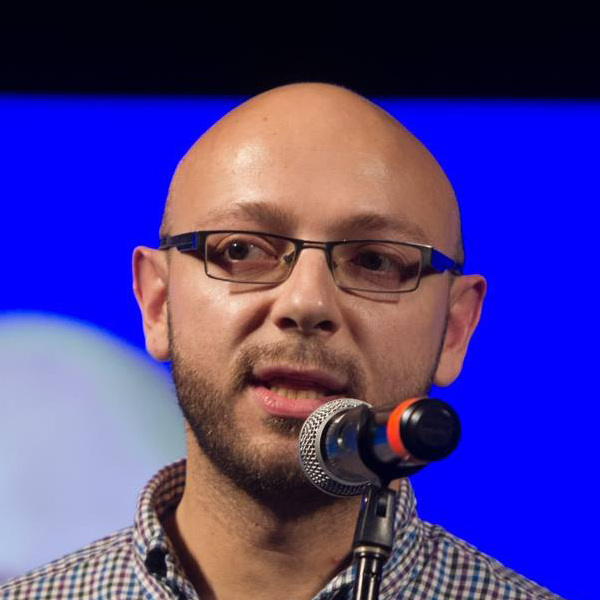
Photo by I. Nightingale
Alexander Piperski , linguist, laureate of the Enlightener Prize
- How often do you prepare a new lecture?
- I looked at the folder in which I keep presentations for popular lectures for adults and schoolchildren, and found eight names that can be considered new for 2018 - so probably every one and a half months.
- Do you spend a lot of time preparing a new lecture?
- It is impossible to evaluate, because I do not have completely new lectures. Popular lectures somehow grow out of each other, from the courses that I teach students, from my scientific articles and reports, from the popular texts that I write, and not so that I come up with a topic that I know nothing about, and begin to prepare a story for the general public from scratch.
For example, last fall, I gave a lecture in Kaliningrad "Where do the names of the peoples come from?" - I did this for the first time, but before that I wrote twenty small texts for the ethnonym of the day at the Arzamas. If only the time of work on the presentation is seated, it will probably be not too solid half a day, but if you take into account how much time I wrote about these ethnonyms, it will be an order of magnitude more.
- What is the most difficult thing to prepare such a lecture?
“It’s the hard thing for me to stop and not try to embrace the immense.” When I was just starting to teach, I was always worried that I would not have enough material for the whole couple - and in the end I prepared so much that I did not have time. Now I understand my pace much better, but nevertheless I have to say all the time to myself: “Do not do 80 slides, you still will not have time and have to click.”
“ Do you drive a new lecture on someone?” Are you advised with someone?
- I do not run the lecture, but if I do not know the language, the example of which I picked up, I try to clarify with the specialists if everything is correct.
- What tips for preparing a new lecture would you give beginner enlighteners?
- rehearse in front of a mirror with a stopwatch. This is also useful because you understand in advance when you are brought into too dry science, and when, on the contrary, in too cheerful chatter about life, and you can adjust it.
-Does it make sense to create some expert council of lecture on lectures or is each lecturer himself can create one if necessary?
- I can’t imagine who would go to work in such advice (or rather, even the tips - for each specialty you need its own): this is a huge job if it is realistic to do it. In addition, the status of such a council is incomprehensible: I would not want it to turn into a censorship committee - but this, fortunately, will not work.
Lecture preparation is a continuous process

Dmitry Viba , Astrochemist
- How often do you prepare a new lecture?
- From scratch - no more than once a year. There is no time for more. But, on the other hand, the preparation of a lecture is a continuous process. In addition, in my repertoire there are lectures that, in its very essence, imply constant significant update, for example, a lecture on modern research of the solar system. And in other topics, science does not stand still.
- Do you spend a lot of time preparing a new lecture?
- A lot, of course. To give a high -quality lecture, you need to know significantly more than you tell. This implies acquaintance with a very large amount of material, even when you prepare a lecture, it would seem, on a familiar topic.
- What is the most difficult thing to prepare such a lecture?
“I would single down two things.” The first is an adequate assessment of the audience and the corresponding selection of material, so as not to utter completely alphabetical truths and not to delve into no interesting detail. The second is to clearly define the boundaries and quality of your knowledge. Separate the things that I know from the things that I am used to. If they ask me a question about the first, I will answer him, but if they ask a question about the second, it may turn out uncomfortable.
“ Do you drive a new lecture on someone?” Are you advised with someone?
- No. As a rule, there is no time for running -in. In addition, for me, reading lectures is a hobby, and I can afford to make them exactly as I think it is necessary.
- What advice on the preparation of a new lecture would you give beginner enlighteners?
- The first advice is large, in a semi -fat italics. Nothing than black letters on a white background did not come up with. Do not try to hit the audience with a palette. On the one side. But on the other hand, you are interested in lighting conditions in the room where you will give a lecture. If the lecture will take place in the dark hall (this is almost always possible in planetariums), you should think about light letters on a dark background.
In general, remember the second advice: try to check the presentation in the combat in advance, because with the highest probability on the projector’s screen your presentation will not look like on a computer (and always worse in terms of clarity, color, and color, and also the edges of the slides will be trimmed or not on the screen).
Third: for those who use yellow lines on the graphs, there is a special boiler in hell. Fourth: including video in the presentation, just in case, in advance, learn to confidently pronounce the phrase: “It is strange, everything worked on my computer.”
Fifth: If your lecture has a slide with a conclusion, write the words "Thank you for your attention!" On the same slide is small below, and not on a separate slide.
And the last: respect your audience. Даже тех ее представителей, которые будут убеждать вас, что американцы не летали на Луну, потому что с плоской Земли отправить ракету на Луну невозможно.
— Имеет ли смысл создать какой-то экспертный совет по обкатке лекций или же каждый лектор сам может создать такой при необходимости?
— Я думаю, что человек, сомневающийся в своих силах, сам найдет, на ком обкатать лекцию. Создание совета мне представляется совершенно бессмысленным.
Prepared by Natalia Demina