
Translated material
Kolobok, Cinderella and others on the asteroid Ryugu
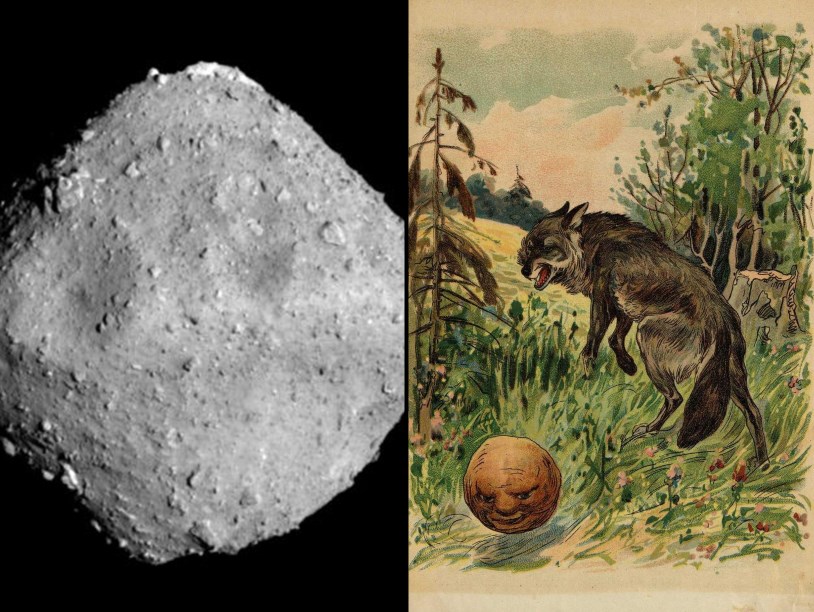
The working group in the astronomical nomenclature of the International Astronomical Union (MAS) approved the name of the first thirteen objects on the asteroid Ryugu, opened by the Japanese spacecraft “Hayabus-2”. The names of fairy -tale heroes, including Kolobok, were selected as the names for them.
Recall that Hayabus-2 reached asteroid Ryugu in July last year. While he occupied the orbit at an altitude of 20 kilometers from the surface of the asteroid, conducts distance studies and plants the descent devices on its surface. At the end of 2019, “Hayabus-2” itself will get closer to Ryugu at a minimum distance and will have to get samples of the substance, which will then deliver to the ground. You can read more about this project in the essays “Hayabus-2 at the goal” and “Asteroid Ryugu: First Meeting”.
A picture of Ryugu, taken by the Mascot device when landing. Photo: JAXA
Asteroid Ryugu was called in honor of Ryugo-Ju-the Palace of the Dragon Ryujin, the lord of the seas from the Japanese fairy tale. The main character of this fairy tale was a fisherman named Urashim Taro. Once he saw the children on the shore mocking the sea turtle. The fisherman bought a turtle from them and let it go into the sea. The next day, when he went out of fishing, the turtle swam his boat and said that in gratitude for salvation, he invites him to the palace of the sea lord of the dragon. When they arrived, it turned out that the turtle was the daughter of the dragon Ryujin named Otokhime. The fisherman was shown a luxurious palace and garden, arranged feasts and dances in his honor. A few days later he decided that it was time to return to his father and mother. In parting, Otochime gave him a beautiful box, but forbade it to open it.
Returning to his native shore, Urashima Tarot could not recognize anyone from the fellow villagers. When he called himself, they answered him that a fisherman named Urashim Taro really lived here, but he disappeared seven hundred years ago. Then he opened the box. From there, purple smoke fell. As soon as the smoke touched the fisherman, he instantly turned into a decrepit old man and died. In other versions of History, Urashima Tarot did not die, but turned into a crane or into a sea deity.
The research team of the Hayabus-2 project was supposed to choose a common topic to give the names to various objects on an asteroid. Since Ryugu was named after the Dragon underwater palace from a fairy tale, such options as “The Names of the Palaces and Castles of the World”, “Dragons in different languages”, “Deep -sea creatures” were offered. In the end, they decided that children's fairy tales would be a source of names. On September 25, such a proposal was adopted by the MAS working group, and after that it was possible to proceed with the choice of objects on an asteroid and names for them. Although the diameter of the asteroid Ryugu is only 920 meters, a number of objects on it are quite remarkable and, from the point of view of scientists, deserves its own names.
The first group included thirteen names. They belong to objects of four types. Firstly, these are craters, secondly, narrow and long hollows (in the international planetological nomenclature, they are designated by the term Fossa), and thirdly-folded crests (Dorsum), fourthly-individual large stones and boulders (saxum).
The last type of objects turned out to be the most characteristic of the asteroid Ryugu. “No matter where you look, there are stones, stones and more stones,” the project participants write. Such a feature of Ryugu is very difficult to land on it the descended devices and the future rapprochement for the sampling of the soil sampling. Previously, planetologists did not even distinguish large boulders in a special type of relief and did not have a separate term for it. The word saxum (“rock, stone” in Latin) was proposed for them by participants in the Khayabus-2 project. The International Astronomical Union agreed with this proposal and decided to call large boulders and rocks with the word Saxum, the size of which is at least 1 % of the diameter of the celestial body.
Among the individual large stones on Ryuga there is an outstanding copy at the south pole of the asteroid. Spectroscopic observations showed that this giant boulder differs from the surrounding surface with its spectral characteristics. Researchers really wanted to give him a name, but doubted the approval from the International Astronomical Union, because before large boulders and rocks on other planets, satellites and asteroids did not receive their own names.
Nevertheless, the permission was obtained, and the boulder at the South Pole of the asteroid received the name Otokhime - the daughter of the sea king. True, a problem has arisen. The name Otochime was already used for a hill on Venus (there, according to tradition, all the names are given in honor of women). The International Astronomical Union proposed choosing another name, but the participants in the Hayabus-2 project managed to convince the working group that Otochime is too important a story about Urasima Tarot in order to abandon her behalf.
The location of the objects on Ryugu. Photo: JAXA
They gave the names to two more large boulders. One of them was named Edzim in honor of the island on which the fisherman of Urashima Tarot lived. The other wanted to call Oz based on Frenc Baum's famous fairy tale, but such a name is already used on Haron, a satellite of Pluto. Therefore, the name of the catapo was chosen in honor of the boy from the fairy tale of the Kajunes , the franco -speaking inhabitants of South Louisiana. The history of the catapo resembles a European fairy tale about the boy-s-firing. Datapho was normal growth, but, as in the fairy tale about the boy-senchik, his parents were poor and could not feed the catapo and his two brothers. Then they decided that the father would take the children to the forest and leave there. But Katapho noted the path, pouring flour out of his pocket, and the children were able to return home. For the second time, Datapho used not flour, but wheat grains, but they were hidden by birds, and the children really got lost in the forest. In the future, they fell into the house where a woman lived, and her husband was a devil who wanted to eat children. Thanks to the dexterity and ingenuity of Dataphs, the children were saved, killed the devil and remained to live in a house with his ex -wife.
A large crater on the equator of the asteroid was named Sendrillon (Cendrillon) in honor of a fabulous heroine, who is called Cinderella in the Russian translation. Initially, the English -speaking name of Cinderella was proposed, but the International Astronomical Union preferred the French version. Another equatorial crater was named after Kolobok. The name Peter Pan was proposed for him, but this option had to be abandoned, as this name was protected by copyright.
Crater Brabo received a name in honor of the hero of the Netherlands legend - the Roman soldier Sylvius Brabo. Its history refers to the field of "folk etymology", it explains the appearance of geographical names. According to this legend, in ancient times there was a giant Dryon Antigon. He stood on the bridge across the Shelda River and demanded a fee from those who wanted to cross the river, and in another option - from the captains of the ships passing under the bridge. With those who unwilling to pay, the Antigon straightened Druon: he chopped off his hand and threw it into the water. Sylvius Brabon killed the giant and also chopped off his hand and threw it into the water. The city that arose at this place was called Antwerp (from the Dutch handwerpen "abandoned hand"), and in honor of Sylvia Brabon was called the area of Brabant. In modern Antwerp, a monument was erected by Sylvia. We add that, according to the initial sentence, the crater Babo was supposed to get the name Sleeping Beauty, but he was considered too long.
Crater Momotarou (Momotarou) is named after the Japanese fairy -tale hero Momotaro "Persian boy." His parents became an old man and an old woman who caught a huge peach from the river, from which a child appeared. He said that he was sent by heaven to become their son. When Momotaro grew up, he decided to free the inhabitants of the village from the demons (in Japanese) and went to the island of the demons onygasima, where he defeated all the evil spirits, including the terrible giant-the leader of the man. Momotaro's favorite food was Kibidango's jackets - and in honor of them another crater on the asteroid Ryugu was named.
The surface of Ryugu. Photo: JAXA
Another hero of Japanese folklore gave the name to Crater Kintarou . Since childhood, he was distinguished by great power, he was able to break the rocks with his hands, bend the trunks of trees, win the bears in the struggle of the sumo. He helped lumberjacks and defeated many demons.
Finally, the largest asteroid crater was named Urashima-in honor of the fisherman of the Dragon-Tree from the Japanese fairy tale.
Two cavities on the asteroid Ryugu were called the Chorai and Tokoyo, both of Japanese folklore. Both of them designate the mountain lying far into the sea, the abode of the immortal. Sometimes in a fairy tale about Urashim Taro Dragon and his daughter live not at the bottom, but on this distant island. In one of the options for the fairy tale, Urashim Taro, who turned into a crane, settled on the mountain of the choraea.
Another legend is connected with tokoyo, in which the Tokoyo is not the name of the place, but the name of the girl who was the daughter of a samurai named Oriba Sim. The emperor was angry at him and sent him to exile to the distant islands of Oka . The daughter was yearning for her father and decided to visit him. But none of the fishermen agreed to deliver her there. Then she took the boat and at night he herself hit the road on the sea. When she arrived at the island, the locals said that they did not know anything about her father. Once Tokoyo spent the night in a Buddhist church. She woke her crying. She saw a priest and a girl whom he led to a cliff over the sea and wanted to push him down, but Tokoo stopped him. The priest said that once a year, the inhabitants of the island are sacrificing the naval deity of Onikushi. Tookoi volunteered to replace the girl and jumped into the sea, clenching the dagger in her teeth. Under water, she discovered the halls, where there was a figurine of the emperor, who expelled her father. Then Tokoyo met with a snake -like monster and defeated him. When she returned to the shore, the priest and the girl took her to the city. The glory of her heroic act reached the emperor, who at that time healed from the disease. The emperor said that Tokoyo, taking the figurine, took off the curse from him, so he returns the girl's father from exile. According to folk legend, Tokyo's name was given in honor of Tokoyo (in fact, it means “eastern capital”).
The Dragon Rugzin, who was visiting Urashima Tarot, was not forgotten by astronomers. His name was the equatorial crest of asteroid Ryugu. The researchers considered that the governing asteroid of the mountain crest resembles a dragon biting its own tail.
The two areas on the asteroid, where the Mineerva-II 1 and Mascot launched devices were planted, are special names Trinitas (the place of birth of Athena in some exposures of the myth) and Alice's Wonderland, but these names are unofficial.