
Translated material
Fire protest
The Baroque performance, remotely staged by Kirill Serebrennikov in Gogol Center, was already discussed in the early January at Colta . Ru in the "Theater" section. The director is still under house arrest, rehearsals were recorded on the video and handed over to him through a lawyer. Continuing the section “Synthesis of the Arts” and the conversation about the mutual influence of stage and museum spaces , we decided to push theatrical criticism and art of history. Sergei Khachaturov considers Baroque to an innovative and multifaceted project and insists that with the help of performance, mass culture and fine art, the Serebrennikov Theater conducts a deep modern revision of the foundations of baroque aesthetics.
 © Ira Polar
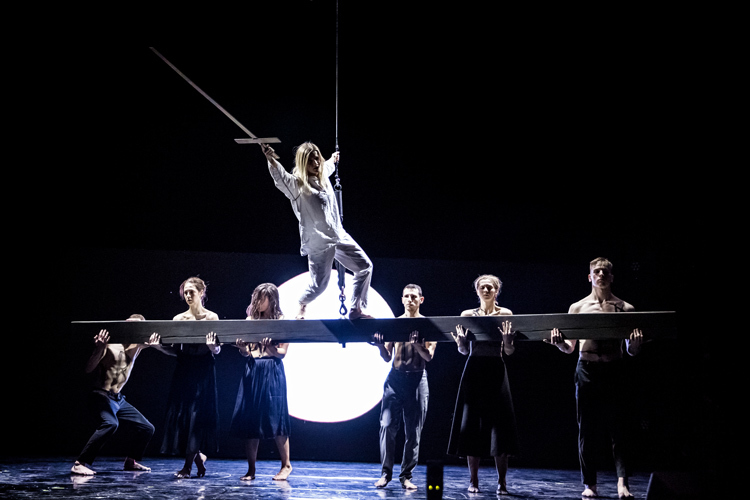
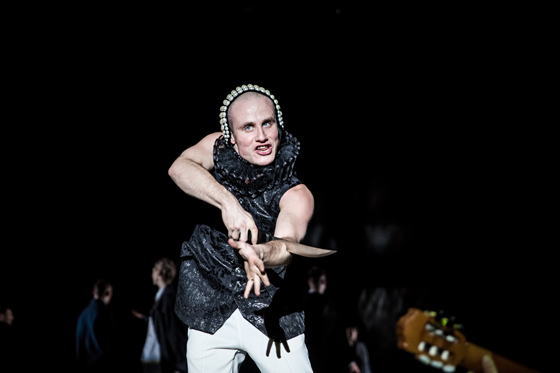
It is difficult to write about this premiere. Memory instantly fixes bright flashes-images. One image: a student, chained by an handcuff to a puffy guard, plays a free hand on the piano of Chacon Bach. The piano is ignited. Another image: Payats (Nikita Kukushkin) sings with passakalia about life (with the refrain “We will all die”), sprinkles with jokes on the anger of the day, descends into the hall and entertains the audience with completely not harmless tricks. Such puffed poster motifs seem to be distinguished by a performance with a political cabaret either Brecht or the theater on the Taganka era Yuri Lyubimov. And to build the Baroque action into this series-in my opinion, a mistake.
 © Ira Polar
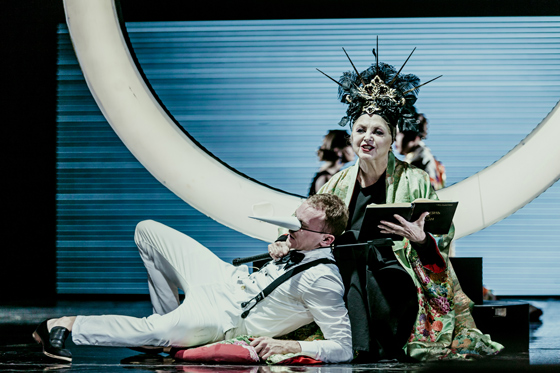
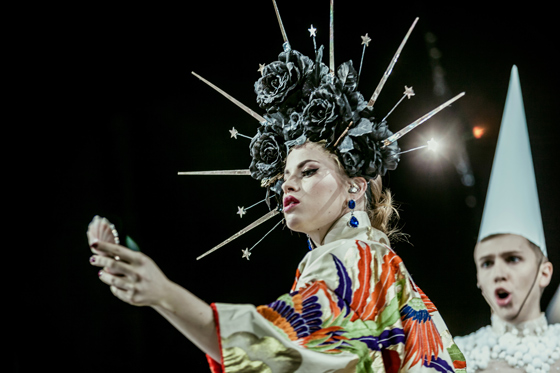
At least two ideas are glorious by the project, invented by Kirill Serebrennikov and embodied by the team of selfless professionals (from director Evgeny Kulagin, choreographer Ivan Estegneev, the author of the musical composition of Daniil Orlov, the artists of the Gogol Center, the invited opera singers, musicians, dancers to costumers, stuntmen, and bookmakers. Articles about Baroque as the style and philosophy of life). Firstly, he is glorified by the fact that he is an anti-player, overcomes many laws of the stage form within itself. Secondly, Baroque is wonderful with its unique chronotope, continuity. At each point of action, we experience a catastrophic tension of mutually exclusive forces of being. The basis is the music, which is unfolding according to the Baroque Folden Baroque principle described by the housing.
I recall one example from mass cinema. James Cameron's film "Titanic". Throat the deadly disaster in the ocean liner lets signal lights from the side. And in an ice night with the northern radiance, they flash a baroque firework of crazy beauty. This unthinkable beauty is fraught with death. The nature of the affects of Baroque sometimes does not accept the coexistence of aesthetics and ethics. Nevertheless, it reduces them in the mirror perspective. When Delez described the monad of Leibniz as a fold, he had in mind the tension of the polar forces. In the places of the meeting, the foul is concentrated with an incredible muscle and mental effort. Contrast emotions complement the world to perfection for a moment, and after a second all this is torn, unable to withstand tension, turns into chaos.
 © Ira Polar
The performance of Serebrennikova gives a chance to understand that perfection at each point of space is fraught with death. For the volumetric embodiment of this idea, it is important to overcome all formal species framework of the performance, first of all, stories of stories according to the linear logic of the plot. All links are binded by a different logic: counterpoint, diffraction, contrast affects. Otherwise, the tension of the gap is not to survive seriously.
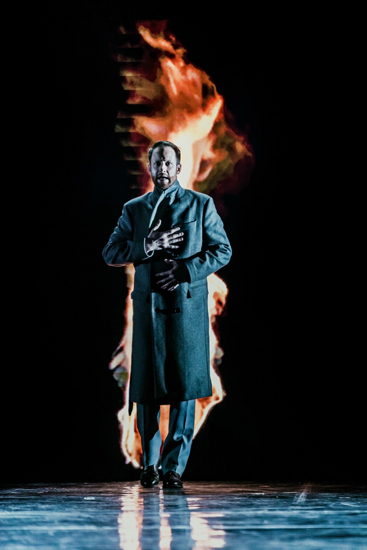
The tag of the play is chosen # Already in the first scenes we see fiery ventures. The electrician during the rain repair the wiring. A short circuit kills him with a beautiful flash of light. The artist writes the word "fire" in different languages. Somewhere nearby explodes, turning into a fire pillar, a car. The Baroque era loved to bind the world of big and the world is small, a macrocosm with a microcosm, with the help of alchemical experiments with four elements.
Self -immolation against dictatorship and violence occurs at the time of the Cold War, frosts in public relations.
Fire was an important medium. After all, it was he who ensured the maximum deployment of the baroque category of splendor with its instant, sometimes deadly beauty. Fireworks inlaid the sky with fiery figures. In this generous scan of the transformed universe, harmony lasted a few seconds. It was replaced by smoldering coals in the cold night.
The director Serebrennikov shared with me an observation of the terrible self -sacrifice of opponents of political regimes. Self -immolation against dictatorship and violence occurs at the time of the Cold War, frosts in public relations. This folding, connecting ice and flame, has become the principle of organizing the Baroque action. The most painful scenes of violence and sacrifice of the heroes of 1968-1969 are accompanied by the sound of the divine beautiful opuses of Ramo, Vivaldi, Handel. The strict logic of action is determined not by the plot line, but by the harmony of musical affects.
 © Ira Polar
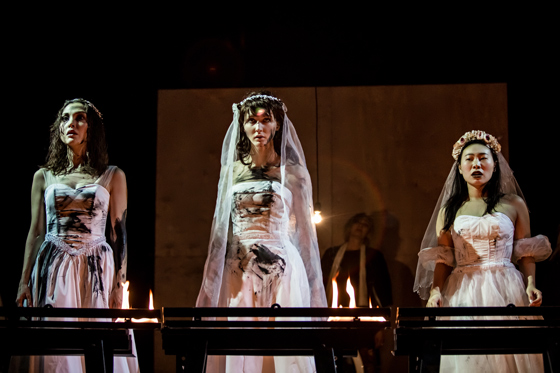
A certain common canvas implies an appeal to the time of revolutions and protests of 1968. Three old women-Moirs, spinning the yarn of life and fate, are phenomenally sensitively represented by the artists of the older generation of the Gogol Center Svetlana Bragarnik, Irina Vybornova, Olga Naumenko. In one stage, they turn into the mothers of the Prague martyrs, students who committed self -immolation in Prague in protest against the occupation of Czechoslovakia by Soviet troops. I recall the biography of Jan Palach, who turned into a burning torch of 20 years. Model monologues are accompanied by Ariya Herodiada from the oratorio "John the Baptist" Alessandro Storedlala. And Jan Pajamh suddenly becomes the one who plays the artist. Without exaggeration, the grand role of Odin Byron. He and two women next to him (an angel of Light and the Angel of Darkness), Svetlana Mamrecheva and Maria Selezneva, find themselves at the points of constant refraction of light and space. They balance on the very edge of the folded bends, preventing the action of the action and not allowing it to unfold according to the usual logic. In an instant, one Byron and his companions can turn into passionate lovers, then into the heroes of the French Student Revolution of 1968, then in the inhabitants of the "factory" Andy Warhol. Now in angels, then in demons. Each bend of conditions is plasticly played amazingly. And transformations themselves are possible thanks to music.
 © Ira Polar
The dizzyingly difficult musical score of the Baroque action was invented by pianist Daniil Orlov. He says: “ Catabasis , four descending notes, which form the basis of almost any passacali or chakons - the main, most characteristic, baroque genres, was the unifying moment. It so happened that this move is contained in almost half of the works performed in the play: Passakalya from Armida Lully, Pur Ti Miro from Poppei's Coronation, Nymph’s cry and crying, “Vedrò Con Mio Diletto” and “AH, Ch'infelice” , finally, finally - Bach's chacon. As a result, this descending motif became a kind of Baroque leitmotif, consonant with its content ... Drama, characters, costumes were created by Kirill Semenovich on the basis of the assembled musical frame. ” Actors Byron, Mamreshva, Selezneva, almost all participants in the project had to connect two lines: the drama theater and opera. The level of execution of complex vocal parties of baroque operas is also perfect. The actors themselves, their heroes - the embodiment of readiness for constant transformations of the baroque worlds, their refraction.
 © Ira Polar
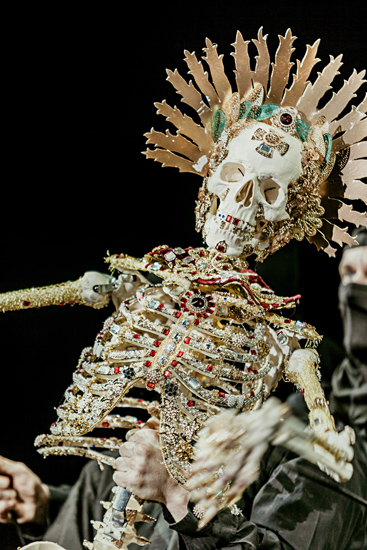
The same transformations, promising abundant generous impressions on the edge of non -being and death, are reflected in the whimsical garland of stage emblems, symbols. Artifacts of pop culture, Trash are built in the allegory of the funeral ceremonies of the XVII century. So, in the scenes of the glorification of the state, the ruler-skeleton decorated with rhinestones appears, claiming that the fire of self-immolation was cold. Magritt people with umbrellas seem to be observing on the other side of the fold behind the ballet pantomime of flaming things from Antonioni Zabriski-Point. And the dancing plastic bag, who arrived from the film “Beauty in American” is the best visualization of the music of the Assor of Emperor Anastasia from the Opera Justin Antonio Vivaldi (incredible beauty Voice of Counterenore Vadim Volkov).
Having overcome the boundaries of the theater, the Baroque Serebrennikov entered the Contemporary Art metapace. And it became a source of abundant and merciless knowledge about the world and man. Knowledge collected according to the principle of the same drop in which the whole universe trembles.
Rehearsal of the play "Baroque"
© Channel Gogol Center on YouTube
Subscribe to the COLTA.RU channel in Yandex.Zen to miss nothing