
Translated material
What is in a black box? Machine learning problems

The greenhouse has already told what machine learning is (Machine Learning, Ml), and even wrote about how NPO to predict the amount of donations and the success of the campaigns with the help of ML. In this article, the journalist of the greenhouse Julia Kalenkova figured out how often cars are mistaken and what it leads to consequences.
Empathy problems
In the report of the London Royal Society , published in 2017, “Machine Training: the strength and perspective of computers who study with examples” of one of the problems of ML named the depersonalization of key services. The survey participants agreed that modern technologies can help in medical diagnostics, but not in consulting practice. Robots do not get tired and work faster, but even a tired doctor in a personal conversation about a serious diagnosis will bring more benefits.
“Only strong artificial intelligence will replace human qualities and empathy, and specially trained for this, such as a robot-companion, which grows with the child and potentially“ changes the bodies ”, from developing children's toy and a partner robot to the robot,” says Aleksey Derevyankin, consultant of the first fiscal data operator in Russia.
Each year, experts predict the appearance of such strong artificial intelligence and dwell on the formulation of the “near future”.
Ethics problems
While robots are completely dependent on people, the unkind intentions of the creators cannot be ruled out. Google, for example, develops software for the Project Maven pilot military project for driving management. More than 1000 scientists in AI, Ethics and Information Technologies, as well as 3,000 employees of the corporation itself, already want to stop such experiments.
They demand to support the international agreement on the prohibition of autonomous weapons. The fears are quite justified: look at how, using machine learning, you can collect the "army of killer drones." While this is a fantasy, but it is worth thinking about the problem.
Hence another problem: cars act on the algorithms embedded in them, and even if the developers want to observe the principles of ethics, how should they formulate them?
In 2020, a social rating system will begin to work in China, which evaluates citizens on the basis of their behavior, financial situation and violations. For data collection, external surveillance cameras, as well as the two largest messengers - QQ and WeChat are used. What are these new ethics in the digital era or the manifestation of totalitarianism?
False correlations
A well -known example of a false correlation: a program that distributed patients in line for the urgency of admission decided that asthmatics with pneumonia need help less than just people with pneumonia without asthma. The fact is that, according to statistics, asthmatics do not die, which means that you can lower priority. In fact, they are assisted in medical institutions in the first place - just in connection with a critical situation.
Another classic example of a false correlation: the consumption of margarine in the United States clearly depends on the number of divorces in the state of Men.

When comparing the data, the machine can come to the wrong conclusions, but people are enough for simple life experience and critical thinking, so as not to make such mistakes.
Vague ideas about technology restrictions
Everything related to machine learning and artificial intelligence is actively replicated. At the same time, there is a lot of information, and the news often confuses an unprepared audience. In the context of discussing the recognition systems of people, the media wrote that criminals were detained in the Moscow metro, but in London they could not . It is difficult to say to whom to believe: in each case we are talking about a certain technology and specific conditions of its work.
At the same time, entrepreneurs, designers and managers often overestimate the capabilities of machine learning. They expect from fast learning algorithms and accurate forecasts for complex requests. “People began to perceive artificial intelligence as a magic wand that will quickly solve all problems - whether it is automatic recognition of faces or assessing financial risks in less than a second. This is not so simple, ” writes Bartek Ciszewski , specialist Netguru .
The problem of the "black box"
In 1991 , Dean died (Dean Pomerleau) , the future founder of Assistware Technology , tested one of the first models of the robot. He rode the streets of the city, while the computer installed in the car, through the camera, followed the road and “remembered” the driver’s movement. The Pomelo coached the system for several minutes, and then let it steer on his own. Everything went well until the car drove up to the bridge, where he made a sharp and unexpected turn. To understand what happened, it was necessary to " open the" black box "and figure out what he was thinking about ."
It turned out that the system used grass along the edges of roads to determine directions, and therefore the appearance of the bridge embarrassed it. Machines operating on the basis of complex algorithms do not store everything in memory blocks, like ordinary computers. The more perfect the algorithms (and you remember that they are constantly studying), the more difficult the decryption of the “black box”. In other words, it is all the more difficult to understand the inner part of the algorithm, explaining how he comes to the decision.
Creating a training sample
Machine training allows you to solve practical problems without obvious programming, and by training on precedents. However, in order for this training to become possible, a training sample is necessary. Sometimes input data can be generated artificially. Objects similar to each other, for example, bank cards, the car will “see” with a minimum sample.
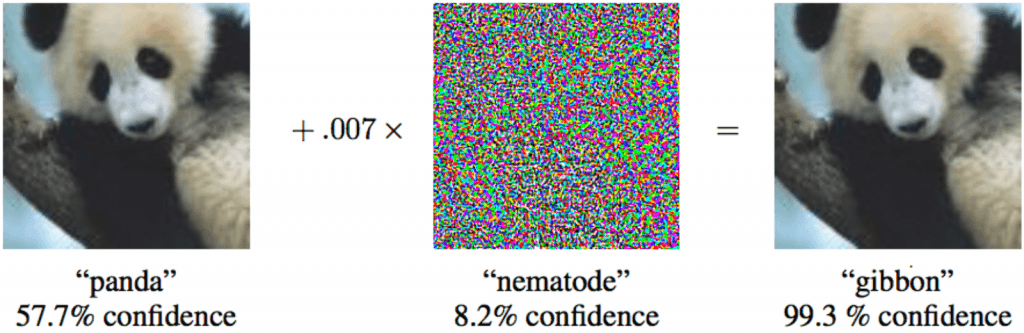
When recognizing persons, it will need to take into account not only the variety of nationalities, but also the conditions of representation, for example, insufficient lighting. Therefore, you have to do Data Augmentation, or "Pulling up the sample." For lack of the ability to independently create various conditions, they are imitated using filters and distortions.
The use of filters, in turn, requires more advanced algorithms. For example, if you add “noise” to the panda on the left, we get a gibbon.
These are general restrictions for machine learning, which are imposed on “geographical” problems. Each country has its own barriers that impede the development of technology. For example, in Russia, according to the head of the Open City Foundation Vitaly Vlasov, there are no problems with specialists, but there are difficulties with the infrastructure:
“It seems to me that we have not very developed an ecosystem for innovative projects in general in any areas. Probably, there are not enough specific knowledge - not how to program, but how to manage and implement your projects. This is necessary so that startups do not die at the stage of ideas. Management, startup Agile and similar skills - this would now help very much. ” Vitaly Vlasov.
Vitaly Esipov , one of the authors of the Telegram-Bot project Open Recycle Bot , also notes the high cost of specialists and the development process in principle. According to the 2018 study , the salary of an artificial intelligence specialist in Russia amounted to about 190 thousand rubles with an average indicator in the field of IT 90 thousand rubles. On the one hand, this indicates the prospects of the direction itself as a whole, and on the other, about the shortage of personnel.
The base of knowledge
The greenhouse will continue to share observations and open new opportunities for the exchange of experience. In February, a great opportunity to help IT projects that solve social problems will present. We invite Data specialists, programmers, designers, researchers and active citizens to Hakaton in St. Petersburg on February 16 and 17, 2019.