
Translated material
Aeneas in a psychiatric hospital
A flurry of outraged "bu-oo!" The walls of Opéra Bastille were shocked, as soon as the staged team came out to bow: Dmitry Chernyakov himself and his regular partners - costume artist Elena Zaitseva, artist Gleb Filchensky and Tieni Tieni ( Tieni Burkhalter ) , responsible for the video design. Philip Zordan, the main conductor of the Paris Opera, and the soloists greeted much more cordial. Although, to speak honestly, in musically the first evening the performance was imperfectly: the choir periodically gathered and entered at the wrong time, the conductor was too much injured by pathos and lumbering.
Passion after the end of the performance was boiling for a long time. The French were raging, but the Russian-speaking part of the hall was not inferior: almost half-Moscow gathered for the premiere, since the day before in Paris, the opening of another Russian megaproject was the “Dau” of Ilya Khrzhanovsky. Muscovites arranged a standing ovation after the performance and yelled “Bravo!”, Protecting their idol. In general, it was fun.
The French, however, should not be blamed: they are not so easy to figure out what exactly tried to tell the city and the world Chernyakov. To do this, you need to plunge with the head into his system of values, concepts and symbols. And it is better to see the performance twice or even three times.
 © Vincent Pontet
The cyclopic opera saga of Hector Berlioz is based on Virgil Eeneid (the composer wrote Libretto) and consists of two parts: “The Fall of Troy” and “Trojans in Carthage”. The composer’s Opus Magnum is an opera masterpiece, the significance of which his contemporaries did not immediately realize. Berliosis himself during his lifetime never heard his opera dilogy entirely. In the original, these are two full -fledged operas, designed for production at two in the evening - a total of eight acts and about seven hours of music. But, as a rule, the "Trojans" are put in an abbreviated form and one evening. The current performance is, for example, about five hours (with intermissions).
In the opera monster of Berlioz, the contrast of units was initially laid: war and peace, destruction and creation, smoky dawn of conflagrations of the destroyed Troy and marvelous solar Carthage. In the center of the flaming Troy is a frantic cassandra soothsayer, a rebel and an outsider. In the center of the shining world of Carthage is the wise and gracious ruler of Didon.
Of course, there is no Trojan horse in the performance.
Also, on the contrast, it puts two parts of the "Trojans" and Chernyakov. The contrast between the terrible reality of the war and the pseudo -regional, invented, blessed world, where those who are sincerely wounded by war are rushing, is still more striking and worse. Such a tangle of patients with questions and a complex system of causal relationships, Chernyakov weaved earlier: in the Zurich "Pelleas", in the Berlin "Boris Godunov" and "Parsifal" , partly in "Tristan" . Problems of outsider and leadership, obsession and frustration, psychological and physical violence in the family, the study of mechanisms and weaknesses of totalitarian power, the behavior of elites and plebs ...
 © Vincent Pontet
The story of the fall of the Great Troy and the wanderings of Aeneas, obsessed with the idea of finding a new land and creating a new state (meaning the Roman Empire), pushes the director to parallels with today's day. Of course, there is no Trojan horse in the performance. Aeneas, the hero of the war, himself becomes this horse, opening the gate to the hated Greeks. He is obsessed with a thirst for power, wants to shift Priam from the throne with the hands of enemies, in which he hopes to find allies. However, the atrocities of the Greeks for himself are a surprise. He did not calculate the consequences of such a union and fully tasted the bloody fruits of his pyrrhic victory over Priam.
 © Vincent Pontet
Chernyakov forces his hero to live life twice - seriously and Ponaroshka. The action of the first part, judging by the sullen concrete buildings that surrounded the square, occurs somewhere in the bombed Baghdad during the Second Iraqi War. At some point, the constructivist houses begin to move up and move like ominous giants with a quiet rustle, revealing the space of a huge scene to its full depth. Priam-a voluptel with an unpleasant fold at the lips-embodies the collective image of the eastern dictator: a heavenly blue tunic, an arrogant-submitting habits of a man, accustomed to the fact that everyone is trembling. The performance begins with the presentation of members of the aristocratic family in the corresponding status of the interior. Priam (Paata Burchuladze), his elegant wife of Hekub (Veronica Zhans), their children and grandchildren alternately appear in a salon decorated with wooden wall panels to pose for group photography in honor of the victory of Troy over the Greeks. Each character has its own relief to caricature, character and its own position in relation to Priam. The Cassandra, dressed in a free-furry trouser costume of an alarming mustard color (magnificent Stephanie distrak, held a role as expressively as possible, sparing the party with a strong and flexible mezzo-soprano with a metal tint). She alone is opposed to the priam, sharply and boldly objects to the king, warns the people. Her frenzied speeches, however, remain the voice of the crying in the desert. No one listens to her prophecy about the imminent death of Troy. The detailed Aria of Cassandra is turned into an emotional interview in front of television cameras; A reporter with a microphone nods sympathetically, but nothing more. A beautiful couple of d'Ustrak was made up of the sonorous baritone Stefan Degu, who performed the party of the bridegroom Cassandra Khoreb.
 © Vincent Pontet
Meanwhile, a jubilant crowd gathers in the square, everyone celebrates the end of the war and the departure of the Greeks. The events of the day are punctually, indicating the exact time, in two languages, the news line running over the stage notes. The mourning memorial ceremony on the deceased Hector begins. The procession moves slowly, approaching the island of commemoration, decorated with candles and portraits. While speeches sound, the faces of Aeneas and Cassandra appear on the screen close -up. We seem to read their thoughts: they do not think anything good about Priam. Kassandra believes that her father is a monster. What is not surprising: judging by several stingy, but meaningful personnel, she underwent sexual violence on his part in her childhood. Aeneas (whose party was excellent, with enviable freedom sang a stately and clever tenor Brandon Jovanovich) considers Priam an idiot: he abandoned a favorable alliance with the Greeks and, it seems, is going to appoint a successor not by him, Aeneas, but of the young son of Hector and Andromahi. By wave of the hand of the King of the baby, they raise high above the crowd, the townspeople enthusiastically greet the future ruler. At this moment, Aeneas sharply unfolds and leaves. This scene seems to have become the last straw that overwhelmed the bowl of his patience, the last argument that prompted betrayal.
 © Vincent Pontet
All the further - the capture and plunder of the Troy Marauders in the White Maskhalates with Kalashnikovs at the ready, the brutal murder of Priam and Gekuba, the self -immolation of Cassandra and Trojan women, the death of the raped wife of the Creus - is stunning Aeneas so much that his reason refuses to accept what happened. He runs away from the horror created by himself. In his clouded head there are voices that he takes for the command of the gods. The ghost of Hector turns to him - a figure embraced by a flame, slowly wandering around the dark scene (one of the most spectacular moments of the performance). "Italy! Italy!" - A draft cry beats in the brain. And on this, the real, horseman life of the hero ends. He ruined everything that was expensive. A yellow bow in the shape of a flower, flying off the hair of a dead wife, becomes a symbol of loss. He clamps him in a fist and leaves.
 © Vincent Pontet
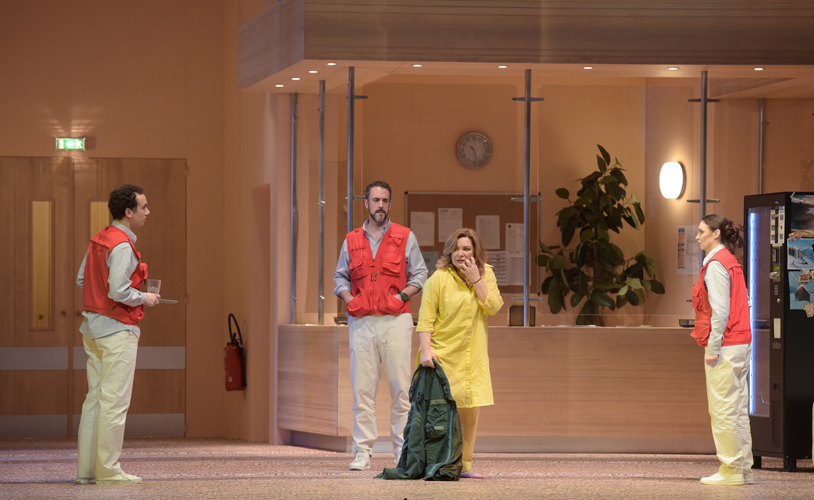
The flight from a past life, which is worse than death, leads him to a bright, clean and late place - "The Center for Psycho -Traumatological Assistance to the Victims of War." He comes there, succumbing to the persuasion of a teenage son, and he roams restlessly, never deciding to finally want to stay here. With some surprise, he recognizes a person who plays chess peacefully-it seems that this is someone from a past life. Perhaps - the enemy, but by the way - who knows? Aeneas hesitates. And here is the head of the center, who conducts sessions of group psychotherapy in the form of role -playing games, offers such an exercise - to play an attack on the city of Carthage. The Libyan king Yarba threatens Queen Carthage Didone (Ekaterina Semenchuk sang and played a party with amazing dedication), and Aeneas, according to her title, should save her. A cruel fight “on fists” with an unknown villain, whose face is hidden by an ominous black mask, ends with Aeneas’s victory. At that moment, he decides to stay. Unable to protect his wife, he should protect the Didon, whose hair is decorated with a familiar yellow flower. Aeneu seems to him that he is given the opportunity to live the situation of Syrevov.
But he again makes an incorrect decision. At first, having answered the love call of Dido, he at the end of the most delicate love duet rises abruptly and retires, the voices of “Italy! Italy!". Didon in anger. In the final, she, having convened all the staff and patients of the sanatorium, will commit suicide. The yellow flower slides off her hair. A non-subservative queen in a cardboard crown and a bright purple mantle made of greedy paper, who had hardly reconciled with the loss of her wife, but failed to survive the betrayal of Aeneas, will die truly among the shining world of dreams. And no role -playing games, no atmosphere of artificially cultivated friendliness and participation, even lush palm trees and emerald lagoon in the murals will save Aeneas from an endless nightmare of guilt, and who love him from death.
Subscribe to the COLTA.RU channel in Yandex.Zen to miss nothing