
Translated material
Underground Vyatlag
We left Kirov to Kirs in the evening, almost four hours, in thick twilight.
The temperature on the street is a small minus. November. Little rain immediately began. Ice. The distance of 270 km we drove at minimum speed. From 30 to 60 km/h. Even not, up to 20 were dropped in corners. Behind Slobodsky they saw two accidents. Both - with the participation of heavy trucks, there are a lot of them here. When they turned less from federal significance on the road to Kirsa, there were fewer trucks, but even without their lights it became darker. It turns out that when you go like a dark corridor, time disappears, you stop feeling it. Or, conversely, it becomes so much that it seems that in this crown I have been going for a week, two.
We reached Kirs in five hours.
* * *
Verkhnekamsk district is located in the northeast of the Kirov region. Nearby is the Republic of Komi and the Perm Territory. The administrative center of the district is the city of Kirs. And Verkhnekamye - these are the villages of Kai, Lesnoy, Startsevo and others, these are prisons, these are deaf forests and swamps. People here live in the forest. Not only collect cranberries, cloudberries and mushrooms, but also roll and sell trees.
The Kirskabel plant is operating in Kirs. There are other places of work in the area-for example, in the correctional institution K-231.
About the northeast of the Kirov region you just won’t hear. They say that somewhere in the forests the bells from Kai disappeared. A Siberian tract passed through the city, which was founded by the Stroganovs. For some time there was even customs. Under Peter I, the bells were removed from the Kai churches, from which it was supposed to cast guns. But the Kai men repelled the bells from the convoy. The bells remained in the forest, but for some reason they did not return to their places. It was as if the vataga, who repelled the bells, decided that the matter was done, then not their care. From time to time and from the severity of the bell, they went into the ground, and where to look for them now is unknown. Since then there are many people who want to find a bell. They say that sometimes they come across their tops. But when they return to the same place the next day, they find nothing.
Familiar Kirov tourists said that they somehow went on a campaign to search for bells. November, it is already snowing. Two adult leaders and six or seven teenagers. We stood in a camp in the forest. For water it was necessary to go down to the spring. And then two went for water. They were not for a long time. The satellites followed them, saw fresh traces - as if someone crossed the path of those two. Twilight, troubled time. They called their own - they went out, without water. The spring was attacked by fear. Why is it incomprehensible. We spent the night, went on in the morning. In the evening we saw fresh tracks again. And again, some unaccountable fear-even rather horror. What they are afraid not to explain. In the morning we went to the railway, left home. Twenty years have passed, and this story is very remembered.
* * *
It’s dark in Kirs. If not for the clouds, the stars would be visible, as wherever there is no street lighting. But in the courtyard of the house of Alevtina Nikolaevna, light burned - especially for us.
The house is three rooms, a small kitchen with a stove, stove and sink.
- Come, sit down.
We barely fit at a small table, we eat chicken soup - tasty, hot.
Alevtina Nikolaevna Telepina teaches at a Sunday school, the first year is in retirement. There are enough things. In the summer - a garden, year -round - grandchildren. Alevtina Nikolaevna can tell about the Verkhnekamsk district.
We came here to look for the missing, hidden in the ground. We are a group of Kirov search engines (and I am with them).
* * *
During the Civil War, the villages of Verkhnekamya go from white to red and vice versa. A lot of blood spilled here.
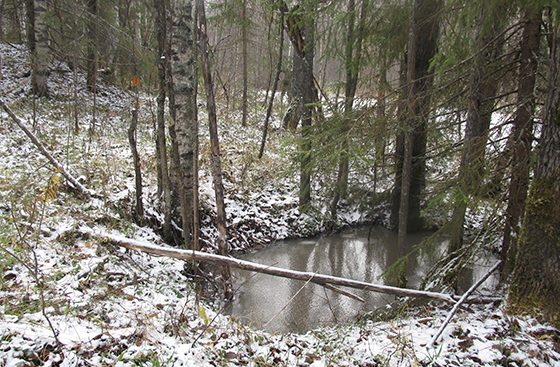
On the Black Lake (near Kirs) a hundred years ago, in 1919, it seemed to be shot by a priest, about. Alexandra Sokolov. But there is very little data. It is known, for example, that it was in April, when the snow was just starting to melt and the ice is still thick in the reservoirs. It is known that the priest was not alone: together with him, the teacher Ekaterina Rudakova and the worker of the Kirsinsky factory Porfiry Filippov took to the execution. Only a pregnant woman in the last dads regretted the wife of Fr. Alexandra. There is a version that the bodies of the executed were pushed into the hole with bayonets and the ice was red with blood. But where they were led - to the lake or to another place, it is not known exactly. However, believers in the 80s came to worship a martyr priest to the Black Lake.
In the morning, Alexander Shironin, a photographer and local historian, shows us the place of the murder of the landowner Smekhov. The landowner was shot in 1924 on the shore of the Gremyachny lake, it is also nearby. Six years ago, our mistress Alevtina Nikolaevna drew attention to the fact that in Kirsa there is a monument to the Red Army soldiers who died here in a civil war. But the dead White Guards are not a monument.
- I went to the priest, asked: why does the church do nothing? - says Alevtina. -I thought that she should somehow act, but then I did not know that the church is all we.
 © Maria Botheva
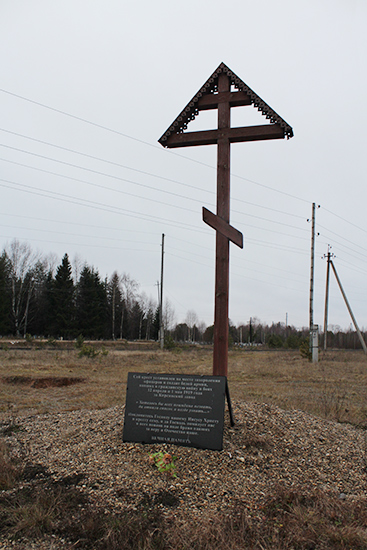
Priest Fr. Anatoly from the temple of the Protection of the Blessed Virgin Mary blessed Alevtin to establish the worship cross itself. It turned out that it is not so simple: you need to find the money, the masters who will make it, people who will help to establish.
“But the Lord always helps.” He sends people, and everything is miraculously solved.
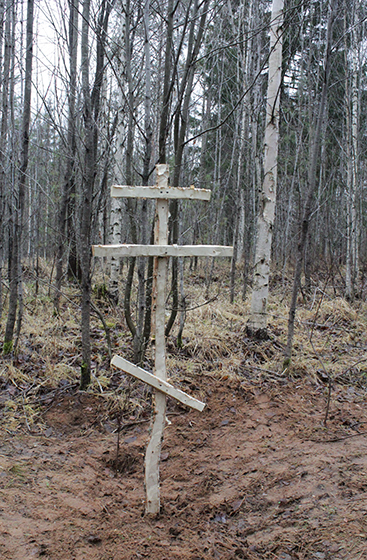
That cross in memory of the White Guards was the first in the area set in memory of those who died here and not buried as it should. He is on the outskirts of Kirsa, where the road intersects with a railway line. They say that the White Guards were buried here.
Apparently, this cross can be considered the beginning of people's work on the practical restoration of the memory of those who died in Verkhnekamie. Restoration in the site of Vyatgla.
* * *
In the 1930s, camps appeared in the Verkhnekamsk district. The history of their creation begins in 1931, when the Yar railway was built - phosphorite. Baracks for prisoners grow up with the arrival of the first steam locomotive.
The first mention of Vyatlag dates back to 1937. The management of Rudnichnaya received an instruction to allocate buildings for the temporary placement of the management of the Vyatka camp and its employees with families. Since that time, tent camps are being built along the road.
 © Natalia Babintseva
On February 5, 1938, order No. 20 was issued for the People's Commissariat of the Interior of the USSR. They were ordered to create in the north-east of the region the Office of the Vyatka correctional labor camp of the NKVD of the USSR. But the first stage of the prisoners from Kirov (several hundred people) Vyatka for the correctional labor camp took before the decree, January 8, 1938. Later, mass stages from other regions of the country (Leningrad, Moscow, Gorky, Kharkov, Tbilisi, Sverdlovsk, etc.) began to arrive.
By March 1, 1938, there were about 7,000 prisoners in the camp, by the beginning of 1940-more than 20,000. About half were “enemies of the people” and “socially dangerous elements” convicted under the 58th article. This also included the repressed for "economic counter -revolutionary wrecking." The rest of the camp population is sentenced to household and criminal offenses (hooliganism, theft, murder, robberies).
In Vyatlag, as in any camp, priests, monks sat. In 2017, 300 copies were published by the brochure of "New Martyrs and Confessors of the Faith who passed Vyatlag." It is very small - 52 pages. It tells about six clergymen. These are holy martyrs - Archpriest Peter Krestov, priest Pavel Nikolsky, Rev. Rafail Optinsky; The ascetics of Vera - Archimandrite Spiridon (Lukich), Archimandrite Pavel (Gruzdev), Archpriest Simeon Kobzar.
In February 1938, Vyatlag was assigned a forest -raised base on an area of 552,000 hectares. Planned volumes - at least 700,000 cubic meters of wood per year.
By mid -1941, the structure of the Vyatka Directorate included 19 units, which were located along the line of their own railway with a length of more than 60 km: it was a logger, central mechanical workshops, agricultural units, sewing workshop, supply bases, construction sites. In the central village there were a secondary school, hospital, kindergarten, club with a library, stadium, shops, a dining room, a bathhouse, a telephone station.
 © Natalia Babintseva
The most difficult period for Vyatgla is the time of the Great Patriotic War. For the needs of defense, the supply of lumber, sleepers, rifle blanks, and barrel overlays was established. Repair and sewing workshops worked for the war, potatoes, cabbage, tournament, oats, barley, Makhorka were sent to the front.
During the war, the conditions for the detention of prisoners deteriorated sharply: in early 1942, contentment consisted only of cereal and flour. There were no fish, meat, fats, vegetables and potatoes in the camp. In November 1941, 389 people died here, in December-699, in January 1942-1111 people.
Andrei Orekhov, the grandson of the priest Dimitry Orekhov, who died here, met in the village on the phosphorite former camp guard and recorded his memories :
“How did the prisoners feed? Of course, not sugar, but what you wanted, enemies! But there was no much mortality, they fed two boilers, there were no interruptions with bread, even some money was accrued.
And when the war began, it became bad, the prisoner is generally death. The rations of bread were cut, in the balland - water and cleaning, there are no replaceable clothing. In winter, they froze strongly, froze, cold. Self -collapses began: who is pulling his fingers on his hand, who would sit down on their feet, then shouted that it was by chance, missed, they say. They hoped to lie down in the infirmary, but no one believed them. Even those who really were injured at work were considered self -power. Of course, they were determined in the hospital, but there is a solder - that in a schizo, you won’t stretch for a long time. Almost everyone died. The principle of socialism: who does not work, he does not eat.
It became very bad in 1942. Everything for the front, everything for victory, camp - horseradish. The free were hungry, everything was on the cards, what to say about these: like flies Merli. Sometimes there were no food supplies for months. And then the winter was fierce ...
My father and I in the winter of 1942 harnessed our Burka every morning ... <...> We drove through the huts immediately after the rise and divorce to work. There, the dead remained on the bunks, who did not survive the night. At first, the doctor examined, then they undressed them, dragged them naked on firewood, and my father and I were already carrying to the cemetery. Where is the cemetery? And over there, you will go ahead on the way - there will be a large field behind the trees, and there they buried it. At first, they did a foot a day, then two, then three, and I remember, it was a day when 17 people were taken, so we went four times, the Burka was completely out of our strength.
 © Maria Botheva
No one thought that such a disaster would be and so many people would die, it took half a camp over the winter ... And in winter what funerals? He put it in a snowdrift, threw snow in snow - and goodbye, comrade, until spring. In the spring, the brigade was already being detached what was left, they buried in trenches. The wolves, the foxes were fat - horror, they also have a hunt.
After the war, how Stalin died, the head of the field ordered this to plow this. They didn’t want to, but I had to. The tractor goes, and behind him, my priests, the bones of white and white are lying! Then the chairman ordered the women with baskets to go beyond the tractor and collect bones. Gathered and dragged somewhere, and planted the field. What oats were there, in the belt! I have never seen such oats. The next year, everything is visible, but there are already fewer bones. And it was so three or four years old, then everything, the bones ended-and the small oats went, the plugal ones. The field was exhausted ... And then there, a highway was laid in the field. ”
Over the course of 1938-1956, about 100,000 people passed through Vyatlag. More than 18,000 died or died in a camp.
The correctional institution is working now. The number of camp points is reduced. But the history of the region has to be collected by bit. It is also not easy to detect the burial places of Vyatgla prisoners.
* * *
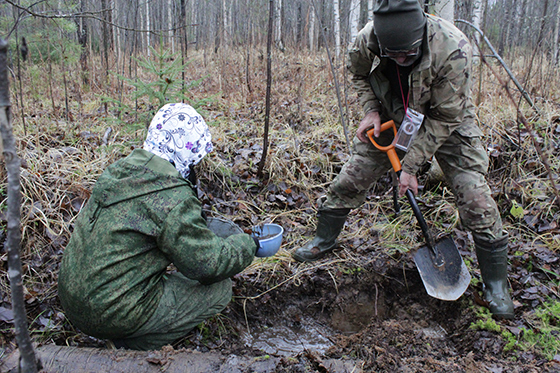
An experienced person can say a lot. For example, round pits in the forests where the Great Patriotic War passed, these are funnels from shells. Often a soldier was buried in them. To understand whether this is so, you need to open the funnel: first scoop up the water, then dig. The place where you need to dig is determined by the touch - with the help of a long iron rod, imprisoned as a screwdriver minus. This instrument is called - a probe. When he stumbles upon an obstacle underground, the person who holds the probe hears a characteristic sound. Wood, stones, glass and bones sound differently. If the bone knocks, they make a pit and check what is underground. If a tree, they see what is under it.
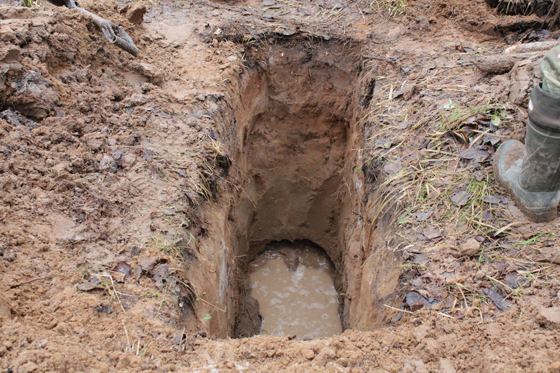
In the Verkhnekamsk district, the land in the forest is freaky with timber trucks, there are pits from uprooted stumps. You won’t understand if there was a funnel or a tree once stood. But in some places there are quite large rectangular pits - approximately 1x2 and 2x3 m.
 © Maria Botheva
Last year, several of these rectangular pits were found near the village of Sork (about 80 km from Kirs). In the forest next to the civilian cemetery. We checked one, shallow. They found a board, and on a characteristic bevel it was possible to say that the board is from the end grave boards. There were forged nails. And under the boards - the remains. Maybe this is a civilian burial, it is difficult to figure out - there is no fence between the cemetery and the forest. But there are a lot of deep holes.
On the other side of the sorca is also pits. This place was shown to search engines a resident of Rudnichnaya Alexander Vyaznikov, who once worked in a timber industry. The remains were also determined in the pits - and also under a tree. But this time the boards are ordinary - without nails and bevels. Apparently, people were lowered into the ground, then they put boards on them and covered with earth.
Now the sorcerers have two memorable crosses. Two large banners hang nearby. One talks about Maria Nikolaevna Malysheva. In 1941, she was arrested that the liturgy was held in her house in Vyshny Volochka. Together with her, her husband Boris Alekseevich was arrested. Both of them served the term in Vyatlag. Maria Nikolaevna died in a camp in April 1942. It is known that she sat in the second camp of the village of Sorda.
 © Maria Botheva
The second banner tells about the priest of Dimitry Orekhov.
“His grandson sent money to a sign and a banner, we hung it,” says Alevtina.
* * *
We go to the forest near the village of Startsevo, about 50 kilometers from Kirs. We stop next to the railway crossing and go along the sleepers. Cloudy. Small, soaked rain drizzles, but soon ends. On both sides of the railway - a bare autumn forest, faded grass.
Five hundred meters go into the forest. On the edge of the edge is a small fossa. We checked her - empty. In forty steps deep into the forest is another shallow groove. An ordinary person could not pay attention. But next to her, after a few meters, - the same recesses, in parallel, at a slight angle to the railway.
The commander of our small search detachment is Natalia Babintseva. For many years, she has been going to the places of the Great Patriotic War to the Novgorod region. Together with other search engines, he searches and raises the remains of the dead fighters from the ground.
“It seems like something was dragged,” she says.
The probe went deep.
- Soft earth, interfering.
Another of the signs that the remains can be in the Earth is a soft land. Under it is solid, the mainland. Usually the probe rests against it. But if it leaves deep, the earth is soft. Maybe once they got the ground here, and then threw a hole.
It is necessary to act quickly until the daylight day ends. We began to make a shurf, first 20 centimeters depth. The probe easily leaves all. The sound determines something wooden. We have to expand the pit so that it is more convenient to dig. At a depth of about 1 m 20 cm - a board. Some remains are visible under the board. Near the railway we find a sawn birch, hastily we build a cross from it.
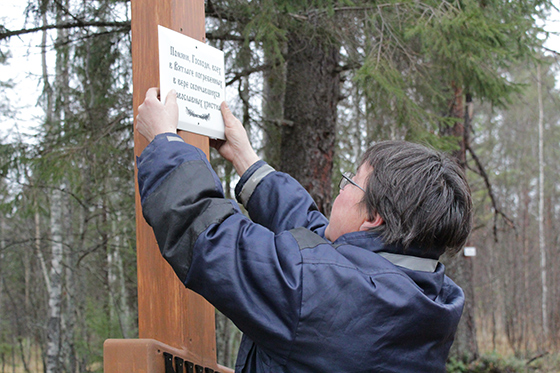
Another wooden cross, Alevtina put it nearby recently. It is visible from the railway. We had with us an enameled sign with the inscription “Remember, Lord, all in Vyatlag of buried Orthodox Christians” - to attach to a large cross. We fasten it.
 © Maria Botheva
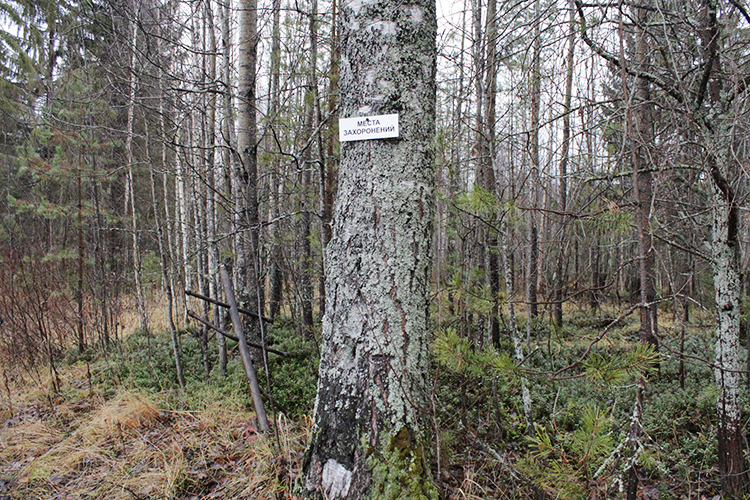
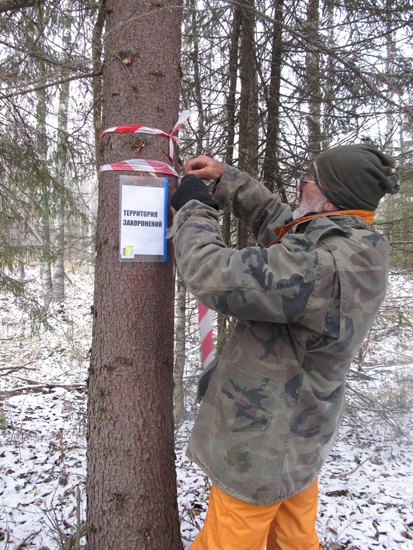
We go around the whole strait, hang signs on the trees that report that there is a burial zone so that logging and other works are not being carried out here. It turns out about 300 sq.m.
Already in Kirov we are talking about what we saw.
- What is this? Something makes people, not relatives, put these crosses, look for burial places, ”says Natalia Babintseva,“ for some reason we also go and look for them. Why suddenly everyone began to sit restlessly? What makes you rummage in history, write articles about Vyatlag, look for traces of prisoners? When you raise the remains of the fighters of the Great Patriotic War - this is very exciting, reverent. The remains of the battles are understandable, understandable. And here - everything is wrong. This should not be. Finding graves is not a goal. The goal is so that the dead here to gain peace. That one needs to put a cross, serve a requiem, give the relatives of the buried to find a place where they can bow.
Probably, it’s too early to say with confidence that the places where we were was Vyatgla's cemeteries. But, it seems, Vyatlag opens a little names of his prisoners. Or it is the dead who want to be remembered about them. Maybe someday it will become known about the places of death and other people. But how to find their traces?
Subscribe to the COLTA.RU channel in Yandex.Zen to miss nothing