
Translated material
Memory. Yakov Protazanov
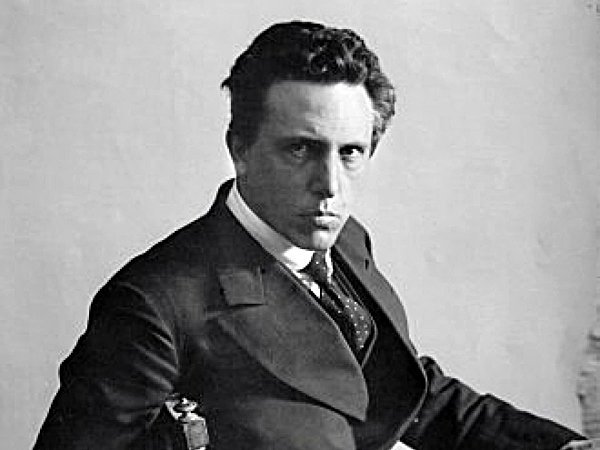
On February 4, 1881, Yakov Protazanov, a pioneer of Russian cinema was born.
Personal business
Yakov Aleksandrovich Protazanov (1881-1945) was born in Moscow, in a large family of a hereditary merchant. His father Alexander Savvich came to Moscow from Kyiv. He did not have enough business grip, so he worked for hire - he served in the company of famous industrialists of the Shibaev brothers. Mother Elizaveta Mikhailovna led the farm, she graduated from the Elizabethan Institute of noble girls, freely mastered the French language, loved the theater very much.
In 1900, Protazanov studied at the Moscow Commercial School and was going to enter the St. Petersburg Polytechnic Institute, but at that time his family went bankrupt, and Yakov got a job as a tutor in the Timashev Merchant House, then worked for some time on the manufactory of Schrader and Co. JSC.
Having received an inheritance from the Kyiv aunt of Efrosini - about five thousand rubles - Protazanov in 1904-1906 launched him to travel abroad (the money ended quite quickly). He visited France, Italy, Germany, Austria-Hungary. During these trips, he first met a cinema and fell in love with him.
Returning to his homeland and replacing several professions (he was a desk, an accountant, translator), in 1907 he became an assistant to the director of the Moscow film studio Gloria.
In 1911, he made his debut in the silent cinema as a director, setting the film "Charming Song". Soon other work followed. In total, before the revolution, Protazanov shot about 80 films.
During this time, he managed to change the place of work twice: Gloria joined the film “Timan and Reinhardt”, where Protazanov performed the posts of assistant director, operator, requisition, head of an acting group of 12 people, cashier, accountant and translator. In 1915 he moved to the movie of Joseph Ermolev.
In 1917, Protazanov worked on revolutionary and disclosure films. He filmed the story "Andrei Kozhukhov" by Sergey Stepnyak-Kravchinsky-a terrorist-populist, who killed the chief of the gendarmes Nikolai Mezentsov. He set a film about Sofya Perovskaya, who led the attempt on Alexander II. In a revolutionary theme, his paintings “Do not need blood” and “prosecutor” were also designed.
However, in 1920, along with the rest of the troupe of Ermolev, who by that time moved to Yalta, the director emigrated. He worked in France and Germany, for three years he shot six paintings there.
In 1923, thanks to the persuasion of the director of the Studio "Interrabp-Rus" (the future film studio named after M. Gorky) returned to the USSR. At this studio I shot several famous films. This is the fantastic tape of Aelita based on the novel by Alexei Tolstoy, and the comedy popular at that time - the “Close from Torzhok”, “The process of three million”, “The holiday of St. Joorgen”.
The following paintings by the director were already sound. The most striking of them are the political pamphlet of “puppets” (1934) and the “unpridant” based on the play of Ostrovsky (1936). The last film received a gold medal at the World Exhibition in Paris in 1937.
With the outbreak of war, the director was evacuated to Tashkent, where he shot his last film - the comedy “Nasruddin in Bukhara” (1943).
Yakov Protazanov died in Moscow on August 8, 1945 at the age of 64. Until the last day, the director worked on the film adaptation of Ostrovsky’s play “Wolves and Sheep”.
 Yakov Protazanov Culture.ru
What is famous
One of the pioneers of Russian cinema. Proletazanov’s simple masterpieces are considered the paintings “Peak Lady” (1916), “Father Sergius” (1918), “Aelita” (1923). Its most famous sound films are the adaptation of the “Aznovanitsa” by Ostrovsky (1936) and the comedy “Nasruddin in Bukhara” (1943), created in evacuation in Uzbekistan.
Protazanov is one of the most prolific directors of the feature cinema, who shot about 115 films (most of them are dumb paintings).
What you need to know about
The head of the Studio "Interrabp-Rus" (the future film studio named after Gorky) Moses Aleinikov personally went to Berlin to return Protazanov to his homeland. Protazanov, as they say, said to the proposal: "I would be happy." And his wife objected: "Where will we live?" Aleinikov promised to arrange it. After which the director’s wife allegedly asked: “Will we have silver spoon?” - "We will." - "Then we are going."
The director had not yet left Berlin, and in the USSR a scenario was already written for him and the scenery for the film “Ivan the Terrible” based on the novel by Alexei Tolstoy “Prince Serebryany” was built. It was necessary to create “Russian Western” from Protazanov so that the film could be successfully sold in the West and get currency, the necessary, including for the purchase of film and equipment.
Direct speech
Protazanov about the first directorial work: “Once, comrades-actors gathered in a theater restaurant on Petrovka. The impromptu feast unexpectedly took on the character of a home -made concert.
My great friend, actor V. Shaternikov, with great feeling and expressiveness, sang and bisled the then fashionable Russian song - "The Song of the convict." My first script was soon written on the plot of this song, which was bought for me for twenty -five rubles - the money that I had then seemed considerable!
At the insistence of the actors, I was entrusted with the production of the picture. The success of this first work was unexpectedly large. The painting "The Song of the convict" dispersed in the amount of sixty -five copies - the figure at that time is huge. My salary increased immediately from eighty rubles a month to four hundred - ministerial salary! ..
From this day, I began to work in the cinema as a full and authoritative director. ”
Actress Olga Gzovskaya about the director : “Protazanov very rarely changed the people with whom he worked. He picked up a team for a long time. Actors, cameraman, artists, somersault, make -up artist have always been a soldered team ...
Protazanov knew how to guess the actor’s mood and correctly use the state of high creative upsurge at the contractor. Therefore, in the pavilion there was always a reserve more than the scenery than the shooting of the shooting day.
The case that occurred during the shooting of the painting “Pann Mary” according to Roman Tetmayer is very characteristic of this regard.
Having shot the scenes that were scheduled for this day, Yakov Alexandrovich invited me to make another solo scene with which we had to start the work of the next day. It was already a late hour, but I felt that the director was right, it was necessary to do it today, otherwise the night would pass, and it could cool down what has naturally accumulated from the work of the whole day ...
Although this scene was not planned by Protazanov for shooting on this day, the director was completely prepared for her, and the difficult shooting was easily and quickly. ”
French director Rene Claire on the filming of Protazanov ( magazine "Cinema Notes"): “I met with Yakov Protazanov at the end of 1920. Some time before, he came to France with a group of Russian filmmakers. I was then a journalist and knew about cinema only what a simple viewer knew about him; Therefore, I was a lot surprised when Protazanov, carefully looking at me, suggested playing a role in the film "The Meaning of Death" - a gloomy drama by the novel by Paul Bourget. I never thought to become an actor, but I was at the age when everything new seems promising. However, my student’s student was very difficult because of my complete ignorance. I hardly understood what they demand from me, and, having realized, did badly. Protazanov’s patience was subjected to grave trials, and he more than once threw his hat to the ground, which served him with an expression of higher discontent; The reasons for this discontent were too well known to me ...
After the filming of the “meaning of death”, I never met Yakov Protazanov again, which I am very sorry about. I would like to express my gratitude to him. Indeed, thanks to him, and later Louis Faead, I realized that cinema is a fascinating adventure and that if I have been given to him, then my role should not be played out of the lens, but behind the chamber. ”
5 facts about Yakov Protazanov
- In 1911, the novice filmmaker married Frida Vasilievna Kennik, sister of one of the founders of the Gloria film studio. They had a son George. After the death of her son and husband, Frida Protazanova turned to Molotov in 1946 and achieved a small personal pension for herself 350 rubles. She wanted to establish Protazanov’s fund and personal scholarships for VGIK's excellent students, but this idea was not embodied in reality.
- For greed to work and for the rage, which was called “lazy and inert people” in Protazanov, French filmmakers, according to the director, jokes Jaques le Terrible, Jacques Grozny.
- The productivity of the directors of silent cinema was incredible. In 1913, Protazanov set 13 paintings, next year - 19, a year later - 12, in 1916 - 15. The owners of the film at that time demanded to produce at least one tape per month.
- Despite the production race, Protazanov was a fan of the Art Theater, carefully developed the psychology of his heroes. And never made a sampling.
- A special place in Protazanov’s work is occupied by a film adaptation of literary works. He shot films on the “War and the World” and “Father Sergius” by Leo Tolstoy, the play “Anfisa” by Leonid Andreev, “Besm” Fedor Dostoevsky, “Peak Lady” by Alexander Pushkin. The name Protazanov was widely fame after the filming of the painting “Leaving the Great Elder” about the last days of Leo Tolstoy. At the request of the writer’s widow, her rental was prohibited by censorship.
Materials about Yakov Protazanov:
Article on the website "Russian Cinema"
Biography on the portal k1no.ru
Article about the director in "Independent Gazeta"
The article "Protazanov in exile" in the magazine "Cinema Notes"