
Translated material
Caution, modern!
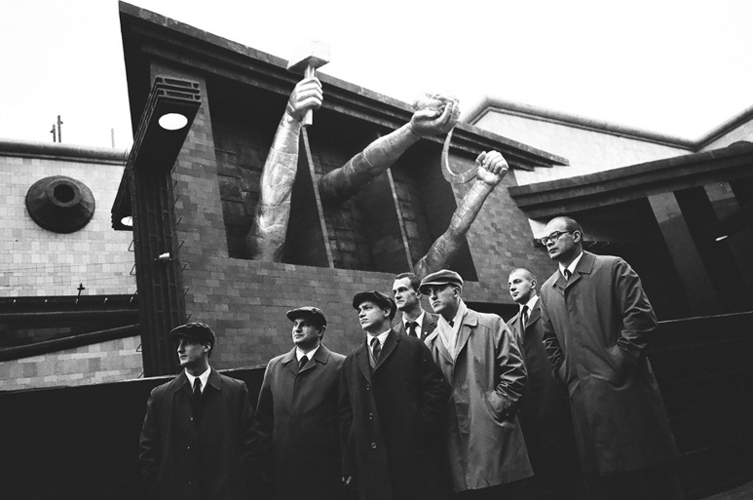
Ilya Khrzhanovsky is a film that few people have seen, but which they tell a lot about. The last two weeks, the entire perokynematographic community (and not only her) discussed only him: colorful panegirists in the profile press faced the extremely simple “fu” of the folk media itself - social networks.
However, in Paris, where the project’s shows are in half in half, almost none of the FB activists have been, and “Dau” scolded and spat on not as a bad film, but as a Satan mill, a totalitarian sect arranged by Khrzhanovsky under the guise of film-Production. All these horrors in the colors and with the intonations of Gran Gignol are described in LE Monde Longrid , as well as in the long-standing interviews of the DAU project.
Visiting shows of film critics respond in the spirit that it is ridiculous to judge the work, not seeing it that private reviews are in general, hyperbola, and in general there is no need to climb into the author’s kitchen, because real art is born out of which Sora.
All these are nonsense.
Let's start with the fried - with the kitchen of the project. It is necessary to climb there first of all: Makhina, who produced 700 hours of heterogeneous material (from which at least one “normal” film was mounted from at least one - it was shown to Ukrainian officials “Derzhkino” last year, they were delighted) - this is very interesting! Moreover, the object of study and representation in the DAU project is a biopolitics, the implementation of power through a system of human relationships, including sexual ones. I would like to know about her process, so to speak, presentations on the set. Just because without this movie the picture will be incomplete: it is obvious that many important aspects of this experiment disappeared when transferring to Kinumedium.
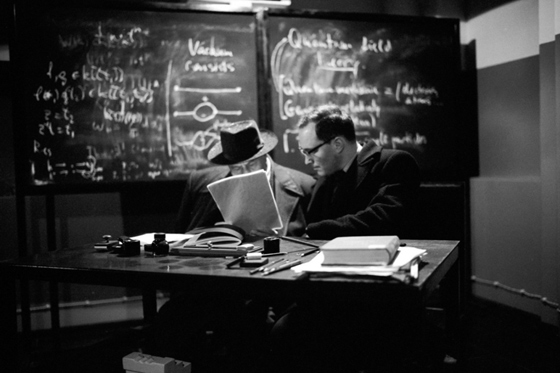 © Jorg Gruber / Phenomen IP, 2019
To study the conditions of production of the film calls us out by the now forgotten theory of the apparatus (or dispositive). Developed in the 70s by French film critics, she claims that the analysis of the film will be fragmented and irrelevant without considering the entire mechanism of production and distribution of audiovisual content: technology, working conditions, nuances of the medium, rolled and display circumstances. Moreover: the authors of the theory of the apparatus came to the statement that the only object of representation in the cinema may not be reality, but this very apparatus. In the case of a traditional film, this is not so obvious, but the extreme case of Dau is an ideal illustration of their rightness: in the end, what is Dau, if not a dock that it really happened on its site (as it is presented by the creators)?
It is the work of the entire Dau apparatus that causes indignation - it is understood as a repressive, totalitarian apparatus and in no case cultural. “Artistry” “Dau” is even denied by its creators, emphasizing the non -regime, the documentary of the occurrence before cameras. In any case, at the micro level of human reactions, gestures and words. That is, in fact, we have before us “120 days of sodom”-but with real shit and real sodomia (although, unlike the characters of de Sad, the participants of the “DAU” seemed to have a stop-word). The production of real excess and transgression, the construction of the Gulag, albeit small and on a voluntary basis, are perceived by the opponents of Dau as a crime against culture.
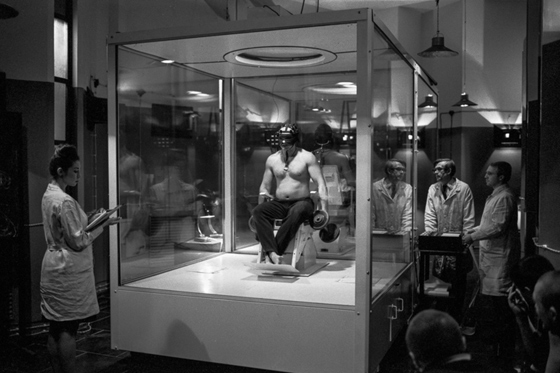 © Jorg Gruber / Phenomen IP, 2019
But art (in any case, in the form in which it exists in modernity and postmodor) is always against culture! After all, he, as Thomas Mann wrote, "nourishes the fire of Satan." Or, as the Soviet art critic Mikhail Lifshitz echoed, "there are good modernists, but there are no good modernism." "Dau" is a concentrate of modernism.
All his signs - the cult of genius, totalitarianism, elitism, a betting and regression rate, emphasis on production technology, performance, and not on creating the illusion of “reality” - were manifested in “DAU” extremely sharply. The unlimited budget arriving from the enlightened donor (in fact, no witnesses note regular interruptions in financing, which happened during the filming period), the figure of the artist as a demiurge, attempts to curb the temporalness, even a final fire that destroyed the warehouse on which the fragments of the total Kharkov installation were stored (Hello Malevich and Malevich and Malevich. His dreams burn all the masterpieces of figure painting) - all this consistently unfolds the modernist logic of the Khrzhanovsky project.
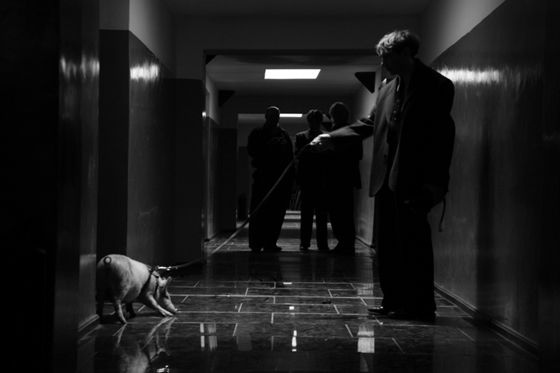 © Jorg Gruber / Phenomen IP, 2019
Even critical reviews about the project work inside the scheme of modernism, which is witnessedly described by the Lifshitz: long before the appearance of the term “post-truth”, he noted the relativism of modernist art critics, the ability of public intellectuals to bring any theoretical base to any art. So here - even the restrained feedback from Mikhail Yampolsky, which seems to hide his confusion in front of the screen cruelty theater in Batay, in the general context, is more of the legitimization of the experiments of Khrzhanovsky than their exposure.
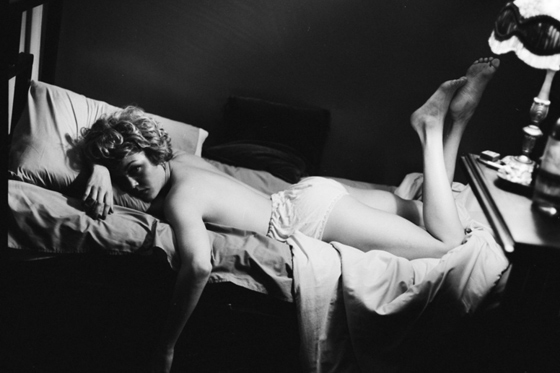
The conceptual part of the "Dau" is firmly soldered with its practical and technological parts. One cannot be realized without the other and cannot give birth to the other. The detailed reconstruction of the Soviet (more precisely, not the reconstruction, but an alternative story for its reasons: the world “Dau” is the USSR, in which the Secretary General became not Stalin or Trotsky, but some Meyerhold or Jewish) requires the reconstruction of the Soviet managerial apparatus. The reviews of the victims of this machine are similar to the retelling “Time, forward!”: The terrible tension of the nerves, dozens of crazy supplies, Khrzhanovsky as a crazy engineer, making more and more kneels - not from sand and cement, but from living people. The apparatus for which the phenomenon of performance (people live before an outsider), power, capital and sexuality (including instruments of power) become the consumables, as a result and produces films, the central and peripheral plots of which are the same performance, sexuality and microvo (in the family or relationships between private individuals: even persistent request to lick the spoon The sour cream, with whom the “mother -in -law” addresses in one of the films - as it is customary to say, “this is also violence”). There is no money on the film, but this part of the ominous atmosphere “Dau” is perfectly created by the installation, so to speak, part of the project - of course, Kharkov, not Parisian.
 © Jorg Gruber / Phenomen IP, 2019
But absurdly indignant at the Rabelaisian superfesses of Khrzhanovsky - and at the same time be raged that there are no “great adventurers” in European film production, but there are only “maximum gray producers who can make applications for grants” and producing “maximally gray films that will later fill the programs of numerous festivals that also exist, also existing. at the expense of state budgets. " There are either grants and control of trade unions, or Fassborders, Visconti, Bergman and Pazolini with the attached features of creative production (wisdom of the budget for cocaine and ransom of blackmails, novels and conflicts with their actors and everything else that can destroy his career at once).
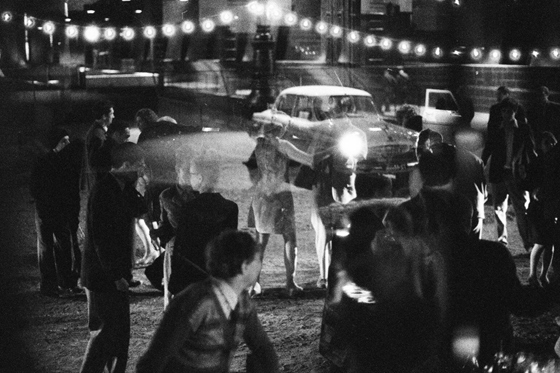
The production of the so -called masterpiece, of course, requires not only author's voluntarism, but also seven -digit numbers (the aura of work of art in the era of its technical reproduction is also created, including the price tag). As well as anti -democratism - the avant -garde by the definition of anti -people, it requires the viewer not only of a certain optics, but also of other cultural baggage - no more weighty, simply different.
 © Olympia Orlova / Phenomen IP, 2019
The same can be said about the totalitarian principle of organizing production-theoretical condemnation of the classical "Stalinist" scheme, in which the adoption of creative decisions from some on earth is delegated by a group to one person, back in the 70s. Alas, the theory of truly collective creativity turned out to be not feasible in practice - even in the Dziga Vertov group, which formally abandoned the concept of authorship and supposedly made creative decisions by voting, real creative power did not belong to the assembly of employees, but to the Duumvirate Goren and Godard. The author’s intention of Khrzhanovsky in the Dau model is equal to Raison d''état ; Of course, it is possible to dispute its existence and justification in principle, but there is a risk of turning into characters - the Brecht didactic play, for example.
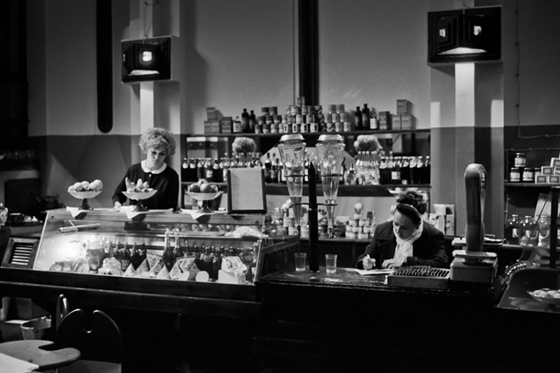
Here it can be argued that “DAU” is not an art (modernism or some other), but a real nonsense: there is no film yet, the footage is not mounted in conventional narrative and requires crutches like installations and games in a quest for alternating entertainment-and they do not really work for technical reasons.
 © Jorg Gruber / Phenomen IP, 2019
But surprise is not the facts of breakdowns and technical/organizational overlays in the Parisian project, but the fact that at least something could be shown. Indeed, in the logic of modernism, there is no need to produce artifacts by an artist (and they are designed for an extremely narrow circle: ideally, the only spectators of the Dau should be the Donators - Adoniev, Officials of "Dermeno", the Arte channel, and so on). His main work is the artist’s own status. And each spit or counterargument towards director Khrzhanovsky only strengthens him in this position.
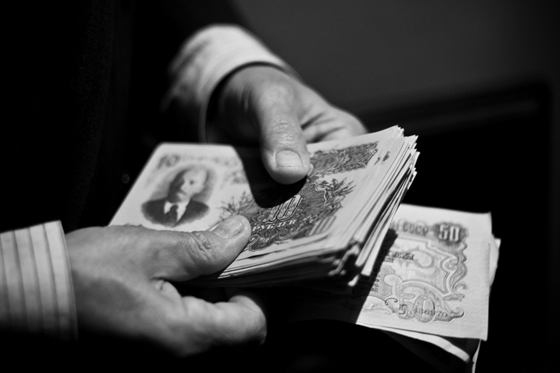
Moreover, the prosecutors' speeches belong to the same discourse of modernism: Khrzhanovsky appears to be a sort of supervision, a personification of evil, a grin, who stole the pleasure of an entire city, buying up all the sidechers, porn actresses and family sets, and even really paid. The policy of the opponents of the “DAU”, no matter how repulsive the process of its production may seem to us, is, alas, a new policy of overthrowing the authorities (what kind of genius he was far away, we will drop it from the ship of the progressive modernity!). It ignores not only the “victims” from the “DAU” (they are used in the same way - only in another, antagonistic, project) but also the dialectic of the slave and the master, power and certainly arising countervity. Interestingly, of course, to read the sensational details of the seduction of guests and actors with a buffet, but it would be more interesting to learn about the obstacles built in the path of Dau by the staff. Nesuns, truants, drunkards and parasites were even at the construction of the Magnitogorsk plant, not to mention the total popular sabotage of the 80s-really everything went according to plan, did not arise a conspiracy, an underground cell of wipers and watchmen?
 © Olympia Orlova / Phenomen IP, 2019
It is clear that the constructive criticism of modernism is quite difficult today - its system today is universal and non -alternative, like capitalism. What can be opposed to the author’s dictatorship - production control? Superhero kitsch? Party cinema shot by ordering European funds? Are there any other strategies for the unification of different audience groups into a single curious whole other than excess-and will this include the audience with another form of totalitarianism?
Nevertheless, the general strategic ambiguity does not cancel the possibilities of tactical maneuvers of thought. The “DAU” case can be subjected to productive analysis, only the stubborn reluctance of the film’s opponents prevents this that the conflict here unfolds in the symbolic, and not real: after all, the opponents of Khrzhanovsky are appealed to representation, to retelling - film and incidents on the site. So the victim from Khrzhanovsky is a picture of the world of the offended public, and not an nameless actress or technical personnel (otherwise all this would be discussed not on Facebook, but in court, but this does not seem to happen). But this picture is again! - It is located in the modernist paradigm of a radical rupture with the previous, voluntarist revision of the unwritten laws of culture, forcible improvement of mankind and completely Bolshevik claims to absolute truth.
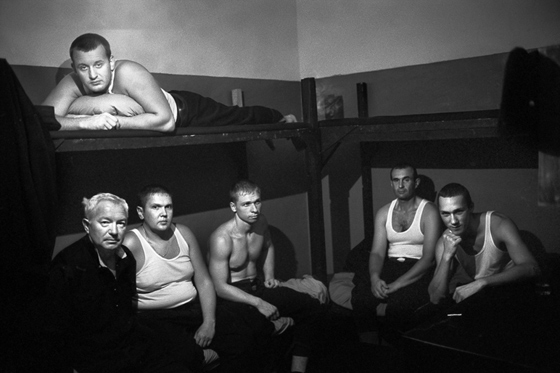 © Jorg Gruber / Phenomen IP, 2019
Dau is accused of the fact that it is a product of the backward past, now the world has become cleaner and brighter. Oh well? Campaigns against the exhibition COUM TRANSMISSIONS “Prostition” (1976), the criminal prosecution of Genezis Pi-Ordge in the early 90s, the verdict of Otto Mulya (1991), the arrest of Oleg Kulik in Switzerland (1994), the trial of the Brener in the Netherlands (1997) show that the past was no more than tolerant Excess than the present.
“Dau” is accused of multiplying violence and injustice - but exactly the same claims are made by modern documentary or military reports. Yes, Khrzhanovsky documents that without his will it would not have happened - but it is naive to believe that the view of the documentaryist does not change the world into which he is invading. Would the Pleskoy boy from Kubasov’s “butterflies” be seduced by the Moscow guest, if not for the other dock-project-“reality”? Would it take place otherwise the fate of the hero of the “Bullet’s flight” if his director had not reached the “Aydar” fighter on the Border bridge? The feature cinema is also not neutral and has no less influence on reality than the Social Experiment of Dau. Take at least the “Donbass” of the Loznitsa - is the reenactive “found video” (belonging to the real sphere of real) on the big screen does not fix and does not enhance the grotesque inhuman image of the enemy? Is the transfer of these truly grotesque stories from the life of the self -proclaimed republics of the East of Ukraine into the sphere of artistic, that is, symbolic, does not finally fix the process of dehumanization of their inhabitants in the eyes of the viewer? And does this dehumanization of the image not serve the escalation of the conflict - because in the war there are no “good” and “bad”, violence and degradation on both sides are always symmetrical (see the same “flight of bullets”)?
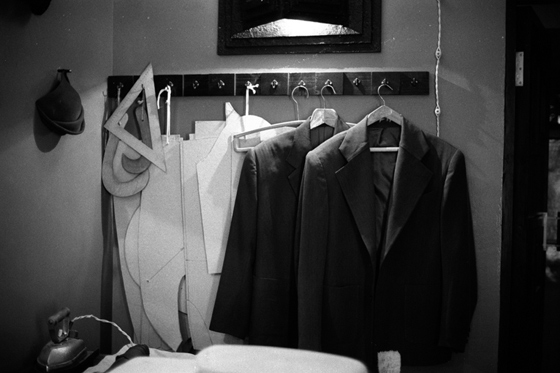 © Olympia Orlova / Phenomen IP, 2019
But is it not the reconstruction of the Soviet system on the DAU site experience potentially therapeutic - and ultramodern? Why are participants in the Falkland War, Indonesian ethno -political purges, a civil war in Uganda, and so on can stage their extreme experience (death of friends, killing the enemy, interrogation and torture of prisoners) to get rid of injury, and post -Soviet people - no? After all, the passage of the “Dau” experience is the same forced auto-to-the-air auto-to-the-air auto, but the “abuser” and the accusing are you yourself, tempted by the buffet and microvo (even Le Monde in your boulevard material leads an interesting bike-they say that the experience of filming in the film made such an impression on the ex-gable of the Azhippo, that he I was going to testify to Amnesty International ;
Yes, probably, even given in microdoses, this experience does not give a good mood, getting rid of problems and does not contribute to personal growth - just as the real experience of the Gulag or Auschwitz did not teach anything “good”, but simply grinded the individuals of both prisoners and guards; But is it worth on this basis to protest against the Kolyma stories or "good -noblishers"? "Act of the murder" of the Oppenheimer and the "wrong elements" of Littlel? The arts of Santiago Sierra, a centimeter of the multiplication of injustice in order to pay attention to the audience invisible to the views of kilometers, and the Pippo Delbono Theater, which takes the scene of the deadly ill and suffering?
Subscribe to the COLTA.RU channel in Yandex.Zen to miss nothing