
Translated material
Soviet art through the problems of horror
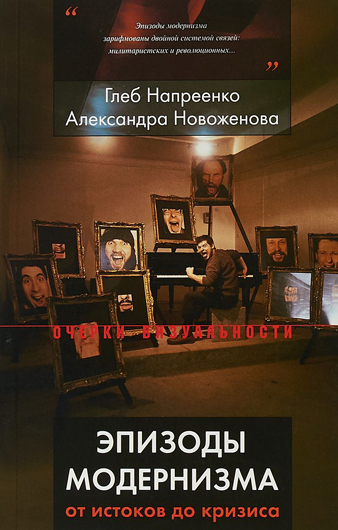
The book "Episodes of modernism. From the sources to the crisis ”(“ UFO ”, 2018), written by Alexandra Novozhenova and Gleb Naprenko, became the result of their joint work on a large series of open lectures and experimental seminars about Soviet art, where sometimes opposite points of view came across. In the summer, the authors held a presentation of a book that turned into a live discussion, but the work in the press - with some exceptions - has not yet received the work. Now the book has entered the long list of the award of Alexander Pyatigorsky . In this regard, and in the continuation of the materials of the memory of Alexandra Novozhenova - Colta.ru, publishes the review of Maria Silina.
Some chapters of the book can be found on the Syg.ma website. [1]
The name of the collection of articles by Alexandra Novozhenova and Gleb Napenko - “Episodes of modernism” - is read as medical slang. These are “episodes” of the disease, attacks, crisis states of artists, systems of representation, functioning of the economy of art in Russia of the era of modernism, that is, in the XIX -XX centuries. This collection is the first finished history of Russian art as violence, the immanent structure of the country's social life throughout modern history.
Naturally, attempts to explain or describe this story were already. But they relate to a reduced understanding of artistic practice as a history of violence against artists, or rather, over the "art" under the oppression of Stalinist totalitarianism. In the earliest examples of this story, readers were offered “formulas” of comparison of totalitarian topics and images (golomste (1994)) or generally a simple alternation of two periods - “good” and “bad” (paperny (1996)).
Later, the classic history of art came under the guise of rationalization of the incident, attempts to explain repressive turns, formally disassemble styles and currents - again strictly within the framework of the history of Stalinism. These were written as “honestly”, “objectively” and chronologically precisely works (Morozov (2007), Manin (2008), Yakimovich (2010)). But these works could not even come close to the history of violence as an immanent line of modernist art history in the USSR, and most importantly, as a living heritage of the present, leaving all violence to Stalin and the past. No wonder in one recent (and much closer to the history of violence as an axis of artistic practice) the book is “Collective sensuality. Theories and practices of the left avant -garde ”(2014) - the author, Igor Chubarov, directly stated the exhaustion of the art history method for an adequate analysis of the history of art of the 20th century. Before the work of Novozhenova -Narenko, it seemed that his words rather offensive to the art critic were not far from reality.
 © UFO. 2018
In addition to the above works that were included in the curricula of universities, previous attempts to talk about violence were at best the monuments of time and the evidence of the “survivors”. This totalitarian history of art is represented by such different, but equivalently emotional texts as “Two Faces of Time. 1939. One year of the Stalin era ”, Maria Skydaeva (2001), the history of the architecture of Dmitry Khmelnitsky“ Architect Stalin ”(2007), the background of which is the obsessive fear of repression, or“ punishment by the home ”by Mark Meerovich (2008).
Perhaps one of the most important works about violence is the book “Did someone remember that we were ...” Olga Roinberg (2004). Structurally, it is actually a document of social history of art, as it tells about the history of artists of the 1920s-1930s, on which it is impossible to work academically without being a marginal. It is not for nothing that art historians, recognizing its fundamental importance for the modern history of domestic art, are focused precisely on the outsthemativity of the author himself. This “naming names” made from the work of Roinberg a kind of monumental abstract or draft that broke off with the death of the author.
The 2010s include new attempts to write the history of Russian art of the 20th century, presented in various museum projects, for example, the guide for the art of the 20th century from the collection of the Tretyakov Gallery edited by Kirill Svetlyakov (2014). In it, as in the collection of Novozhenova -Narenko, there is also a little from Freudism and read horror, however, these attempts were made in the traditions of the post -Talin art history - according to the patterns of humanism. The main meaning of such art stories (we can also recall the texts of Lyubov Shakirova in the catalog of the works of Alexander Gerasimov (2015)) - how to rationalize the story so that everyone finally reconcudents and begins to enjoy art. However, what kind of reconciliation can be discussed if there is still not a single monograph on repressive campaigns in the art of the 1930s, and most importantly, historically and art historically accurate analysis, why and how exactly the artists suffered. The very modern history of Soviet art is divided into three eras: a successfully monetized avant -garde “outside politics”, Stalin's art (unambiguously majestic or unambiguously criminal), as well as the era of increasingly blurring borders of the post -staging thaw.
The considered collection brilliantly solves these two problems - the analysis of violence in the history of art and the revision of chronology. Firstly, the book presents an art history analysis of various mediums of representation of violence, artistic manifestations of undermining of trust in language and bodily in the conditions of both the dictatorship of market relations and the dictate of Stalinism, which spread far over the period of “rentalinization”, thaws, etc. Secondly, the authors work in complete freedom from chronological banality. So, in the work that began to take shape in 2014-2016, there is not a word about the “revolutionary art” and the 1917 revolution are generally absent as a significant line. In 2017, in the freegot’s freezer, it became clear (and this is confirmed by texts) that “revolutionary art” is a product of returning to the Leninist norms of the 1960s, a large deception that is successfully used today only by state-owned large museums for the next development of export exhibitions of the avant-garde.
However, what kind of reconciliation can be discussed if there is still not a single monograph on repressive campaigns in the art of the 1930s, and most importantly, there is no historically and artisticly accurate analysis, why and how exactly the artists suffered.
So, I’ll go to the analysis of the book. The texts of Alexandra Novozhenova reveal the representation of violence at different levels: from the crisis position of the very status of the artist (chapter 1 about Paul Fedotov and chapter 2 on the problems of documentary and reliability in Nikolai Ge, Ivan Kramsky and others) to artistic techniques for the image of violence (in photo collages of military propaganda in chapter 7).
Gleb Naplyenko has a different strategy. For him, the history of art is a search for a way out of state violence (chapter 3 about Casimir Malevich and about the strategies of avant -garde artists in Chapter 4). This output from power control, elimination or active resistance is almost impossible and succeeded, judging by the last chapter of the book, only radical in their hopelessness symbolic gestures, filled with violence (about the artist of Dmitry Pimenov in chapter 11).
In some chapters, copyright voices echoes. So, for example, with the text of Navparenko on anarchic inception and the doctrine of Leni Casimir Malevich (Chapter 3), the head of Novozhenova on production art as the doctrine of the most rational energy savings (chapter 5) resonates. The approach of the two authors, in contact on the topic, is as different as possible, and therefore is clear.
Naplyenko is pursued by the idea of Stalin's violence as a hermetic bubble, once again it seems impossible to break free; This idea is consistently revealed in chapters 10 and 11. Novozhenova uses common concepts, such as energy - mobilization, savings - inaction to show how artistic concepts and techniques of artists are revealed in interaction with society: the Stalinist mobilization economy, military threat, etc. Its method of analysis - the search for interaction strategies (unlike strategies for refusing Naplyenko’s interaction) - allows you to productively talk about mediums and interglies from unexpected, but accurate angles.
So, it shows how, based on the analysis of the application of photographs in the works of Ge, Kramskoy and Vereshchagin, we can talk about different regimes of the reliability of realistic images (chapter 2). The “archaic” easel picture among AHRR artists is an element of the performing constructive construction of new cultural spaces (exhibition-forwarding, distribution of paintings-openings, political manifestos and servicing the military).
Attempts to designate horror and “monstrous otherness” are distinguished by a desperate scream about violence and a mess of wounds in the works of Sherman with the techniques of Soviet military photo collages, although they would seem to be shared by continents and gender agenda.
Novozhenova’s optics helps to see how this active redundancy, the multi -agreement and the omnivorous of the ahrr'ovites turned out to be strategically completely inaccessible to production workers - it would seem, much more imprisoned for functional calculation and medium “invarionism”. The latter, as the author shows, were really utopian, or rather, less culturally mobile, rigid, due to their focus on the creation of monofunctional objects, where "all mental energy should be canalize without a trace into a conscious, socially useful action." This is how the actual and deeply conservative meaning of any “utopia” is revealed-something that cannot develop and move. This conclusion invites the reader to productively reconsider the ratio of utopian and “realism” of the same Stalinism.
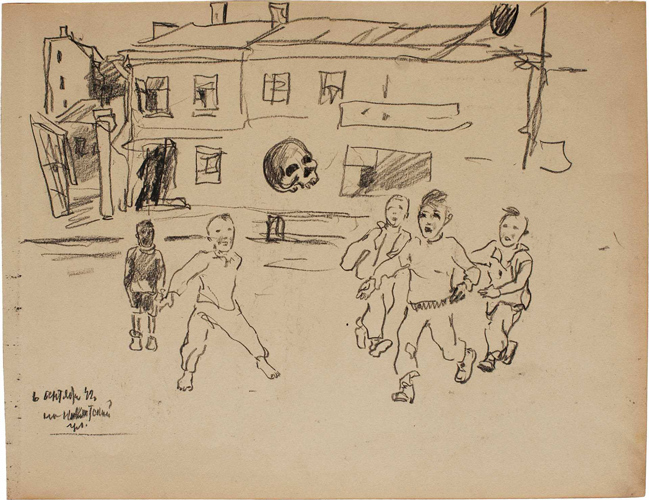
Two chapters about art during the Great Patriotic War sound in unison (chapter 6 Napenko and Chapter 7 of Novozhenova). The theme of war is fully revealed in them as violence, which is quite natural, but this is done as the post -Soviet art history could not. In the texts of Novozhenova and Naplyenko there is no idea to overcome by artists violence, horror and death, the authors do not impose humanism balm on these states. On the contrary, they show how artists, photographers, poets, memoirists were in a state of this horror, who found a way out in the representation of violence, death and decay in military works. So, for Napryenko, Deineki’s work is both the artist’s answer and his inability to cope with the prohibitive situation of violence, which was born not on June 22, 1941, but in the 1930s, with the beginning of the Stalinist terror. In the first paragraph of the chapter, the author exposes the ambivalence of such concepts as life - death, vigor - collapse, citing a human skull instead of a ball, a parachute jump transformed into a deadly accident, etc. Then it is really difficult for the reader to dismiss these images and forget them as a meaningless poetic metaphor.
 © Evgeny Khalde Ruin Nuremberg. 1945
If Deineka’s Napenko expresses a breakdown when transcoding already developed images, then in the chapter on military propaganda photography (chapter 7) Novozhenov shows the evolution of this process of transition to horror problems. The chapter shows the process of “surrealistic shuffling once meaningfully connected parts” and the “holistic identifications” of the socialist canon. Evgeny Khaldeus is fetish and obsessive repetitions typical of photographs of surrealists, motives for defragmented bodies, torn heads, barely distinguishable in mud. In the propaganda photo collages of Alexander Zhitomirsky, home, allegedly discovered in the pockets of the killed Germans, photographs of wives and friends are subjected to pieces of dead bodies. For the analysis of Novozhenov, the critical tools of art practices Cindy Sherman, a classic of American contemporary art, are attracted. Attempts to designate horror and “monstrous otherness” are distinguished by a desperate scream about violence and a mess of wounds in the works of Sherman with the techniques of Soviet military photo collages, although they would seem to be shared by continents and gender agenda.
The chapters following these two (the most saturated by the concentration of horror, or rather, the analysis of the scopophilic pleasure of pornography of death), cover the poststalinsky reality. As Novozhenov shows the material of the monumental sculpture of the turn of the 1960s-1970s, “the communist project becomes visible, as if from space,” and this generalization, this “historical distance” “allows not to notice the so-called mistakes” of Stalinism (chapter 8). The heads of Novozhenova (9) and Napresenko (10) reveal in more detail how exactly artists and relevant artistic practices could not get rid of the reflexes of Stalinist reproduction of violence and preferred to abstract from the past in their own way.
Novozhenova produces this analysis using the example of the use of semi-abstraction and semi-exporation in the art of the 1960s-1970s. She reveals the almost convulsive desire of Soviet artists and the leadership of the art industry for the semiotization of abstract images, the inability to allow the lack of meaning in artistic work, to produce a “radical criticism of an autonomous object”. This is shown as examples of criticism of the bourgeois (American) abstract formalism from the lips of the Stalinist functionary of Vladimir Kemenov, and on examples of the strategy of working with abstraction in monumental art and printing (monumentalists E. Zharenov and V. Vasiltsov, graphics of M. Schwartzman, the Movement group, etc.).
The impossibility of getting rid of the blind spots of Stalinism is also shown in the article by Naplyenko on the example of the relationship between modernism with his faith in meaningful design of artistic reality and the artistic unity of the message and postmodernism with its displacement of meanings as an artistic strategy. On the example of Vitaly Komar and Alexander Melamid, it is shown as a totalitarian contrast between “us” and “them”, the USSR and the West becomes a dominant in the works of artists. The conclusion of the chapter is the statement of the impossibility of overcoming the modernist authoritarianism of the language with which the artists of social art and non-conformism supposedly postmodernist played. It was here that Napapenko draws the border of the artistic situation before and after the collapse of the USSR: “Stalinism in the Soviet Union monopolized history, setting the dominant historiographical scheme that changed, but radically revised before perestroika. And therefore, the reflection of the place of the Soviet state in history inevitably came across a Stalinist interpretation of this place - and the opportunity or inability to question it. ”
However, the last, eleventh, the head of the collection (collective, although individual intonations of the authors in it are quite distinguishable), which, as one could expect from the traditional history of art, could give possible directions for the solution of this damned “Stalinist” issue, begins with the state of the fact that in the 1990s “the state gained a monopoly on violence”. With a careful reading, the head refers to all the episodes dismantled in the collection - from insanity as the state of the artist Fedotov to the representation (or rather, reproduction) of reproduction of violence by the artist and power in the works of Oleg Kulik, Anatoly Osmolovsky, Alexander Brener and Dmitry Pimenov.
This is the reproduction of violence or attempts to get away from it, both in the conditions of Soviet disappointment in “words” and “Pravda”, and against the backdrop of Russian disappointment in democracy, awareness of the a priori error of any democratic choice, which returns the reader to the newly -viv anality (chapter 5) of the energy accuracy of the production proletariat and mobilization virtuosopistance and excessiveness and excessiveness Stalin dancers. It turns out a dead end between these two utopian projects of savings and redundancy, where neither the mistakes of choosing or mobilization of efforts give liberation from the monopoly of power and the state. It is in such a situation that Dmitry Pimenov becomes the final figure of the analysis - the forever beaten “terrorist”, the “killer” of the first persons of the country and the “provocateur”.
As a result, Alexander Novozhenov and Gleb Naprenko really wrote the history of the functioning of violence regimes in domestic art, showing one of the ways of working with this material.
[1] The text was written in 2017 as an internal review in connection with the possible nomination of the manuscript of the book for the Kandinsky Prize (approx. M Silina).
All texts of Alexandra Novozhenova on colta.ru
Subscribe to the COLTA.RU channel in Yandex.Zen to miss nothing