
Translated material
The dark side of the Kremlin
This is the name of the database on the DDOS website, which contains more than two hundred thousand electronic letters of the Kremlin functionaries and the persons associated with it. The creator of the site Emma Best gave an interview NT
According to Emma Best (Emma Best), and this is declared on the Distributed Denial of Secrets website created by her (in the title-Play: On the one hand, DDOS is an allusion to the viral attacks that the sites collapse, on the other hand, the declaration that the site refuses to conceal any secrets, by the contrary, it intends to intend them. distribute), she and her colleagues do not adhere to any other motives, except for the principle: information should be available to people. Everything that the authorities hide from their citizens should be open. In the newly lined Russian files under the general name “Dark Side of the Kremlin” ( Dark Side of the Kremlin )-230 thousand email letters for 1997-2016. The latest are dated 2017. Some part of the base was already published by the Russian media-especially the one that was obtained by the Haltai-Boltai hacker group, which, as it turned out, worked under the control of the FSB, but most of the researchers are studying, who are interested in how the Nubrevelesk community struggled for budgets. The DDOS project has less than 20 people, and only two of them are public - this is Emma and an activist under the nickname Architect.
Who are you? How do you mean yourself?
I am an activist of the movement for transparency of information with an emphasis on national security issues and a special interest in real documents. I asked for many times the documents in [American] state organizations based on the Law on Freedom of Information - Freedom of Information Act. In 2016, I participated in a campaign that demanded that the CIA lay out a database with the possibilities of searching for it: before that it was available only from four computers in the library in the suburbs of Washington. And we achieved that this base was publicly available, which was not easy, given the secrecy of this organization.
They wrote that you declared war on WikiLeaks and Julian Assange for the fact that Assange during the presidential campaign posted the correspondence of the chief of staff of Clinton, who, in turn, was opened by the GRU hackers, according to the special prosecutor Müller. Is that so?
No, this is not so. I criticized WikiLeaks, I wrote that they posted files transferred to them by a certain state, I also wrote about the claims that the American state has to this organization. Some things in the behavior of Assange are being fed, in particular, that it allows itself to be dishonest. But to say that I waged a war against the organization is not true. Yes, I published a list of 140 statements by Assange, which is offensive in nature, I released a correspondence with 1100 messages of their inner chat. But I published the information that showed the organization in a positive context, and it was I who posted the complaints of the Ecuador government into free access that the Assange was hiding at their embassy in London. I support a lot of what Wikileaks did, especially with regard to issues of transparency and access to information, but it does not follow that I will bite my tongue when WikiLeaks or Assange is doing what seems to me dishonorable.
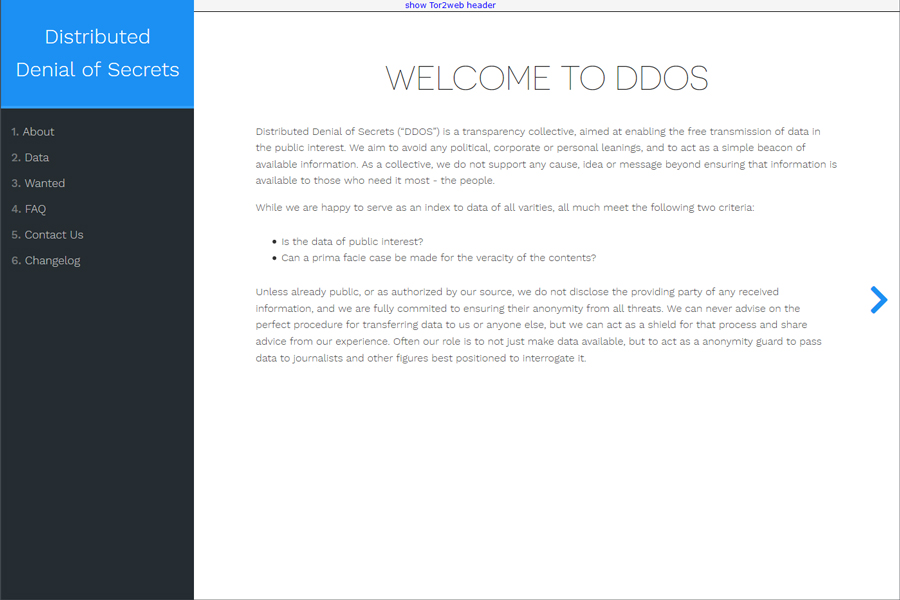
The main page of the DDOS site
The American media accused Assange of participating in the Kremlin war against Clinton. Do you agree with this?
In any case, I think that Assange understood that the Russian state was the source of [the correspondence of the Clinton Headquarters]. But I will repeat our principle: we make information accessible to readers, and there is no motive behind this-people will read and make conclusions themselves. If we are convinced that the leak was sponsored or made by some state, we are talking about this, regardless of who posted this information.
When you write: “Materials sponsored by the state” ( the site has a whole section - State Sponsored ) - what exactly do you mean?
Materials that were possibly hacked or widespread by certain state organizations. We are convinced that the source that made an affordable correspondence [head of the Clinton headquarters] John Podesta was such, the materials regarding Sony were also in the State Sponsored folder, as there were repeated indications that the Severnaya Korea was the leak. So this is either not so, but we consider it necessary to warn readers that there are such suspicions.
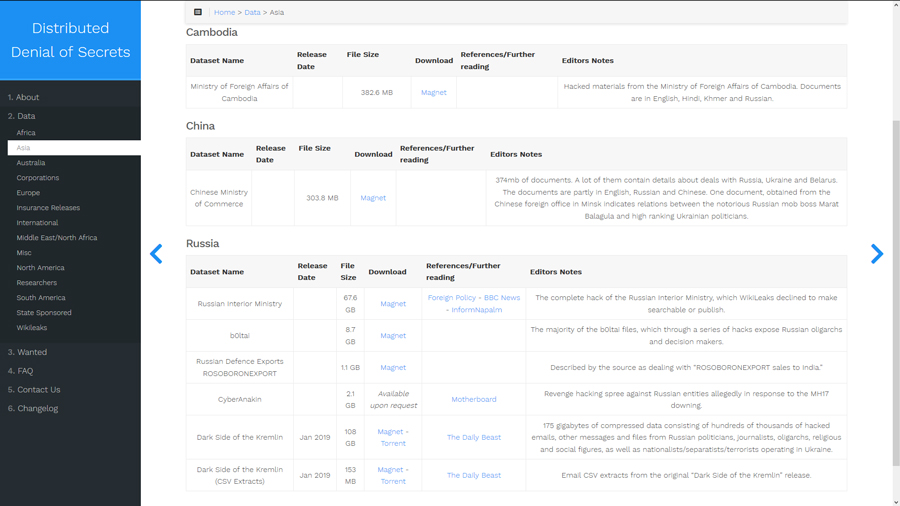
The “Dark side of the Kremlin” is files of 61 different leaks, 175 GB of information, right?
Yes, 175 GB - if not compressed. This is about 230 thousand emails. We repaped these files for the convenience of users and squeezed them strongly, so you will have to download only 108 GB. We made the database of files is available for a simple search, and made a number of things to facilitate working with the base.
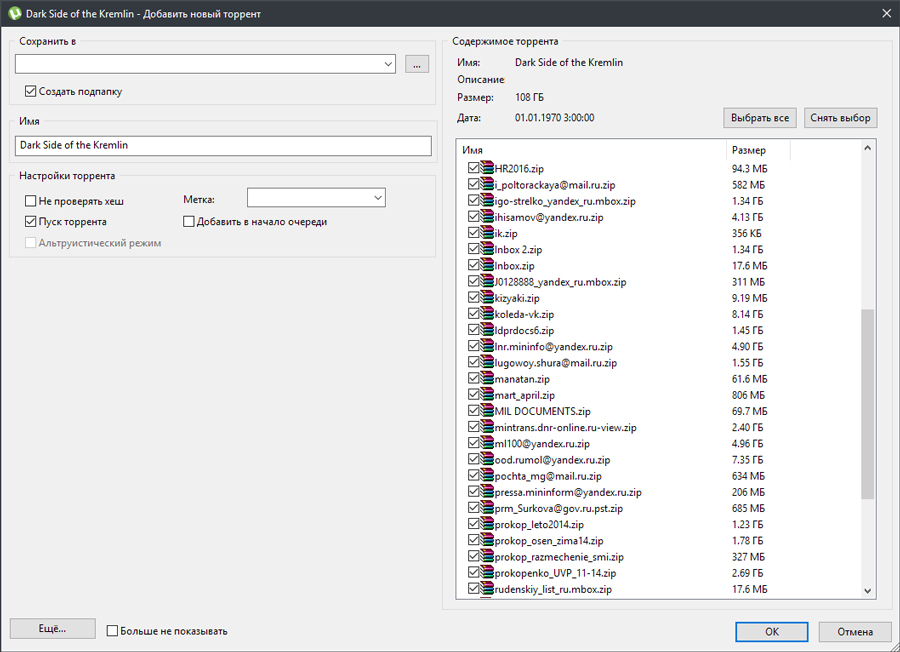
The content of one of the folders of the torrent distribution of the File "The Dark Side of the Kremlin"
What time is these Russian files belonging to?
The latest are Frolov files [ Kirill Frolov - one of the leaders of the Association of Orthodox Experts]. These files became available only a couple of months ago, and there are materials from 1997 to 2016. There are absolutely no letters of 2019 in the database, it seems, nothing from 2018, and if there is, then quite a bit dated to 2017.
You said that part of the materials is that at one time it was published by a group of hackers, known as “Shaltai-Boltai” or “Anonymous International” (first of all, this is the correspondence of the assistant to the President Vladislav Surkov, dated 2013-2014). The recently released group of the group said that Shaltai-Boltai worked in close contact with the FSB. Have you heard about this?
Yes.
Do you think that they can use you - including Russian special services? How sure that the files that you have unveiled are not wiring the special services or that they were not a conscious leak for some purposes of the FSB, how did the necessary information of the KGB or the German Stasi flow out in Soviet times? Or that the files were adjusted in a special way?
These are completely reasonable considerations. We check the files, verify them using DKIM - this is a cryptographic signature that cannot be faked. That is, the files are authentic. In such cases, we prefer not to reflect on the motives of those who made this information accessible, but to provide it to users, and they will already draw their conclusions. Because the other approach is even more dangerous: when the publisher begins from his own reasons, including prejudices, to decide what to lay out correctly and what not.
Do you pay for information?
No, we do not pay for the information provided, as well as we do not receive money for the publication of a particular information. We get materials from sources and post them if we are convinced that the information is authentic. And we do not receive any remuneration, as Wikileaks did in the history of Goldman Sacks ( probably we are talking about a story related to the promotion of WikiLeaks of Hillary Clinton’s employees in Goldman Sacks, and then it became known that Goldman Sacks provided the Ecuador, in whose Ecuador, in whose The embassy in London hides Julian Assange, $ 500 million - * nt * ).
Then how do you cover your expenses?
We pay for everything from our pockets. We have no bitcoin wallets, there are no forms of collecting donations, although we do not exclude that if a generous donor appears, then we can accept funds from him. But we will do it as openly as possible. At the same time, the main thing that we do is check the authenticity of the information. Usually, when we get information from sources, it is enough for us that we know these sources. But it happens as it was with Bradyy Foundation - when there were suspicions that Russian hackers did it, we gave a message about this, but posted the information. (Bradley Foundation - a charity organization located in Miluoi, the Visconsin, the USA, its servers were opened in November 2016 by Anonymous Global, which stated 30 GB of information from the organization’s server, including a letter from which it followed that the organization was given $ 150 million, which seriously exceeded the size of the permitted donations .
You say “we” - how many of you are you in DDOS *? *
We have many partners in various journalistic organizations, to which we provide access to new files in advance. As for our group, I usually say that we are less than twenty, and most prefers to remain anonymous. Only two of us - I and the person known under the nickname Architect are public, but at the same time I know these people and I know where they are and who they are. For various reasons, they prefer to remain anonymous.
You are unlikely to read Russian, I do not hear any Russian accent. How then can you confirm the authenticity of files in the “Dark side of the Kremlin” database?
We contacted colleagues among hackers and journalists who were able to confirm the authenticity of many of these materials. But in cases where we cannot 100% confirm the authenticity of materials, we say so: if there is misinformation, then the responsibility lies with those who provided these bases. We did not have such cases, with the exception of the story with the Bradley Foundation bases, when we immediately provided the base of this kind of disclemer. But I do not know anyone who could swear that the laid out bases are 100% authentic.
We may well be mistaken, which is why we make raw information available for preliminary reviewing (Peer-Review) and analysis. But ultimately, the files should speak for themselves.
A couple of personal issues. How old are you?
Thirty two.
By education, are you a journalist *? *
I've been a journalist for the past few years. But the focus of my work has always been and will be - documentary sources. And for my journalistic work, it is important that in my professional baggage - work with archival materials.