
Translated material
"Agora": In 2018, Russia was six times more likely to limit Internet freedom than in 2017
Over the past year, human rights activists recorded in Russia more than six hundred thousand facts of restriction of the Internet. This is stated in the report of the organization "Agora" published on Tuesday, entitled "Freedom of the Internet 2018: delegation of repression." According to the study, the number of cases of restriction of Internet freedom has grown by almost six times compared to data for 2017.
- Then the number 115 706 was recorded, and this year, the lawyers of the Agora counted 662,842 separate facts.
Most cases are associated with the restriction of access and the prohibition of information on various grounds, including prohibitions on the decision of state bodies.
In 2018, the so -called "red zone", where the number of individual cases of restriction of the Internet freedom, increased, hit 41 regions. Last year there were 26 of them.
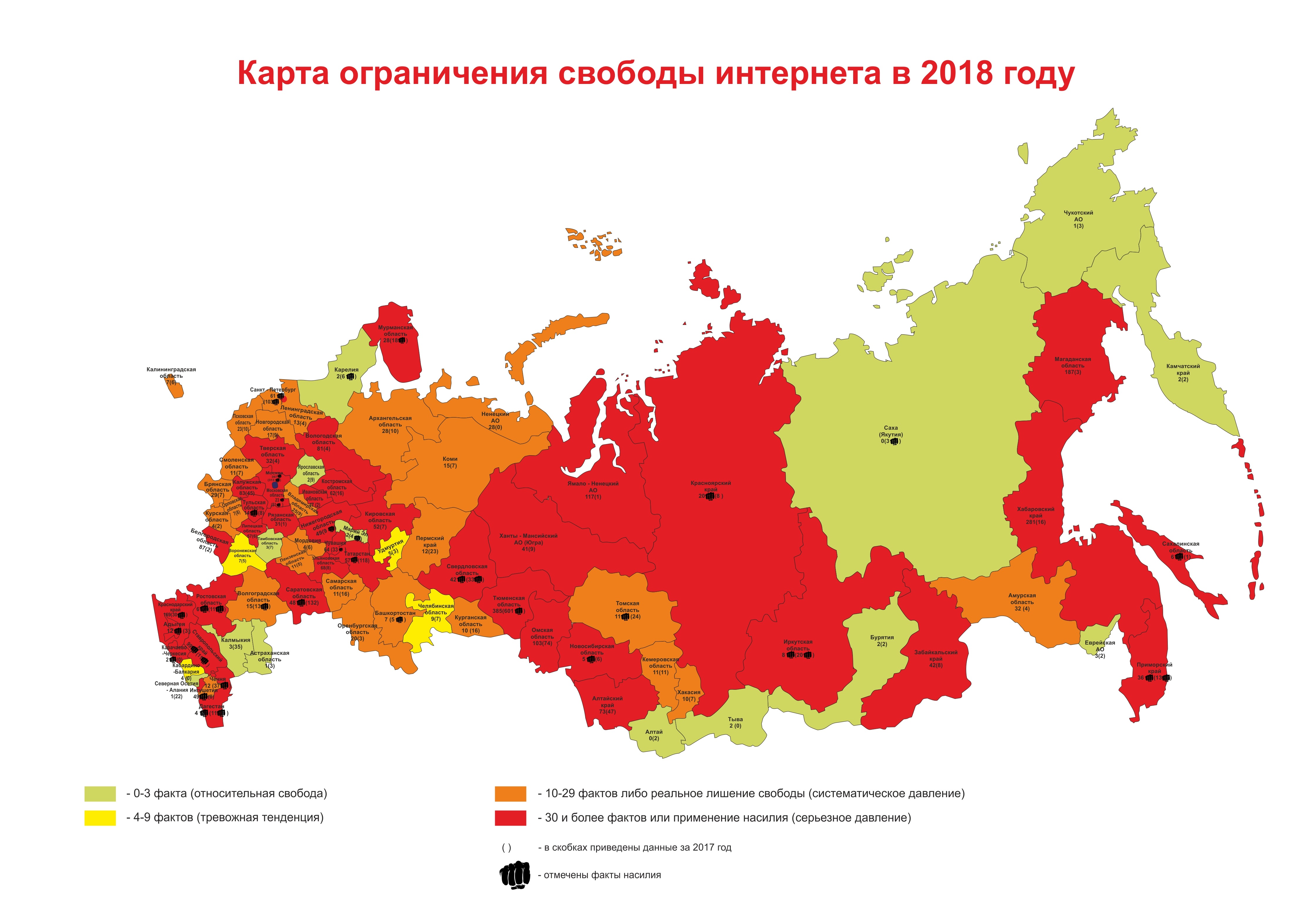
- The situation in Adygea, Ingushetia, Karachay-Cherkessia, the Khabarovsk Territory, Belgorod, Vologda, Ivanovo, Kirov, Kostroma, Magadan, Oryol, Penza, Ryazan, Sakhalin, Tula regions and in the Yamalo-Nenets Autonomous Autonomous Okrug. In these regions, the total number of individual restrictions has either increased sharply, or cases of violence or sentences to real deprivation of liberty for online active are noted, Agora experts report.
Since 2015, 11 regions-Tatarstan, Altai, Primorsky and Krasnodar Territory, Irkutsk, Kaluga, Moscow, Omsk and Saratov regions, Moscow and St. Petersburg, as well as the Crimean Peninsula annexed by Russia-have never left the “red” zone, the study said.
SR in mobile SR on Instagram Wed FacebookBased on the data obtained in the preparation of the report, human rights activists conclude that the Russian authorities hope to control the Internet, forcing large services to cooperate and monopolizing the Internet access market.
At the same time, according to the authors of the report, state bodies recognized blocking at the level of Internet providers ineffective. They also realized the reputation risks that the mass criminal prosecution of ordinary users bears, the authors of the study believe.
- The Russian government this week supported the bill on the possibility of isolation of the Russian Internet segment from the global network. Sources of Rain in the lower house and the presidential administration report that the law may pass the first reading in February.
The authors of the bill claim that its adoption is necessary, in particular, in connection with the threats of aggressive actions in cyberspace, allegedly emanating from the United States. Disconnecting from the global network to protect against threats, according to the authors of the bill, should ensure the "stability" of the Russian segment of the Internet
Wed on YouTube Wed to Yandex.Zen