
Translated material
Holy Ivo with Beatle haircut
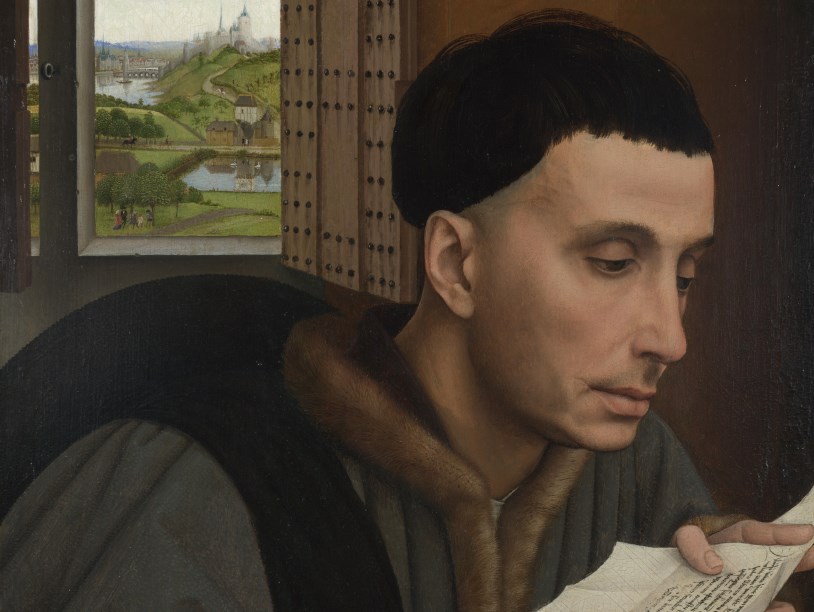
Art criter Christopher Wright believes that the painting “Reading Man” attributed to the workshop of the XV century of the XV century, Rogir Van Der Weiden (1399 - 1464), in fact, a fake made in the 20th century by the famous falsifier Eric Hebborne. The National Gallery in London, where the picture is stored, categorically denies this assumption. About the version of Wright tells The Guardian.

Since a man in the picture reads a certain document, it is assumed that it depicts Holy Ivo Breton, who during his lifetime was a judge in a church court and was nicknamed the "lawyer of the poor." After the canonization, he was considered the patron saint of lawyers. Christopher Wright told reporters that the picture was dated the middle of the 15th century, but a recent study showed that the board on which it was written was made about half a century after the death of Rogir Van der Weiden, so now the picture is attributed not to the artist himself, but by his workshop. But Wright does not agree with this option. He claims that the “Beatle haircut” of the depicted man and other details of the picture “shout about the 1960s”, and the text that he reads is nonsense, which the artist of the 15th century would never have allowed.
According to Wright, the real author of the picture was Eric Hebborne, who wrote it on a genuine board of the 15th century, extracted from ancient furniture.
Photo: National Gallery, London
Eric Hebborn (1934 - 1996) was one of the most famous falsifiers of paintings in the UK. He studied at the Royal Academy of Arts and received several awards, including the British Roman Prize, which allowed him to spend two years on an internship in Rome. There he met the artist, a specialist in Pusin's work and part-time agent of Soviet intelligence Anthony Blanus , who once said that some of the drawings of Hebborne are indistinguishable from Pusssen's works. After such a statement, Hebborne decided to try to give his paintings for the work of the old masters.
Thanks to the acquaintance with the mistress of one of the London antique stores, Hebborn got several sheets of old paper, on which he performed his first fakes. The drawings were successfully sold to several galleries in London. After that, Hebborn moved to Italy, where he opened his own frequent gallery.
Hybborn paintings were sold for tens of thousands of pounds at auctions, including Christie's, among them were fake work by Kor, Castillion, Van Dyck, Purussen, Tiepolo, Rubens, Yana Bruegel and other authors. According to Hebborne himself, he sold thousands of fake paintings, drawings and sculptures.
In 1978, the curator of the National Gallery of Arts in Washington Konrad Oberhuber acquired two drawings in the London gallery of Kolnagi, the famous and respected seller of the works of old masters. One drawing was attributed to Savelli Sperandio (1431 - 1504), and the other Francesco del Cossa (about 1430 - about 1477). Oberhuber noticed that both works were performed on the same paper. Puzzled by this fact, he decided to warn his colleagues in the world and soon discovered another similar work by Del Cossa in the Morgan library in New York, and that copy was studied by three experts. All three drawings came from the Kolnagi gallery, who replied that he had acquired them from Eric Hebborn.
For more than a year, Kolnagi did not dare to publicly report what had happened, fearing the accusation of slander. And even having made an official statement, he first did not mention the name of Hebborn. Therefore, he continued to work, slightly changing his style in order to avoid further exposure, and made at least about five hundred drawings in several years. The profit from its fakes is estimated at more than $ 30 million.
Hebborn admitted to his fakes only in 1984. He stated that experts-artists were not a serious obstacle to his activity. Most of them were too interested in gaining benefit, therefore, consciously or not, they played along with deception.
Nobody put forward official charges against Hebborn. He wrote two books: Drawn to Troble (1991, later published under the name Confessions of a Master Forger) and The Art Forger's handbook (1996).
In 1996, Eric Hebborn was found lying with a broken head on one of the streets of Rome. Three days later he died in the hospital. The murder remained unsolved.
The authenticity of many works of art that have passed through the Hebborne gallery continues to discuss. It is argued that in his confessions he often attributed to himself the authorship and genuine paintings of the old masters. In particular, Hebborn also spoke of a “reading man” from the National Gallery in London as his work, but then refused these words.
Christopher Wright first announced the “reading man” by modern work in his book “The Art of Fakeing” 35 years ago, then not putting forward the candidacy of Hebborn. In response, the then director of the National Gallery ordered to abolish Wright lectures and stop selling his books in the Gallery bookstore. Although the employees saved the books, removing them under the counter, and sold them at the request of buyers.
The 1984 book and the 1991 Hebborn interview, where this picture was mentioned, the National Gallery answered only once, in the 1997 Bulletin. It said that the picture belonged to the collector, who died in 1806, and its entire further history was well documented until the acquisition of its gallery in 1975. For example, there is a drawing by Joseph a scarf of the 1850s, copying a “reading man”. Thus, the “reading man” was known long before the period of Eric Hebborne.
Wright believes that the provenance of the picture was falsified with a garbage, and the gallery simply cannot confess to the acquisition of a fake. In the figure of the scarf Wright sees a number of inconsistencies compared to the picture from the gallery and believes that the drawing reproduces the unsuitable job.
In the last statement of the London National Gallery made on this occasion, Wright’s assumptions are again called groundless: “The picture was written on an oak panel dated dendrochronology ... Until the middle of the XV century ... pigments, paint and varnish and the structure of layers are completely compatible with a probable date of about 1450. For the first time [picture] it is mentioned in 1801 and has a complete and continuous prolapse to the present day. ”