
Translated material
Paid rallies: technology from Belarus
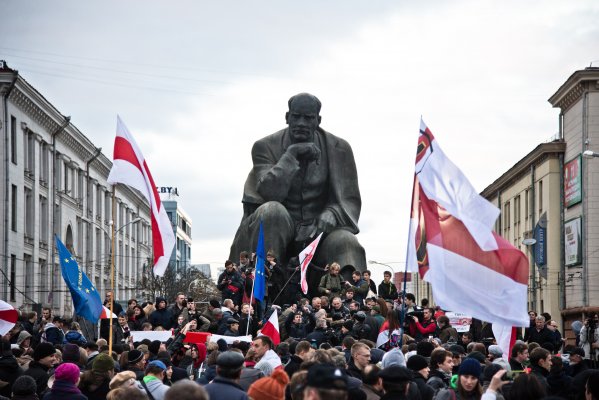
At the end of January, the Government of Belarus introduced a “single tariff” for “non -state street events”. To carry out protest shares, you need to not only obtain permission from the authorities, but also pay for the protection of public order, cleaning the territory and possible medical expenses for shares. The payment by the organizer of the shares concludes the payment agreement with the local police department no later than two days before the promotion.
There were similar rules in Belarus before, but before that the prices were set by local authorities, now they are united throughout the country. For an event of up to 10 people, according to the calculations of the “German wave”, it will be necessary to pay about 31 euros, up to 100 people - about 260 euros, up to 1000 people - about 1555 euros, more than 1000 participants - more than 2590 euros. When holding shares “in places that are not classified by local executive and administrative bodies to permanent places for mass events,” you will need to pay one and a half times more. Street shares in the framework of election campaigns in Belarus will remain free .
OVD-Info talked with politician Yuri Glushakov, human rights activist Natalya Satsunkevich and political scientist Dmitry Bolkunets from Belarus about how all this works and why new rules are introduced.
Yuri Glushakov, ex-candidate for the president of Belarus from the Green party
The Republic of Belarus, no matter how hard it is for anyone to challenge the capitalist state. I would even say that we are dealing with hypercapitalism. Because we have a state as such. Monetization of everything and everything - education, medicine, sports, culture, leisure - is put on stream.
A similar practice with rallies has been valid for a long time. In 2017, I submitted an application for a rally on May 1 in Gomel, in the midst of protests against another monetization - the introduction of a tax on the unemployed. This was the first allowed rally in Gomel in about 20 years. The police set the fences, inspected us all and drove us through the frame.
Then I had to pay several hundred (Belarusian- OTD-Info ) ambulance rubles (the Course of the Belarusian ruble-1 to 30 Russian- ATS-info ), Gorsapu (an enterprise engaged in the cleaning of the territory- OTD-info ) and the police. Most of the Ministry of Internal Affairs - about 300 rubles almost, Gorsapu and doctors - about 40 rubles. We said 100 participants. The amount is decent: at that time in Gomel, the average salary was really 300-400 rubles, we raised money with the whole world. They considered expenses themselves, did not devote to calculations.
Not everyone in Belarus can pay for rallies. In Gomel, the Communists from the Fair World abandoned the action in the centenary of the revolution due to the inability to pay expenses.
When I organized a rally, a contract was concluded before it, part of the amount was paid by prepayment, but most of the money after the action. It is important to note that the idea of a “single tariff” to rallies is fed as part of democratization . Supposedly it will be “like in the West”: he notified the rally, paid and conduct. In practice, of course, rallies can still be prohibited.
Dmitry Bolkunets, political expert
If the organization that wants to hold a rally is not controlled by the state, it is usually not given a place to conduct it. Apparently, now we decided to earn a little on the opposition: a creative idea in a crisis. Although it clearly contradicts the constitutional right to freedom of assembly and obviously discriminatory: citizens who are in “non -state organizations” also pay taxes from which police officers, ambulance and other services are feeding.
A couple of years ago there was a similar situation: for a long time the Belarusian authorities prohibited the performances of several music groups, they spoke next door to Vilnius. Many residents of Minsk went to Lithuania to listen to Belarusian music. At some point, someone prompted the Belarusian authorities, and the concerts of these groups began to be allowed in the empty premises of the ice palaces built in the district centers. The authorities of Belarus realized that you can earn money on this, and not give money to neighboring Vilnius.
The Belarusian authorities have become more loyal to the actions of the opposition for the past two or three years. Last year, an event was allowed in the center of Minsk in honor of the centenary of the Belarusian People’s Republic, which was almost impossible before.
The prohibitions led to the excitement around the opposition events - this is the problem of any authoritarian regimes. Now the pre -election year, as well as the extremely unpopular “Tuneuaniye Law” is in force: perhaps the authorities are preparing to restrain protest actions.
Natalia Satsonkevich, Human Rights Center "Vesna"
Changes to the Belarusian law on mass events began to operate on January 26 of this year. The authorities announced these changes as an unprecedented breakthrough, liberalization and complete freedom. In fact, the usual zilch and imitation turned out.
Belarusian legislation in the field of peaceful assemblies is very actively changing, it is the twelfth changes in 22 years: the authorities quickly respond to new challenges, the development of the Internet and social networks, for example.
In October last year, a consideration of the report of Belarus in the UN Human Rights Committee took place. The criticism of the actions of the authorities was strong enough, especially in the field of freedom of assembly. By November 2020, Belarus was recommended to change the legislation and enforcement and provide information on this regard for the committee.
The need to pay for the possibility of expressing opinions is stupidity. What other rights do we have to pay, in the most literal sense, from our wallet? The state must fulfill its obligations in the field of human rights, and not joyfully transfer them to people.
Now the procedure for concluding contracts with the police and the amount for payment has been settled. But healthcare organizations and cleaners can put up their prices: no framework is established in principle.
It is good that there are clear terms of concluding contracts. Previously, the authorities used the “closed circle” method: the organizations refused to conclude contracts before receiving permission to the action, and the executive committees did not give permission before the conclusion of contracts.
In the next two years, two major political campaigns, presidential and parliamentary elections should be held in Belarus. This also adds intrigues and increases the degree of stress in society.
According to these tariffs, only static promotions can be held, without movement, in special places. There are six such places in Minsk, these are dull parks. If the action is in another place or a procession is held, the prices increase by one and a half times.