
Translated material
Nuclear threat and balance of fear
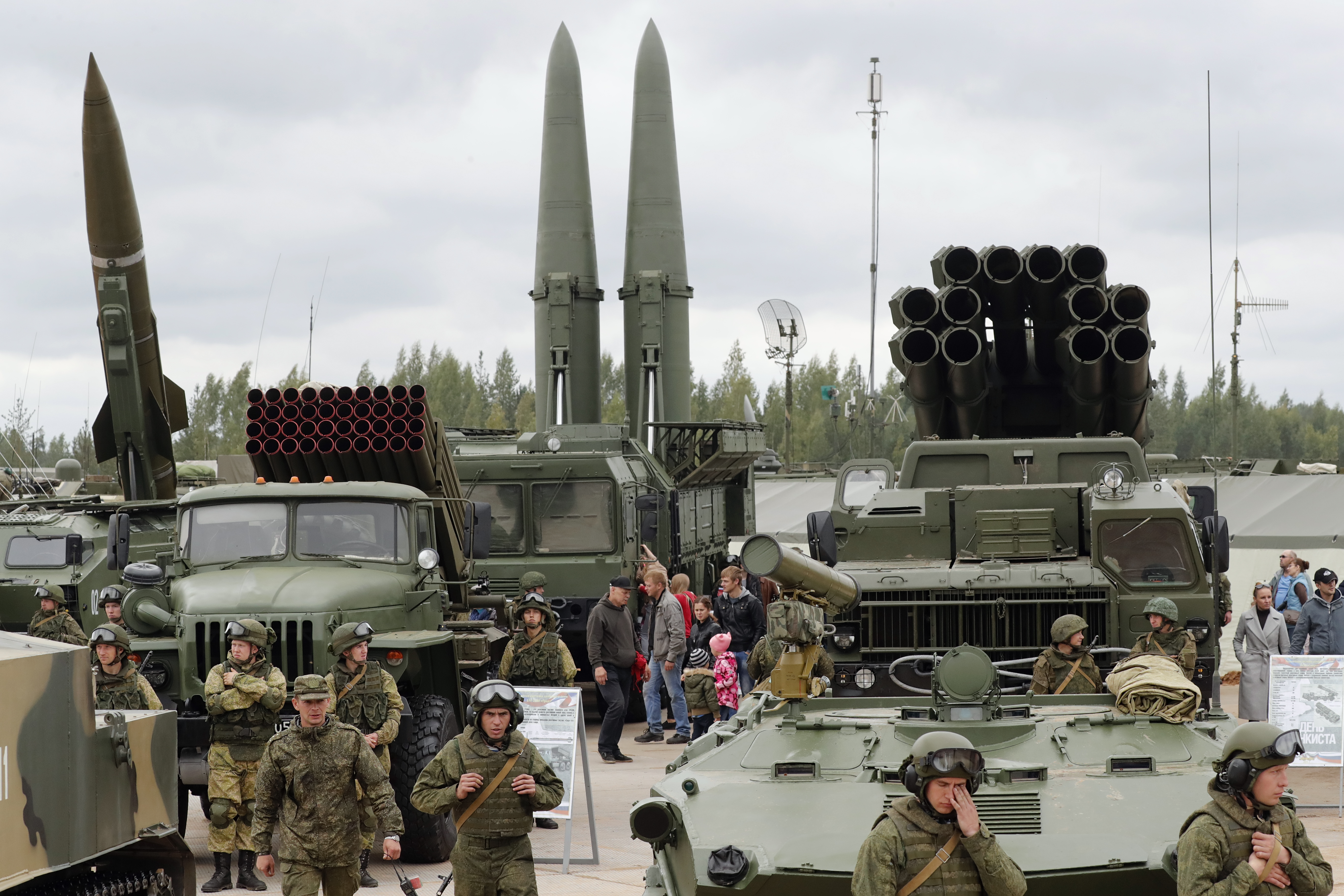
What will hold back a nuclear threat when all contracts collapse? Discuss military experts and political scientists
Will the agreement on the elimination of medium and lower-range missiles go into non-existence, then the START-3-will the arms race become uncontrolled? Will there be at least some restraint levers? They are discussed by Alexander Golts , Konstantin Borova (both - Russia), Yuri Fedorov (Prague), Andrey Korobkov (USA).
Full video version of the program
Elena Rykovtseva: It seems that an unfortunate agreement on the elimination of medium and lower -range missiles comes to an end. Konstantin Borova, hello. We will mourn this agreement today because it is not possible to save it, both parties accused, the United States - Russia, and Russia - the United States of violations. We will talk with our experts, on which the truth is, who is really the culprit of the crash of this contract. And also about what will continue to keep the world. Please give me a political assessment of what is happening with this famous agreement, historical, which has been operating since 1987, and suddenly it will die now. Do you think this is a big tragedy for the world or is outdated, it's okay?
Konstantin Borova: The contract is outdated and performs such a dangerous restraining function. There is already India, Pakistan, China, which should have connected to this agreement or enter a new contract. There is a certain level of new technological development, which, of course, was not taken into account in the 1987 agreement. Another computers' performance, other technological solutions related to missiles. The historical value is great, because it was then in the Cold War. Its value is not even in the substantial part, but in the fact that the process began, the process of negotiations, the Soviet Union, the United States.
Elena Rykovtseva: And the process of destroying a dangerous, terrible weapon that scared Europe. The Soviet Union has really destroyed a lot of things on its territory.
Konstantin Borova: The destruction was not very radical. The main thing - the parties began to negotiate, began cooperation. In today's conditions, this is the main problem - there is no this cooperation for many reasons. The main reason is that Russia does not want to observe even signed agreements, say, the elimination of chemical weapons. In the XXI century, return to the old problems. Geneva Conventions on the Protection of Prisoner of War Rights. There were prisoners of war, Ukrainian sailors, there are Geneva Conventions, they cannot be judged - this is forbidden. They are not to blame for anything, they are military. No, they committed a crime. It began with Nadezhda Savchenko, which they tried to judge for crimes committed in Russia, is absurd. There is no this atmosphere. Russia does nothing to be brought together. Today's press conference of Maria Zakharova, at which the Western journalists laughed, just laughed in a voice when she said that everyone was trying to intervene in the internal affairs of Venezuela, the only Russia protects the poor Venezuela.
Elena Rykovtseva: If she protects, then she indirectly intervenes.
Konstantin Borova: If there was another Russia, if all issues could be resolved. It must be understood that the problem is not in the number of weapons, but there are many of them, 1550 restrictions and 700 on START-3. If Russia had behaved normally, adequately, this atmosphere of negotiations would have arisen - what Gorbachev managed to create, the atmosphere of perestroika.
Elena Rykovtseva: You perfectly understand, this is your position, she is known, but there is another position that America is to blame for everything. She is also well known, with this position we will somehow try to figure out what she is to blame for. Let's see the story about the history of this famous agreement, which comes to its end.

What will hold back a nuclear threat when all contracts collapse? Discuss military experts and political scientists
The text of the copyWidth PX Height PX
The url has been copied to your clipboard
No Media Source Currently Available
0:00 0:01:53Elena Rykovtseva: We already know that Sergei Shoigu said: well, we are finishing part in this agreement and proceeding exactly to create medium -range missiles, very soon they will go into operation. Andrey Korobkov from the United States is in touch with us. We have heard this exchange of courtesy for several months. The first nevertheless, they still raised the question that we are suspended our membership in the contract-the United States, motivating this by the fact that Russia does not fulfill its conditions, Russia has a medium-range missiles. Russia does not accept these allegations and puts forward oncoming ones that the US missile defense system in Europe can be used to launch missiles of the same average range. How do you regard these arguments? How to terminate the contract for some reason or as reasonable accusations?
Andrey Korobkov: The main stumbling block is still the Iskander-7 missiles. By the way, negotiations have been going on since 2013 regarding the contract and its review in some way. But still there are two reasons, they are not associated with a direct violation of one of the parties, but simply with the fact that technological and military realities have changed, drone technologies are developing, and computer systems develop. The contract was revolutionary, he not only reduced weapons, and he first destroyed a whole class of missiles. Why are they so dangerous? Because the flying time of these missiles is two to three minutes, if it is an intra-European exchange, unlike 15–20 minutes for an intercontinental missile. If there is any provocation or technical problem, then nothing can already be done, even warn the other side, only remains to pray. Technologies are changing - this is the first. The second is, of course, a change in the strategic balance. All the contracts that were concluded at that time concluded between the United States and the Soviet Union. Now for the United States - this corresponds to the new concept of Trump - the main threat, China is becoming a real partner. Therefore, one must have an agreement that takes into account the balance of China, the balance of India, Pakistan. This is not stated, but this is a real problem. The United States is very concerned about the rapid development of such technologies, this type of missiles in China. In general, the irony is that the main factor is the player who is not even mentioned in this bike. For the United States, there is still an additional factor, and not only, by the way, for the United States, this is North Korea. Because although they are working on a long -range missiles, but in reality their carriers are mainly the average radius. They already have from various estimates from 20 to 30 nuclear warheads. By the way, the North Korean program began directly with Soviet participation, and until 1954 the Soviet Union provided very active assistance to North Korea in the development of the nuclear program, like China, by the way. Now we do not like to remember this, but without our initial contribution, they would hardly have succeeded in something now. Therefore, I think that it is completely pointless to blame the other side, but you just need to accept that the technological and geopolitical situation has changed, we must work with this.
Elena Rykovtseva: I will insist that in the argument, in the motivation base, the guilt of one side and the other side sounds exclusively. No one says that he is outdated, that this is interfering with all this, a formal pretext for the termination of this contract is the fault of one party or the other in violation of this agreement, their reproaches. I would ask you to evaluate the quality of these reproaches, do you consider them fair - those that the Americans put forward, which Russia violates, it has a medium -range missiles, and those that Russia has nominated, that the American side can use about the launch of such missiles?
Alexander Golts: Their value is approximately the same. The Americans pulled for a long time with the presentation of any specific facts. As a result, they presented a complex system of indirect evidence, what is called "smoking pistols" was not presented. The Americans said that one day you experienced a resolution of a rocket from a stationary installation to a large range, and the next day the same missile, but at a permitted range, less than 500 kilometers, experienced from a mobile installation. This indicates that you have violated the contract. This is a complex system of evidence. You can bring many arguments why one installation was replaced to another, as you understand. The price of Russian arguments is even less. The most serious is that the Americans can secretly install the MK-41 launching nuclear nuclear tomahaws. This is such a rather fantastic story, because the Americans have never even tried to experience such a launch from a ground position. No one will dare to secretly establish in order to launch, never having experienced. Honestly, if the good will of the parties, all these problems could be solved as a result of the dialogue of experts. But the Americans, when they charged their charges in 2013, they did not want to specify them, obviously, hiding the sources by which they received this data. Russia, on the contrary, really wanted to know what sources they got it all. And the parties rested for a long time, missed the time when everything could be decided at the level of diplomats and experts. Now I would really like to object to colleagues when they say that missile technologies have spread and China must be taken into account. In my opinion, this is not a strong argument for one simple reason. Russia and the USA today have 90% of the nuclear potential accumulated on the planet. It will not be difficult for them to restrain the same China with the help of strategic ammunition - this is not a problem. When we say that China should be connected to these negotiations - this is an attempt to get a story at a dead end. 90% of China’s nuclear potential is located on smaller missiles. This means that we, offering China to connect to this agreement, we will offer the Chinese to abandon 90% of their nuclear potential. It is clear that under any conditions Beijing will not agree to this. In my opinion, all the talk about the desire, about the need to make this agreement multinational, is an attempt to finally take the matter to a dead end.
Elena Rykovtseva: Unlike the American side, which does not announce its further actions to create new weapons after the termination of this agreement, the Russian side prononized them. On the one hand, Vladimir Putin says that we will not get involved in the arms race, and on the other hand, on February 5, Sergei Shoigu, the Minister of Defense says that “the General Staff presented the Supreme Commander-in-Chief of the list of events that he approved. During the 2019–20s, we need to develop a terrestrial version of the Caliber Caliber with a large-range winged racket, which is good It has established itself in Syria. And another list related to the termination of this contract. It seems to you whether it will not work out that for the Russian side it will only be a reason ... The eternal question is whether she wants to get involved, as Vladimir Putin says, she doesn’t want to, but she is happy to get involved and is not very preoccupied, apparently, in order to maintain this agreement.
Konstantin Borova: Experts say that Russia today will not pull any arms race in any form, there are simply no resources. The balance between the interests or the protection of the interests of citizens and the preservation of power, under the preservation of power, we mean the continuation of the expansionist policy of the Kremlin, aggressive statements, aggressive actions, the balance of these interests today is not in favor of the arms race, of course. Because the number of problems that have accumulated, which manifest in different forms, is not up to the arms race, of course. The Kremlin group can maintain power only by starting to solve social problems to some extent. It is clear that the ideal scheme for solving social problems, which many are talking about, the development of medicine, the protection of pensioners - this is already impossible. Any armament race or an increase in the military budget can simply demolish this power - it is already dangerous for the Kremlin itself. Therefore, it is not necessary to worry, there will be no arms race, but the statements will be made, as it was done, that in the end we are better, so we will find ourselves in paradise, and all our enemies in hell. Many times these statements have been made that the answer, of course, would not be so expensive, and Dmitry Rogozin, and Shoigu, and Putin himself, the answer cannot be as expensive as the United States does, but there will be a very cunning answer. I want to remind you of one of the possible answers - this is a “dirty rocket” that can be said almost openly, launching California, the entire territory of California for the next 500 years will become non -residential territory. A cheap answer, crazy, of course, statements were made and continue to be made. Today I walked and thought about what questions to ask military experts, I realized that the questions should not be asked to military experts, but to psychiatrists.
Elena Rykovtseva: Yesterday, in his annual message, Donald Trump devoted four sentences to this agreement, nevertheless he said something about him. Russian television channels, I noticed, they interpret so that he did not rule out the continuation, some gave hope that this conversation would continue. Although in fact he said that it would be about the modernization of this agreement with the participation of China. How do you interpret his performance in this part?
Andrey Korobkov: To mention Russia, the less often, the better. These are already problems related to his accusations of relations with Russia. We started our conversation with Gorbachev, with his role. I think that Gorbachev’s actions were connected not only with the fact that he was white and fluffy, namely with objective economic reality. After all, when Reagan came to the White House in early 1981, he had a very belligerent rhetoric, and the logic behind this rhetoric was absolutely economic. He believed that if we increase military expenses, then the Russian economy, like a smaller size, and much less effective technologically, it simply could not withstand a new arms race. And so it happened. What you have now discussed with Konstantin is just related to this problem for Russia now. A new arms race, a new round, and at a new technological level, which is very important, can simply destroy the Russian economy again for the second time. Moreover, we see that oil prices have fallen and stomp, despite the crisis in Venezuela and other problems. I think that although this is not mentioned, as then, it is like the Americans say an elephant in a room or a gorilla in a room that dominates everything. Trump does not think about this, about the economic effect for the Russian economy. He thinks on the contrary about the economic effect for the American economy. There, the opposite is the contrary - the creation of jobs, the initiation of state order, which will become a very important incentive. Therefore, the irony is that the same actions will lead to completely reverse results in Russia compared to the United States. I think that although there is such a swing with fists, it is really, of course, the leadership in Russia should be aware that an attempt to somehow answer this challenge can lead to an economic disaster. But what to do, except for these loud statements.
Elena Rykovtseva: Alexander, do you think Shoigu’s statements that in response to suspension will really be spent on the budget for new weapons exactly in connection with the suspension of this agreement? I will read again: “The head of the defense department announced plans for the development of medium -range missiles, which have not yet been. According to Shoigu, they are supposed to be created for two years. “Within two years, Russia will develop ground -based missiles with an average range,” said Minister of Defense Sergey Shoigu on Tuesday in connection with the US decision to abandon the RSMD agreement. ” Seriously relate to this, how much will it spend on it and will such forces really abandon it?
Alexander Golts: Of course, I can’t say about how much it will be spent, because, like all Russian citizens, I know five numbers from the military budget, which allows, we will be frank, the Russian authorities are manipulated as you like. Shoigu said that we would be built into the military budget, neither you nor I can check it, I suspect, and the State Duma cannot check it. As for the caliber missile, there should not be many problems here. Binding the sea rocket existing to the ground installation is not a great problem. I think that in the indicated time the designers will contact this problem. Another question that concerns the Zircon hypersonic missile, its tests in the marine version should have begun only in 2019. It is not entirely clear how it will be developed here in a ground version. In any case, I do not see big problems with the development. Other problems are how to understand, the Russian industry is at the maximum of the production of this wonderful weapon, it is no longer able to produce it anymore. Therefore, these forecasts that Russia stuffed its western borders with these missiles seem to me somewhat premature.
Elena Rykovtseva: It is interesting that everyone has their own fears in connection with the termination of the contract. Europe also has such a fear, given that it also directly applies to it, a military nature, for Russians an economic nature, whether new money will be spent on this. Therefore, all the same story is unpleasant, no matter how obsolete and so on is considered it. This is something so restrained. Moreover, many experts directly linter that if there is no this agreement, then the START-3 Treaty may be doomed, which ends only in 2021, it may not be extended.
Konstantin Borova: Today there was a press conference of the Deputy Minister of Foreign Affairs, dedicated to this. He said that the American side is not preparing to extend the contract in 2021, it can be extended for another five years, START-3. And he says that there is still enough time. But as if he hinted and said directly that the Americans are not interested in extending this agreement. There are many reasons. The first and main reason, of course, is not an atmosphere of trust. Usually the atmosphere of trust that arises between countries that perform at least previous agreements. When the country ceases to fulfill the 1949 Geneva Conventions on prisoners of war, an agreement on the ban on chemical weapons, it simply makes no sense to talk about some promising agreements. Russia has lost confidence in the international arena. It is not surprising that Putin was practically dismissed from his position in the G-8. There is no trust. And nothing is done on the Russian side in order to restore this atmosphere of trust. The number of suspended agreements, there are a lot of them with the United States, and with Japan, and with other countries, nothing is decided. What Putin insists on is in all cases to negotiate, in a pure form of PR. Meet, talk, seem to the whole world, hold a press conference. It is not surprising that even Abe refused to hold a press conference with him after three hours of empty conversations. Because any contracts, any agreements are prepared by experts, and meet in order to conduct a discussion at the highest level. Usually they leave to put two commas, decide: here is a comma or here. In this case, there were no preliminary agreements, no work of experts. Russia, the Kremlin is not just interested in discharge. There is no longer about publicity, not about perestroika, but simply about the discharge that began even with Brezhnev. We sank below the level that was somehow achieved under the road Leonid Ilyich Brezhnev.
Elena Rykovtseva: Let's see a survey of our passers -by whether they are afraid that Russia will go broke on all this.
Survey of passers -by in Moscow
Elena Rykovtseva: It will withstand everything.
Konstantin Borova: The last phrase was said quite sarcastically.
Elena Rykovtseva: A military expert from Prague Yuri Fedorov joined us. Do you link directly to the termination of the contract with the Agreement on strategic offensive weapons, START-3? If the second conceptual contract stops, what will the world hold on, what will the military balance of Russia and the USA have?
Yuri Fedorov: First of all, I would like to agree with Konstantin Borov, who said that the main link is still a matter of trust. I just wanted to say that Russia, or rather, the government of Mr. Putin does everything possible to undermine this trust. Directly, of course, these two contracts are not related. But they are connected by the fact that if it is broken, and it is actually torn, I think that this agreement is doomed in its current form, I mean the agreement on medium and smaller missiles, then the question of the fate of the strategic weapons agreement will arise directly. These two questions are not directly related, but internally, of course, some kind of connection exists. The position of Russia here is quite contradictory, because on the one hand Moscow is very interested in the fact that the strategic weapons agreement is preserved, because without this contract the United States can increase quite quickly, very significantly build its strategic potential. But Russia does not have such opportunities, on the contrary, Russian strategic weapons will be reduced simply because the warranty life of a number of important systems has long been exceeded, including the so -called Satan - this strategic missile is very dangerous, with 10 and 8 warheads. In this regard, Russia, of course, is interested in ensuring that this agreement is preserved, while in the United States, especially among the leaders of the Republican Party in the Congress, there are serious doubts whether the United States needs to maintain this contract simply because Russia, firstly, does not comply with other agreements in the field of arms restrictions, and secondly, this allows Russia to have some kind of impact on the development of American strategic weapons. In the current conditions, this from the point of view of opponents of the contract in the United States is simply dangerous for America. This is the situation. In addition, I must add that such requirements are put forward from the Russian side today for the extension of the START-3 agreement, which are unacceptable for the United States. I do not want to go into technical details now, I just want to note the inconsistency of the Russian position. On the one hand, Moscow seems to be interested in maintaining it, and on the other hand, he is trying to even limit the possibilities of modernizing and developing American strategic forces. What the world will stay on after and if these two contracts lose strength, I think that it will stay on the balance of fear, not on the balance of agreements, not on the balance of mutual interest, but on the balance of fear. About the way it was during the Cold War, during the period when this war existed when the United States and the Soviet Union fully competed with each other, including in the strategic field, in the field of weapons. What will this lead to? Again, it is very difficult to say. I think that after all, the situation will unfold as it unfolded in the late 80s, when the leaders of the Soviet Union faced a very difficult problem: either to agree with the United States and agree to the complete destruction of missiles of medium and smaller range, which, in fact, happened, or to be before the prospect, when in the event of a possible conflict then the Soviet Union, today Russia will be obviously destroyed even without the possibility of even without the possibility response of a response. This is a very dangerous situation, because both the side will be able to be in a state when the one who strikes the first to strike the first to survive the first nuclear blow. This is called the situation of the first nuclear strike. This situation is very dangerous. In the late 80s, it ended with the fact that Gorbachev was forced to sign an agreement on the destruction of medium and shorter missiles. Well, how it will end in the future, over the next two to three years, I can’t say. I can only hope that still some kind of instinct of self-preservation in Moscow will triumph.
Elena Rykovtseva: Today a message has been published on the study of the Swedish Institute of Defense Studies, which analyzed all the military exercises of Russia from 2009 to 2017. The Russian army, according to researchers, is preparing to participate in increasingly large -scale military conflicts. They believe that the Russian military is preparing for long regional wars with opponents of the scale of China and NATO. At the same time, the report notes that in recent years the Russian army has noticeably increased its combat readiness. This conclusion, for example, on you, what impression does? Theoretically, all teachings are aimed at working out our actions in the conditions of regional large-scale wars or is it something so purely specific, should we perceive this as the alertness of Swedish experts before they see on these teachings?
Alexander Golts: You read only an information message, and this is quite serious, I say responsibly, since I read this document entirely, this is a completely serious and detailed study, which, of course, is extremely interesting to both military experts and military specialists who are preparing for what the Russian general forces are preparing for. I would like to emphasize that there is no talk of using nuclear weapons at all. The exercises may include theoretically the use of nuclear weapons. There we are talking about what war Russia is being prepared for. I emphasize once again, this is extremely serious work.
Elena Rykovtseva: Do you agree with this conclusion that in recent years the Russian army has noticeably increased its combat readiness?
Alexander Golts: Of course. There are several obvious things that are characteristic of Russian maneuvers in recent years - this is the transfer of troops over long distances, the ability to quickly deploy, the movement of troops, deep maneuvers, the use of tactical and strategic aircraft. All this suggests that the troops are preparing for large -scale military operations. This is an absolutely obvious conclusion. The millionth army, if quite frankly, cannot prepare for anything else. If we have a million military personnel, then we must prepare them for a large -scale military operation, otherwise the question arises: why are we a million?
Elena Rykovtseva: Do you think that it can lead to the termination of one agreement by the destruction of another contract? Your opinion, what will the world have on then?
Alexander Golts: I agree with those who say that the START will not live after 2021. Because it is really very deeply connected with the agreement on missiles of medium and smaller range. Roughly speaking, if you are quite primitive, if you limit the increase in strategic weapons and allow you to increase medium -range missiles, you will get a situation tomorrow when all the forces of a particular state will be thrown into the production of these missiles, and they will be in the most important strategic areas, let's say. I think that the public does not really understand today that as a result of the actions of Moscow and Washington, we found ourselves in a situation of strategic disaster. After 2021, no agreements on nuclear weapons will remain at all. The situation is different even than it was in the early 80s, when OSV-1 was acted, OSV-2 was signed when the pro-missile defense agreement was valid. And it created some kind of airbag. After 2021, none of this will work. Мы окажемся не в ситуации 70-80-х годов прошлого века, мы окажемся в начале 60-х, накануне следующего кубинского кризиса.
Елена Рыковцева: Например, Юрий Федоров говорит: баланс страха — это все, что будет держать. А ваш ответ, что же тогда будет держать, когда ни одного ядерного договора не останется?
Александр Гольц: Этот баланс страха очень неустойчивый баланс. С уничтожением этих договоров ликвидируется вся система транспарентности, обмена данными о пуске, предупреждения о пусках и прочее. Наоборот, в условиях такого прямого военного противостояния очень важно дезинформировать противника, потенциального противника, не сообщать ему ничего о своих действиях. В этой ситуации очень многое может произойти, очень много скверного может произойти.
Елена Рыковцева: То есть мы должны сделать вывод, что если Владимир Путин прекращает показывать мультфильмы — это не к добру?
Александр Гольц: Мультфильмы не имеют отношения к реальности, не имеют отношения к транспарентности, они имеют отношение к пропаганде.
Елена Рыковцева: К сожалению, мы вам ничего хорошего не сказали, уважаемые слушатели, не порадовали вас тем, что после 2021 года сохранится хоть что-то сдерживающее. Но будем надеяться на страх.