
Translated material
Who is Andre Agassi?
It would seem, what does Andre Agassi have to do with entering the Higher School of Oncology?
Help not to help in vain“If you put an antibiotic in a Petri cup with a microorganism environment, we get a white umbrella around. This means that the antibiotic acts. With the highest school of oncology, the same thing: each person around him should create some kind of bright spot, and the more such people are scattered by clinics, regions, even in small towns, the faster we get a qualitative change in oncology, ”says Stas, a student of the Higher School of Oncology.
Over a year in Russia, more than 580 thousand people get sick of cancer, and more than 290 thousand dies. Behind these figures are real human stories: in Novosibirsk, a cancer-patient girl was treated for a long time for bronchitis, in Ozersk a man committed suicide due to the lack of pain relief, for the same reason in Ivanovo, an oncom-patient pensioner jumped out of the balcony. It is still very difficult to find a professional, thinking oncologist in Russia.
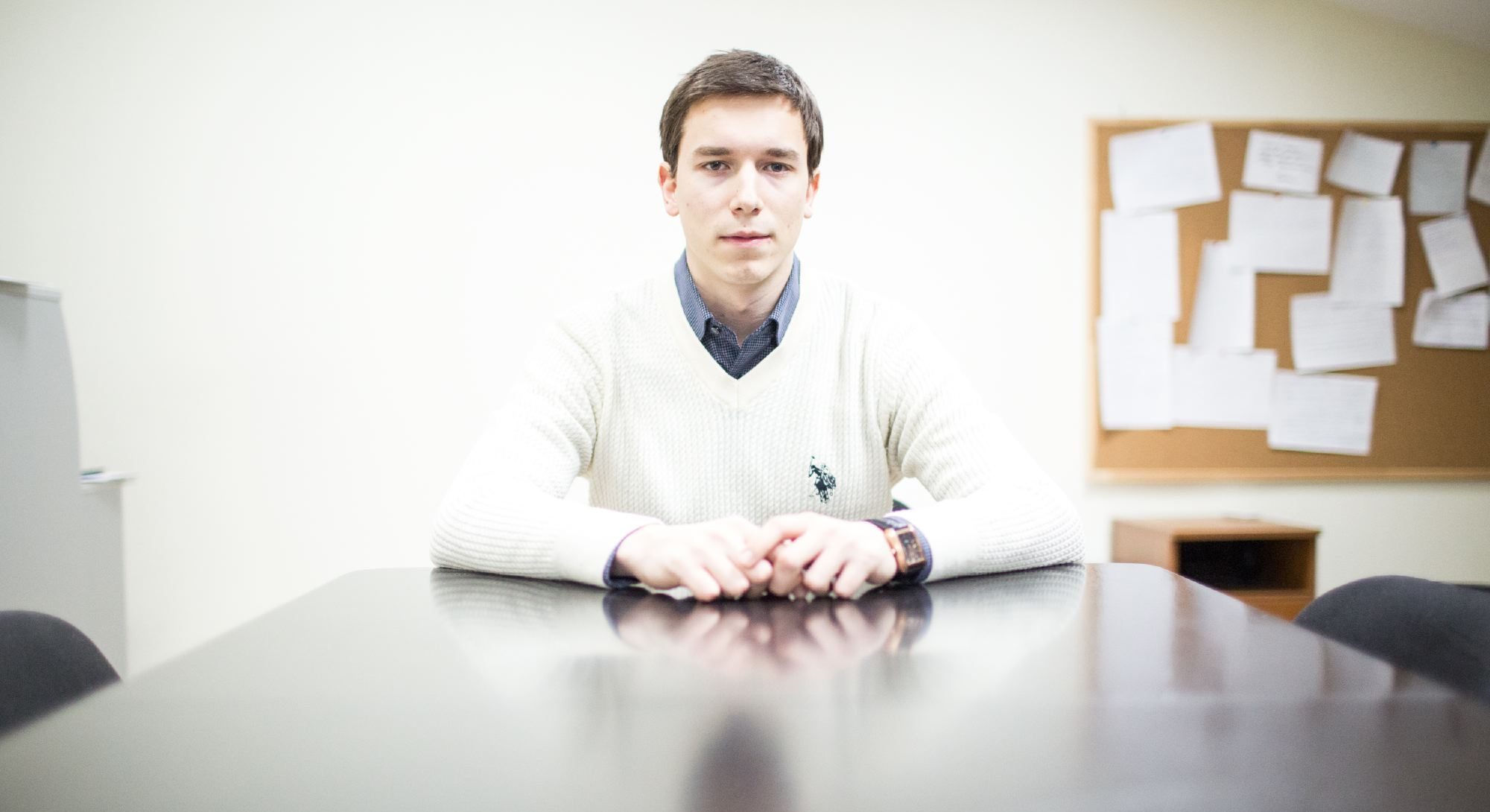
 Stanislav in the office of the Cancer Prevention Fund photo: Alexey Loshchilov for TD
This can be corrected: the Cancer Prevention Fund has launched the Higher School of Oncology, where only the best and motivated graduates of medical universities from all over Russia and the CIS countries are selected. One of them was Stanislav Volchenkov.
The only condition for graduates of VSU is work in Russia after graduation. Stanislav and his classmates will treat cancer patients in Russian clinics. These will be oncologists who know how to communicate with patients, not to be indifferent and at the same time not to burn out. They will constantly read scientific articles about the latest achievements in the fight against cancer in English and will learn to think critically. But most importantly, they will be able to constantly share their experience and educate a new generation of those who think and care about patients who are not afraid of superiors and bureaucracy. The school organizers believe: this approach will gradually change the training of oncologists in the country, and cancer treatment in Russia will become high -quality and affordable.
But becoming a resident of the Higher School of Oncology is not so easy. Stas found out about VSU when he studied at the first honey them. I.P. Pavlova. By that time, he was already sure that he wanted to become an oncologist: after the fourth year, he was practiced at the oncology research institute. N. N. Petrova. “I assisted during operations,” recalls Stas. - I realized how the work is organized. I then saw that oncology is the most rapidly developing area of medicine. And if I become an oncologist, then I will never be bored. ”
Together with Stas, 349 more oncologists from all over Russia and the CIS countries submitted applications to the VSU. 19 went to the third round, of which 10 remained after the full -time round.
 Stanislav in the office of the Cancer Prevention Fund photo: Alexey Loshchilov for TD
At the last stage of the qualifying competition, Stas was terribly nervous at the Higher School of Oncology. Public performances were always not easy for him. He answered the jury's intricate questions: it was necessary not only to confirm his knowledge, but also to demonstrate the ability to think non -standard in critical situations - for example, to imagine what to tell a patient whom he did not warn about the possible consequences of the operation. Suddenly one of the examiners asked: "Who is Andre Agassi?" Stas was even more confused, but blurted out: "This is the first racket of the world." Everyone laughed in the hall, and the examiner explained: “It is written in your questionnaire that you have been engaged in large tennis for many years. Everyone should know well what he is interested in. ”
From the moment Stas entered the VSU and became the resident of the Research Institute of National Assembly. N. N. Petrova, a year and a half has passed. It really was not boring during this time. His day began in the department early in the morning - study in the residency is completely associated with a practical approach, for example, with patients. On Mondays, Wednesdays and Fridays, additional courses on hematology, scientific communication, communication with patients. These courses are conducted by VSU graduates. The principle "if you want to understand something well here, teach this perfectly-teach this another." In total, there were four sets in the VCU, and in each of them oncologists of different specialties. In additional courses, the guys pass on to each other knowledge. On Saturdays, the director of the Mercy Medical surgical oncology department Vadim Gushchin contacts Skype students - together they learn to critically read medical articles in English. At some point, Stas noticed that every evening ends late in the evening in the cancer prevention fund. Classes flowed into long discussions, all the time was engaged in scientific work and homework, free time was not left at all.
Another principle of VSU is a complete immersion in study. With this regime, students do not have time and effort to work. Thanks to the scholarships that the fund pays, Stas may not be distracted from the main one. “Of course, this is not the money that you can bite, but I know for sure that at the end of the month I will receive a small amount. This allows you to direct all the forces only to study. ” Agree: each of us would prefer that he was treated by a doctor who would not miss a single seminar than the one who was forced to earn extra money to a taxi driver and slept at lectures.
 Stanislav in the office of the Cancer Prevention Fund photo: Alexey Loshchilov for TD
Now all the additional courses of the VSU set in which Stas is studying has already ended. The guys are waiting for the results of the tests that they recently passed. But the study does not end there: further the residents will develop their teaching skill and deal with those who have just entered the VSU. “The best indicator of how we studied these two years will not be the results of tests, but how we will apply the knowledge gained in practice and transmit them further,” Stas explains.
In the summer of 2018, the fourth set was held at VSU. The introductory exams were even more difficult: if earlier applicants needed to just speak to the commission and tell about themselves, then this time the guys presented their projects that could solve the problems related to cancer patients in Russia. Residents of the VSU from the previous three sets chose new students together. Now beginners go the same path that Stas and his classmates. The new residents do not have enough time for part -time job, it is very important for them to concentrate on studying to become exemplary doctors.
The more professional oncologists in Russia, the more light spots will be. Cancer can be defeated, but for this we need our help. In order to make it possible - please donate 100, 200 or 500 rubles for the work of the Higher School of Oncology.