
Translated material
The Germans crashed into a pipe
The EU countries tightened the rules for gas suppliers in order to complicate the life of Gazprom. But it was his Germany who brought out from under the blow
On Friday, the EU regular representatives approved the amendments to the gas directive of the European Union, which tighten the regulation of gas supplies from third countries. They were discussed primarily with an eye on the northern stream under construction - 2. The final version of the amendments should now be approved by the European Parliament and the EU Council. At the same time, Germany tried to soften the blow to the Northern Stream 2 as much as possible. Perhaps she will be able, in principle, to bring him out of the action of a supplemented directive.
Unified rules for all
The “gas directive”, which was discussed on Friday, is a document adopted back in 2009. He formulated the basic rules that now regulate the domestic gas market of the European Union. At the same time, the relations of the EU members with gas suppliers from third countries are mainly regulated by national legislation: in other words, each country decides how much gas, who and under what conditions to buy it.
Amendments to the gas directive were proposed by the European Commission back in 2017, and their essence boils down to the following: firstly, a significant part of the control goes to the European Commission, and secondly, the rules of the domestic market begin to operate in relation to third countries. One of these rules is the ban on that the same company acts as a gas supplier and the gas pipeline operator.
These amendments say in the text of the document, are designed to guarantee “the lack of discrimination between gas pipelines supplying gas to the European Union and exporting from the European Union, as well as in relation to other market participants”. In addition, "an isolated approach of national legislation leads to delays in the implementation of the rules of the Unified Energy Market, the application of contradictory measures." And finally,
Relations with the third supplier countries are a matter of security and timely gas provision of all members of the European Union.
According to the text of the EU Council, published according to the results of the negotiations, if the amendments are adopted, all countries of the European Union will have to notify the European Commission of the intention to conduct any negotiations with suppliers: whether it is the conclusion of new contracts or the current change, and wait for its permission. “The proposed amendments will apply to the application of the current rules of the European Union to gas pipelines from third countries,” the document says.
France confused the cards
In the company Nord Stream 2 - the operator of the Northern Stream - 2 project, prepared amendments, of course, criticized: they "create uncertainty for investors." But the rest was commented on with restraint: so far there is a stage of construction, which these amendments do not affect.
The battles suddenly unfolded at the European level. A few days before negotiations, it was known who was standing in what position. Poland, the Baltic countries, part of the countries of Eastern Europe actively advocated amendments - they are the main critics of the Northern Stream 2.
The main opponent of the amendments was Germany: it was she who, after the completion of the construction, will become a gas receiving point of “northern stream - 2” and will turn into the largest European gas hub,
It was German companies that have invested most of all in the construction of the gas pipeline. At the same time, Germany expected support from a number of European countries - in particular, Austria, Belgium, the Netherlands, Greece and its main ally, with whom literally a couple of weeks ago, the Aachenic agreement seized the intention to jointly determine the policy of the European Union, France.
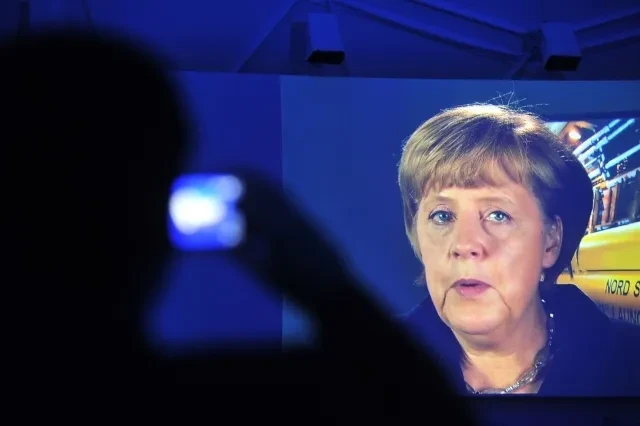
The right on the eve of the negotiations, France suddenly changed his mind. On February 7, the French Foreign Ministry said that "the changed directive will apply to" North Stream - 2, and France intends to support the adoption of this directive. " Thus, the Foreign Ministry confirmed the information of the German newspaper Süddeutsche Zeitung, which, with reference to its own sources, said that the Nord Stream 2 is fraught, according to the French, “strategic problems” for Europe, so France will support amendments. It was, of course, a blow to Germany. But during the negotiations, France repeatedly changed the position: and already on Friday, during a press conference, Angel Merkel said: “We reached a compromise regarding the gas directive, and this was possible because Germany and France interacted closely,” the Chancellor said.
We agreed that it was Germany, on the territory of which the gas station is located, will make all decisions on the gas pipeline.
In other words, Gazprom has to deal not with Brussels, but with Berlin, and by its decision, Germany will be able to withdraw the Northern Stream 2 from the action of the directive.
What next?
In any case, the final text of the amendments has yet to be agreed. “The next stage is negotiations between the EU Council, which is represented by its current chairman, Romania, the European parliament and the European Commission,” the representative of the EU Council Katarin Rettig told Novaya Gazeta. “If the EU Council and the European Parliament agree on the general text, it will be sent for approval by member countries, and then it must be approved by the plenary meeting of the European Parliament and the meeting of the EU Council.” In the EU Council, the document should support at least 16 of 28 members of the European Union, which represent at least 65% of the total population of the EU.