Translated material
Why do we not know how to talk about drug addiction

The text “Heroin is the property of the model” , which caused a violent reaction among readers and Roskomnadzor, showed, among other things, an important problem: in Russia, in fact, there is no language for a meaningful conversation about the heroine and dependent on it. Samizdat studied comments on the already deleted text on his website and on social networks in order to isolate the main patterns of commentators' behavior, and presents his brief study of the not yet formed language of this important discussion.
What is the difference between language and speech? If we recall the works of the Swiss linguist Ferdinand de Saussure and the French philosopher Roland Bart, then the language is a complex and closed sign system with its own rules, and speech is the use of language, a direct process of communication. The whole communication of the individual - with the outside world, with other people, and even himself - comes down to the use of these two structures. But do we really know how to use and interpret them? And, more importantly, how are these systems transformed and developing in the process of communication?
Day after day we exchange opinions and impressions, we gossip and console, say, say, we say - and in this speech not only everyday life, the context in which we live, but also discourse are, in fact, the same speech, the process of linguistic activity. If you rely on the philosophical interpretation of postmodernism, then the discourse is a special holistic mood, immersed in a certain context. For example, if you are discussing a new song to Beyoncé in a company of five, then create your discourse around this particular song and the style of the singer. The more in the discussion of subjects and contexts, the wider and deeper and the more, of course, is more difficult.
The discourse, which is formed on social networks, is able to construct the view of the whole community on a certain problem. As in any system, the language isolate the sign as a basic unit, a brick from which a wall of language communication is built. If you accept social networks for a separate closed speech system, then a comment will be such a unit.
We became interested in how it is really possible to trace the process of formation of discourse on social networks or as the existing discourse is displayed on a specific example. To do this, we turn to the “Heroin - Property of the Model” by the Roskomnadzor, which has already been deleted at the request of Roskomnadzor and to the reaction to it in the comments on the Samizdat website and in social networks. We formed the primary sample and analyzed comments that relate directly to the topic of heroin dependence and the heroine of this article itself, a feasibility study to understand what discourse is built around the topic of heroin on social networks, how users react to the topic of heroin and drugs, whether they resort to evaluative judgments on what experience they are based and what vocabulary they use.
Julia Melamed, director and columnist
Communication, community, society depend on what communication is carried out. She transforms sociality. Social networks are not just technology, this is communication, and communication is never indifferent to what it is carried out. If we want to understand something about society, we must study modern communication, that is, social networks.
Like any language phenomenon, comments on social networks can be interesting for analysis. These are signs, markers of our time. However, the comment format does not imply any deepening into the plot: after all, the commentary inherently should be short and ironic.
Natalya Bozhenkova, Doctor of Philology and Professor
Discourse is any communicative act, a kind of sociocommunicative phenomenon, so even one comment on someone’s post should already be considered as a discourse. The involvement in this discourse is the second component. Comments are a separate independent discourse, and it really causes research interest.

Comment as a product of subjectivity
The German philosopher and sociologist Jurgen Habermas interprets the discourse as a product of speech communication, which is not only and not so much the process of speaking, but includes the reflexivity of the participants in the communication, their equivalent and full part in all its aspects. Comment is a broadcast of subjectivity in relation to the topic. The subjectivity in this case is an attempt by an individual, that is, the author of the commentary, to objectify the topic through his own sensations.
The French philosopher and theorist of culture Michelle Foucault notes that "the commentary prevents the accident of discourse by the fact that ... it allows you to express something else than the commented text itself, but only on condition that this text itself will be said." That is, a comment is a reaction to the topic, and it is directly related to it. And although it translates the subjective point of view, when there are many individuals (and their comments), a new field is formed, and this field is of particular interest. After all, then the individual loses subjectivity and becomes part of the discourse.
Nikolai Fogler, author of the Sygma portal, admin of public "Semiotics of everyday"
I think that many of us saw how the commentary section sometimes quickly begins, as they say, to live our life due to “stuffing” or trolling, which, in turn, is also a rather unique pattern of network communication. Even the most trivial commentary under the accidental news belongs not so much by its author as the entire infrastructure of the values and contexts of a particular place on the network, as well as the huge cultural background of society and the community, from where the statement was made. Not “who says?”, But already “what does it say?”.
Linguistic analysis in practice
Comment on social networks is a reflective text, it arises at a time when the reflection of the one who reads the original message (material or post on social networks) acts as a subject in the topic of the message and projects his subjectivity on objectivity. Simply put, a person finds in his experience some similar subjects and hurries to share it, because he is convinced that this will complement the text of the original message. However, it turns out that any comment is the user's opinion regarding how the message is built into his picture of the world. As a result, a peculiar field of various experiments and opinions is formed around the topic, and this field represents the attitude to the topic. In our case, this applies to the topic of heroin and heroine-dependent, and we tried to find out what subtramas can be distinguished by relying on the content analysis of comments on the Samizdat website.
In order to conduct a correct analysis, we have identified the criteria for the choice. First of all, this is one type of source - comments on the website of the battle, you are a transformer on the page of remote text and comments on the pages of Facebook and VK Samizdat under post with the text. We analyze one type of message - user comments. We also have the parties participating in the process of communication (sender and recipient) - these are readers on the one hand, both the authors and heroes of the material on the other. The time of the appearance of messages is all the comments that appeared before the analysis - until February 6.
The first and most frequent subtemes that users raise is the stigmatization of heroin -dependent. Some comments displayed the clear branch of heroic -dependent from society: such people have no place in society, they are all sick, weak and have no right to full coexistence with those who do not have heroin dependence. This clearly separates the topic of discussion and reflection on only the image of a drug addict.
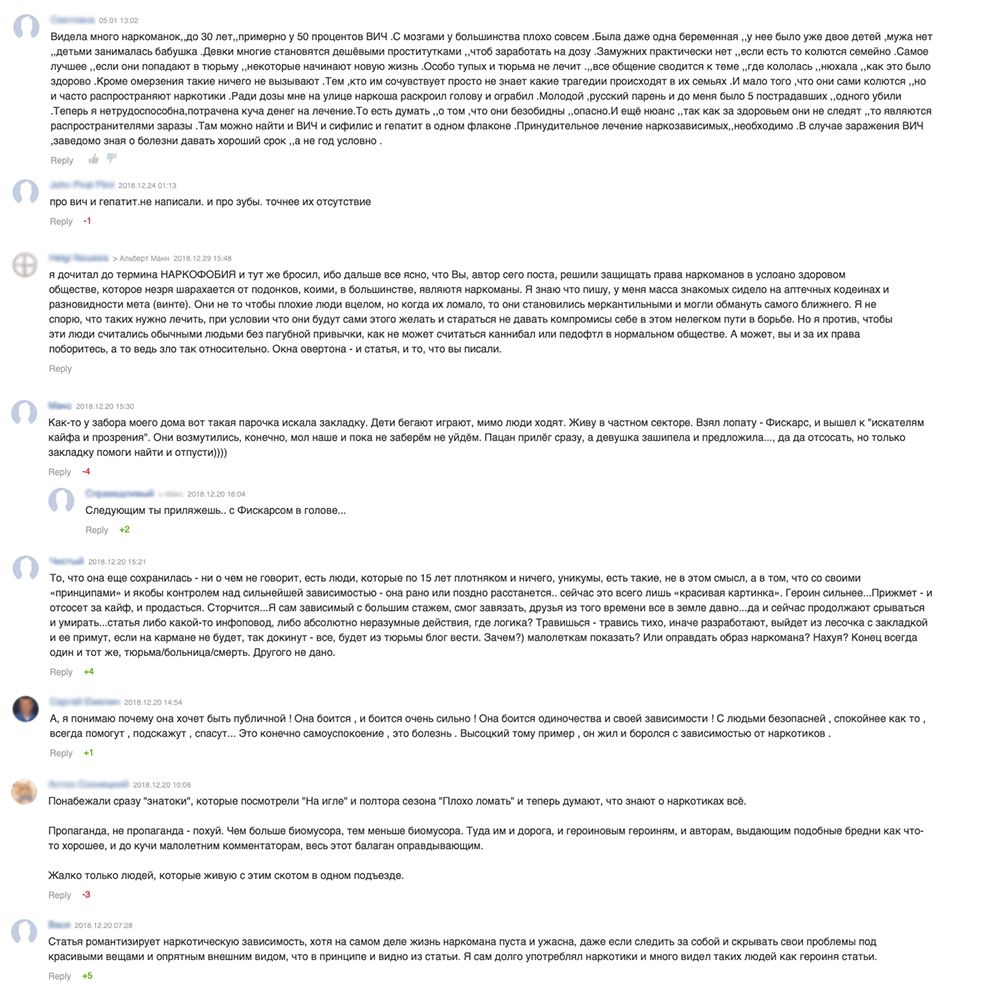
The following follows from the first summary of stigmatization - the accusation of the heroine of the material of lies. These accusations are built on the basis of information obtained from some user experience. Moreover, in some cases, a mass culture (films, TV shows, video clips) acts as an experience. Due to the fact that in most cases the image of the heroine-dependent is built before the user through mass cultural cliches-and the heroines accusations are built on data, which the user often gives out for his real experience.
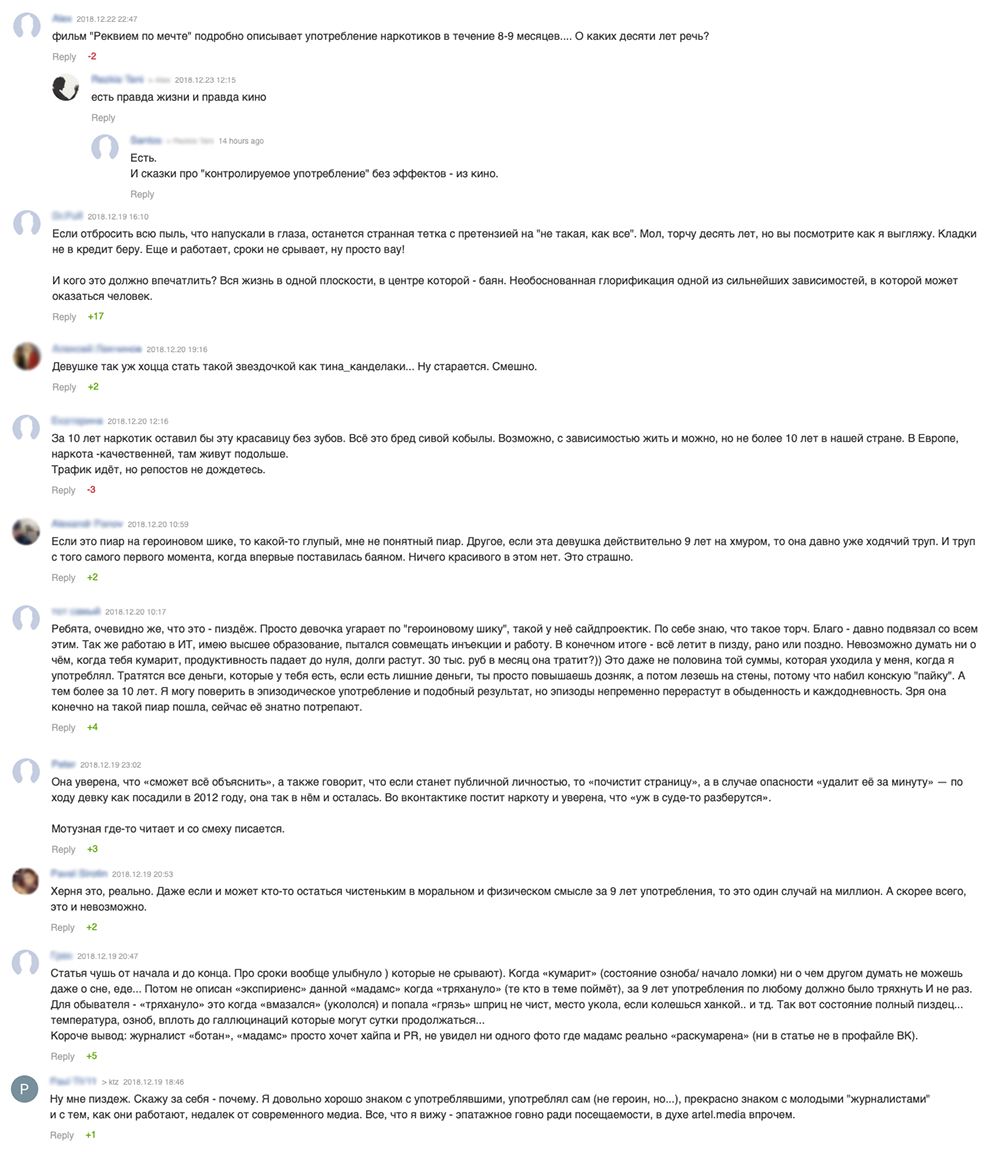
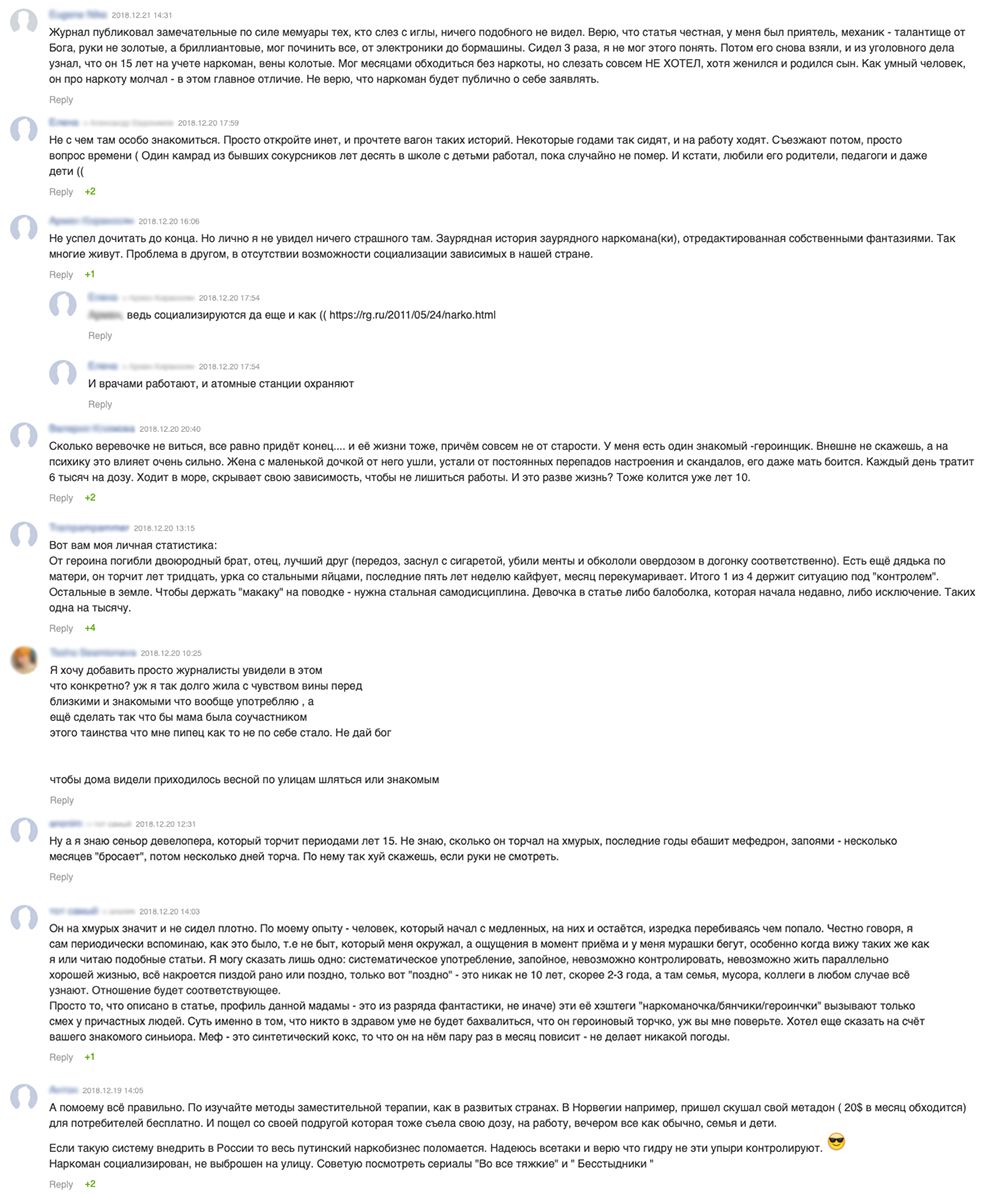
Further appeal to experience is reduced to negation. Users give a denial for their own examination. In this case, individuals are not only important for some reason to become part of the discourse, but also to convince other individuals that the judgments in the text are false, through the prism of this denial.
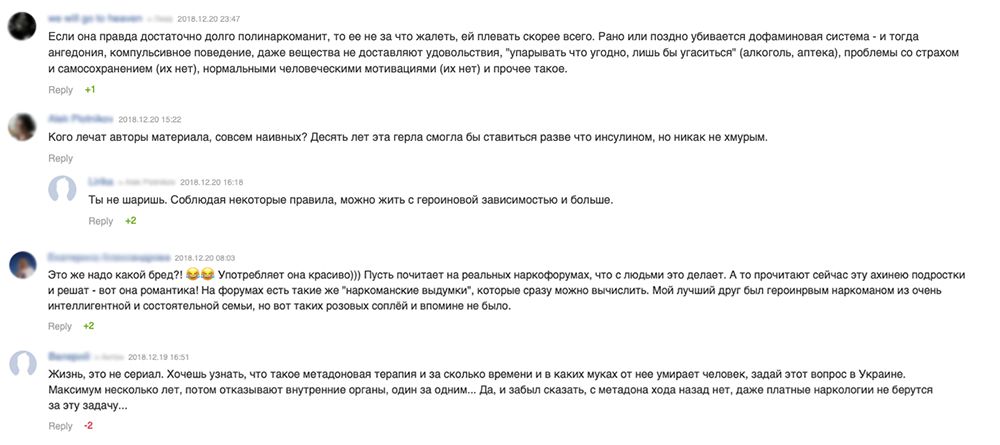
One of the most important shade that arose as a result of discussion is the development of discourse. The further development of the subject of discussion on the spiral, which, as we found out, is the main task of comments, took place, although it was hidden behind other discussion branches. In this case, users pulled out the questions that they had after reading the text, or, probably, these questions already had, but there was no site to ask these questions.
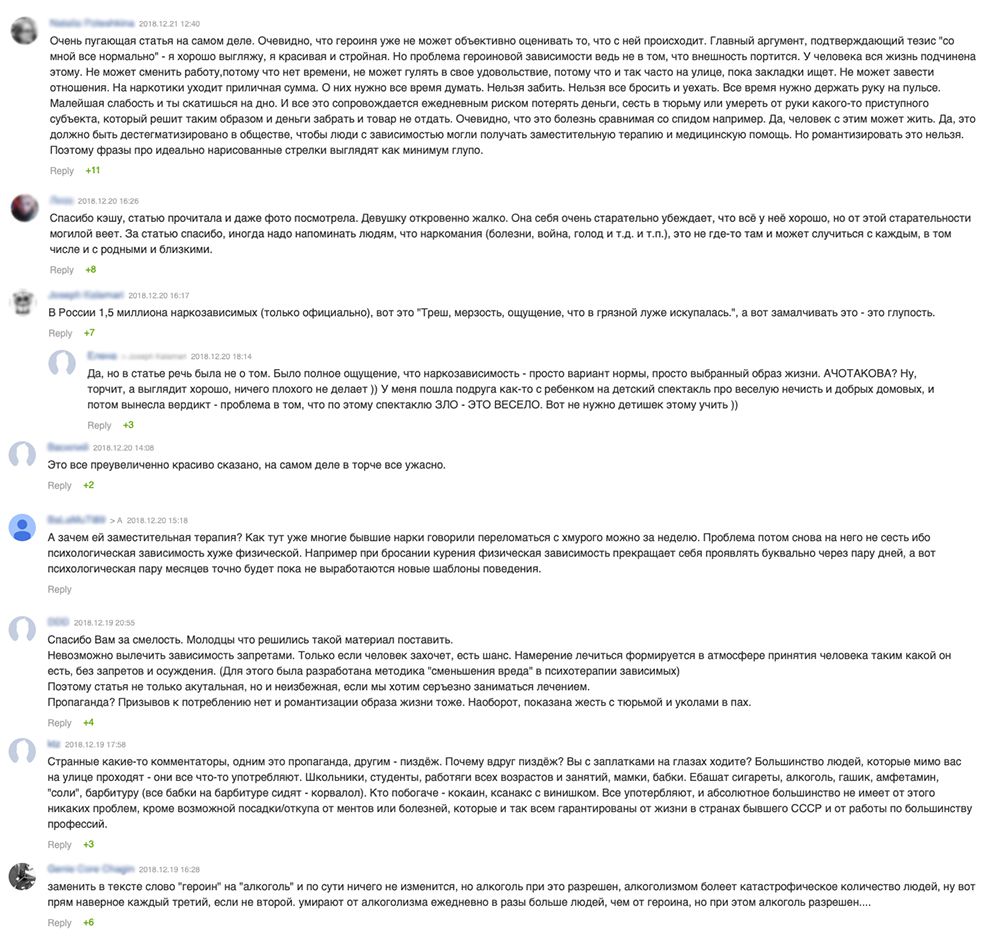
What is really important - users shared their experience related to heroin addiction. So the comments field turned out to be not only to speak out for them, but also to become part of the discourse.
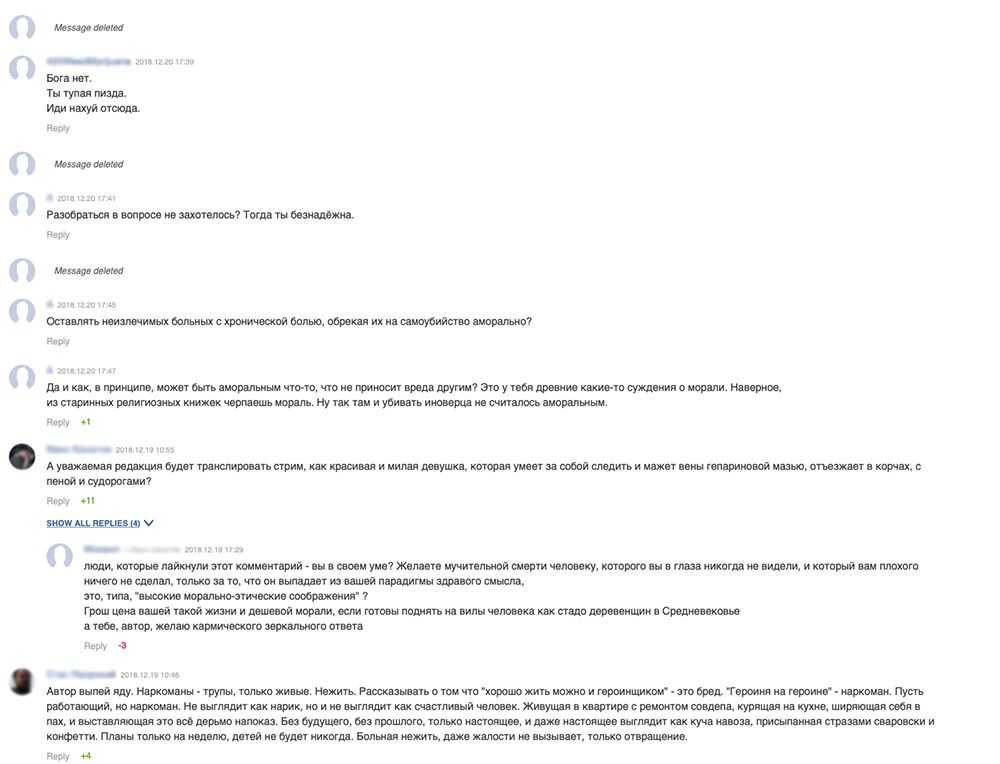
Cases with destructive subthemes, for example, hatred in relation to the topic and its heroes, is the most common pattern in the commenting environment. In our case, this pattern was also, and this can be a signal to the deepening into subjectivity.
Social networks as a progression of subjectivity
After analyzing the text comments, we directly turned to comments on Samizdat social networks, including those that accompanied posts in social networks and publics. Interestingly, in this case, the subtans were distributed a little differently. For example, there were much less comments that stigmatizing heroin -dependent.
But there were much more comments accusing the editorial office of unscrupulous work. Moreover, this was directly due to the fact that the material is not relevant to the audience and incorrectly develops the topic of heroin -dependent. On the one hand, this may be due to the fact that in the fields of comments under fasting among the leaders of opinions or in publics the audience is formed around a specific profession or a specific area of activity, and then for users not only the subject of discussion is important, but also the form in which this discussion is clothed. On the other hand, in this case, a skew can occur in the sample, because the field of comments under various posts and raschers collects a different audience with different contexts - accordingly, different discourses are formed. And, of course, this can be a signal that users are ready to discuss the topic and speak about it.
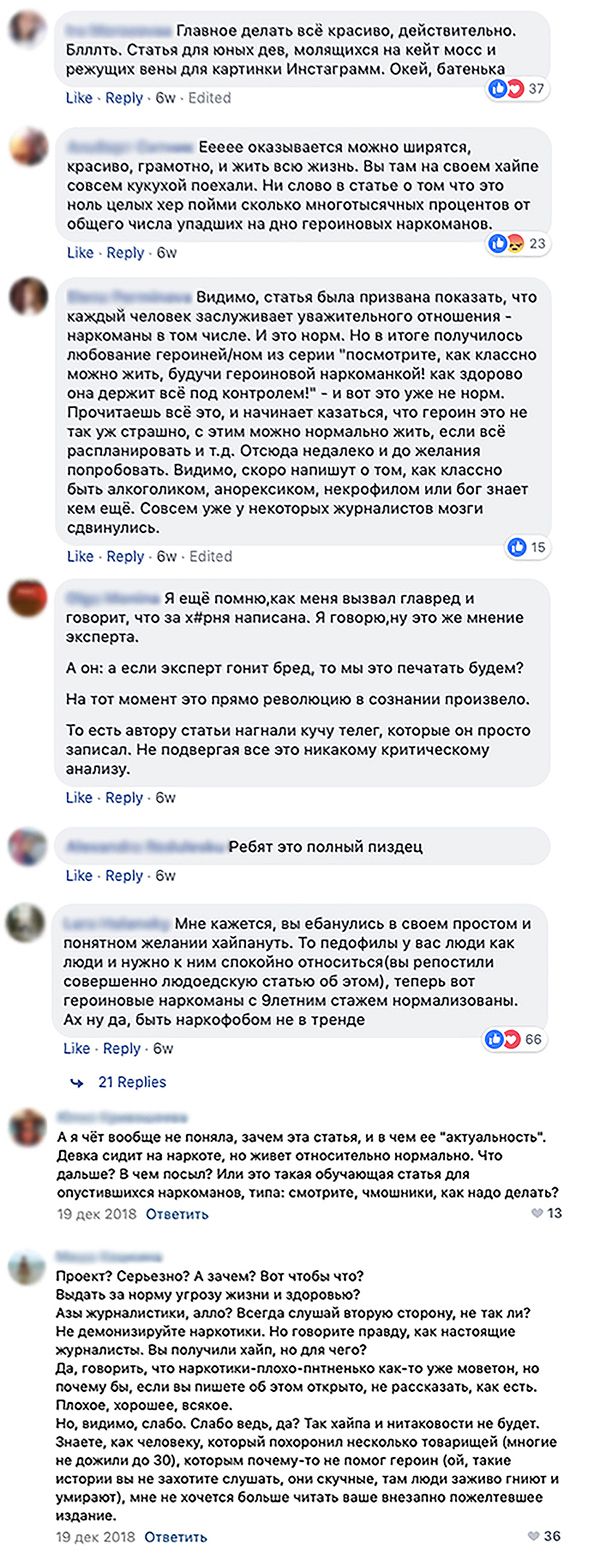
And since various classrooms of the audience are formed, then subjectivity is much more intense, and there are much more comments with evaluative judgments. Moreover, in this case, users do not rely on any experience, nor at the cliche from mass culture.

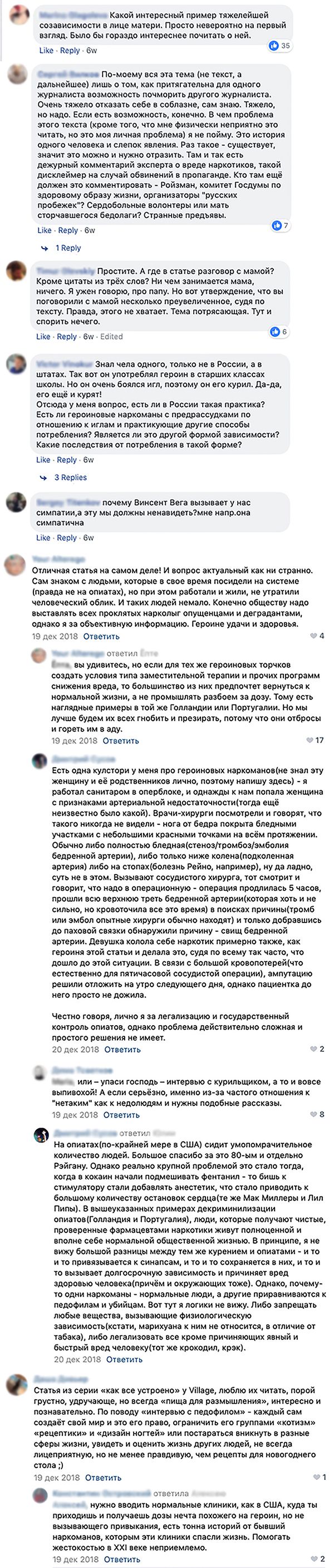
As on the site with the text of the material, a positive dynamics of discourse development is clearly expressed in social networks. The topic received even more development, because it was discussed not only in the field of the text itself: here the field is no longer limited only by the material itself and comments on it. In the comments under the post, and then in the comments under the rags of the post, new subtans appeared, entire user clusters interacted with each other, combining discourses.
Natalya Bozhenkova, Doctor of Philology, Professor
This long correspondence under a topic, as a rule, is not related to the problem itself, but with the linguistic expression of someone and those who communicate on this topic. I can be wrong, but almost always from the topic go to discuss who and what said about this. Here, especially if there are any negative or taboo replicas, we proceed to the assessment of “our own” and “alien”. When there is a problem, and within the framework of this problem, statements appear in relation to it, then in this way we begin to look for this “circle of our own” in order to get approval.
The author is dead, and the comment is alive
Roland Bart in his famous essay “The Author of the author” writes that today we can no longer find what the author put into the text. According to Bart, we have no right to interpret the text based on the personality of the author or context, because immediately after the release of the text, he loses any authorship. Now the text lives its own life, moving from one interpretation to another. Moreover, each interpretation of many others will differ due to the social, cultural and political context of the one who interprets it. At the same time, the text should be considered not only words and sentences, but also absolutely any sign system: from word to song, from the picture to the street. Social networks in this context every day reproduce millions of different texts and messages.
Our small linguistic analysis of comments showed that the interpretation of a particular text - an essay on a heroin -dependent woman - revealed the lack of a language that would allow to discuss the topic of heroin and heroin dependence. Instead, we found that, first of all, when discussing heroin, there is a stigmatization of heroin -dependent and drug addicts in general. This stigmatization appears as a result of the transfer of subjectivity commenting on the topic of discussion. This subjectivity is based on those clicked images of mass culture that users give as factual evidence.
Another aspect of this stigmatization and subjectivity is evaluative judgments, in some cases bearing hatred and generalization. This also reflects the individual’s linguistic feature to generalize the components of the topic unfamiliar to him and interpret them in his own way.
However, the lack of experience in discussing the topic of heroin, on the other hand, provoked a discourse among those users who seek to discuss the topic, but did not find platforms for this before. Therefore, there is a request of a particular discourse. And this is the most important.