Date
Author
Вячеслав Половинко, Елизавета Кирпанова
Source

Preserved copy
Translated material
"Drop irrigation of social problems"
Experts evaluate the economic part of Putin’s speech before the Federal Assembly
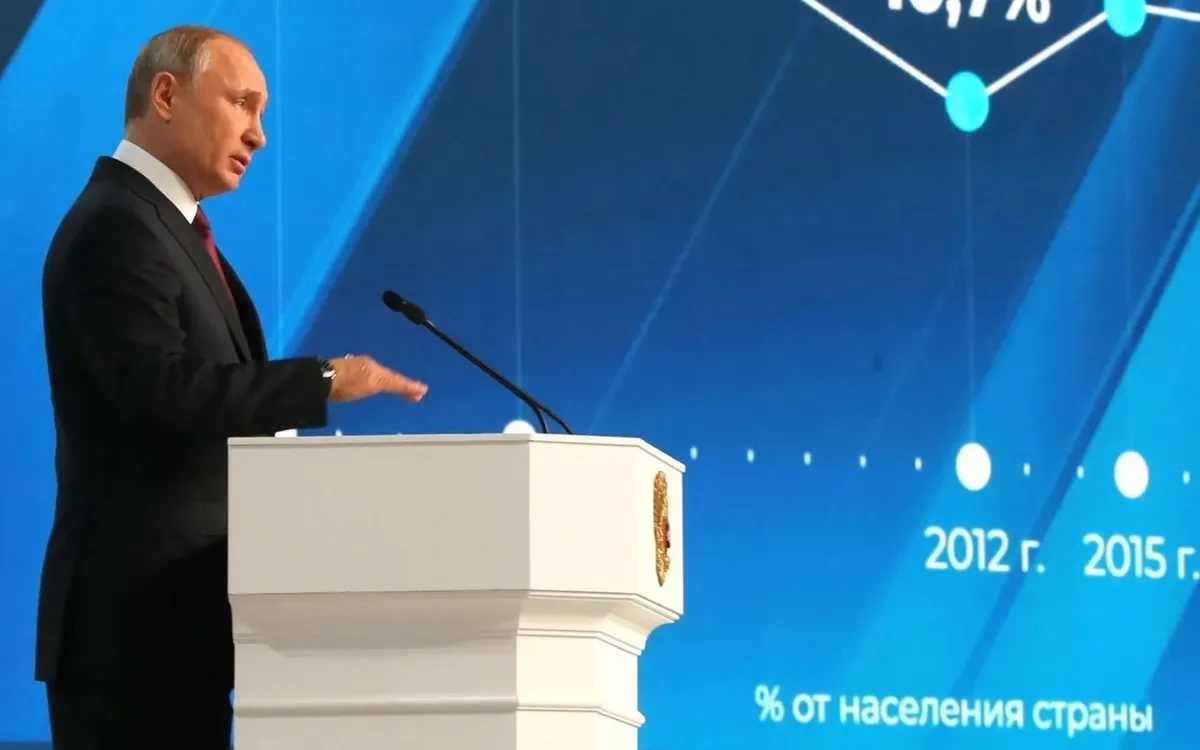
The next message of the president to the Federal Assembly turned out to be very peaceful and completely social in its first part. Putin focused on the internal agenda and decided by 2024 to halve poverty in Russia: through the distribution of money to the poor, through new programs and through the next request to the security forces not to put pressure on the business. Against the background of the previous message, in which missiles occupied most of the time (although this time it was not without the “Poseidons” and “Zircons”), the performance of Vladimir Putin on February 20 looked progressive: they say, there will be enough foreign policy, let's think about people.
At the same time, a huge complex of measures proposed by the president-mortgage benefits for large families, support for families with children with disabilities, exemption from real estate tax, a social contract for the poor-from the side it looks like a large distribution of money that, it turns out, there is no longer in the country (and there is no more to hold on).
Additional injections in the amount of about 120 billion rubles a year will be required, but this money, according to the Minister of Finance Anton Siluanov, will not be difficult to find.
Another question is, is there something more conceptual for unusual generosity than momentary help to the poor? “New” interviewed experts - and in their view the picture does not look so rosy.
Evgeny Gontmamer
Doctor of Economics
- Poverty in Russia is one of the most important problems, it integrates everyone else. This is a fact, you can’t argue with Putin. But there is nothing about poverty in those national projects that are now launched in the country, as there is no comprehensive solution to this problem. Here the question is also in the wording. If you understand poverty as the number of people living below the cost of living (19 million people that Putin spoke about), then these 19 million can be financially added. But after all, it doesn’t work, and Putin also said about it: much more people feel infringed, they cannot afford much.
The scale of such poverty - low -income - they are much larger: according to various calculations, it can be 30 and 40 percent of the entire population of Russia.
You can’t solve the problem here.
The national projects are built “around a person” only formally - this is all related to health and education. And those proposals that the president put forward in the social sphere - they are not related to any reforms. The logic here is different: we allocated several trillion rubles from the piggy bank - they must be spent on defense (Putin and spoke about missiles); They must be spent on infrastructure projects with unproven efficiency; They must be spent on a social. About the same thing happened in Medvedev times: they distributed money, bought some kind of equipment for hospitals, and spent the Internet to schools. Any money in the social sphere is good, but they do not solve the problem.
And the whole problem is that in Russia there is no freedom of choice. We must liberate a person and give him and his family to develop the way they want, and not feed this family from a spoonful of distribution of money.
The current approach: I will give you money, but you don’t have to talk about freedom here, we know without you how better. In a broad sense - do not talk about fishing rods, eat the fish that they give you. It is said about the freedom of entrepreneurship, but against the backdrop of the arrest of Michael Kalvi, this looks ridiculous. Let's tell the truth, finally!
The new message of Putin is a drip irrigation of social problems: where it is thin - we will pour money there. The president was reported to small manuals for a family where there is a disabled child. 5000 rubles for a non -working parent is, of course, not enough: let's make 10,000 rubles. But the problem of disability in Russia is not solved. How will this child study, how will medical services provide for him? Nothing is said about this: and indeed, in the texts of the national projects there is no word “disabled” (although there are almost 8% of the population in Russia), except for sectorals of some attitudes, where and how much to allocate money; There is no person in these documents.
You can talk about specific measures. For example, preferential subsidizing a mortgage rate for a family with two or more children for the entire loan. Of course, all this is good, but in an explosive way, the number of people taking such a mortgage will not increase. Preferential subsidies, of course, reduces the price of a mortgage, but still getting housing in Russia is very expensive, and the salaries are low. This is the “scissors”: Putin, by the way, did not say anything about them. The measure proposed by Putin is not bad, but it will not turn off any trends.
The President mentioned the “social contract”: the state is ready to give people money, provided that people will take on some obligations (find a job or retraining). No one denies the possibility of this approach, but this is a very narrow measure. It does not work for all poor families: it is assumed that someone who works should be in the family, but at the same time everyone turned out to be for some reason below the poverty line. Then, if your income at least a little exceeds the poverty line, you do not get anywhere, in any social contracts.
The question of jobs arises: well, you have been retrained, but where will you work, especially in the conditions of a small city?
10 million questions. It is all necessary and necessary, but it is not a panacea at all.
Real estate tax benefits look very good, taking into account the increase in the load that we constantly go. This will bring certain progress. But the increase in benefits for two children is the same as with mortgage benefits. On the one hand, it’s good that more families will receive these benefits; On the other hand, this poverty will not eradicate this poverty. In general, I think that all families need to pay benefits for children, regardless of their income, since Putin is so baking about increasing the birth rate. Otherwise, a vicious circle is obtained: a family with two children gives birth to a third, but the benefits that are paid do not cover those expenses that eventually arise.
Some measures will require costs this year, which Putin said. They will be repaid due to budget surplus: we see that it is planned with us even this year. After all, the amounts are small: they are trying to hit us with billions of rubles, but on a country's scale it is very small money - of course, they are. “Hitish man” is large with us.
You just need to understand what all these measures should lead to. In order to report in 2024 that there were 19 million people behind the poverty line, and 9 million were left, these infusions, subject to their accuracy in the theory, will be enough. But money can be poured with problem points for a year, two, three, four, five. If the economy does not move and will not grow real, and not stand still, as now, then the “tanning galloon” will also end. Now the task is to provide assistance to poor people, and not to make sure that these people become less.
No one makes people to earn themselves without seeking such help from the state.
Unfortunately, nothing was said about this.
Anatoly Vishnevsky
Director of the Institute of Demography of the Higher School
- Such economic promises, rather, have a political meaning. Say, the government takes care of you. However, they cannot seriously affect the birth rate. Help for families with children can only be welcomed, but to believe that relatively insignificant promised material benefits can encourage people to give birth is incorrectly.
Some people can lead to such measures, but they are still not comparable to costs, including time and energy that is required to educate a modern child. People are meaningful and soberly related to solving the issue of whether to give birth or not give birth. If you have one or two children, and they give you, for example, tax benefits, then this is very good. But people do not give birth to another child only because they received it (of course, if they did not plan a child regardless of benefits).
Low birth rate is part of the lifestyle of a modern person. There are countries richer than Russia, where the financial situation of people is better, respectively, there is a bit higher there. But it is still not enough to ensure the so -called simple reproduction, and not enough to maintain the population.
Now in Russia there is a not very favorable demographic situation. We are reduced by the number of potential parents, since the generation born in the 90s prevails, when the birth rate was low-accordingly, few children were born. However, our state is not an outcast or a “sample of low birth rate”.