
Translated material
Memory. Emperor Peter III
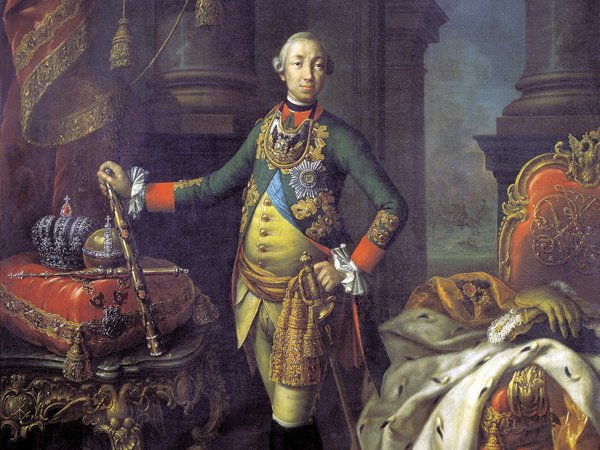
On February 21, 1728, the Russian emperor Peter III was born.
Personal business
Peter III (at birth, Karl Peter Ulrich, 1728 - 1762) was born in the city of Kil, in the Duchy of Golstein. He was the son of Karl-Friedrich Golstein-Gottorp and Cesarevna Anna, daughter of Peter the Great and Catherine I. Mother died a week after his birth. His upbringing was engaged in the chief-chore of Otto Brumer. In 1739, when the boy was eleven years old, his father died, and he inherited the title of the Duke. The regent under the young duke was an uncle, Prince-Eshkrus of Lubeck Adolf-Friedrich (future Swedish king Adolf Fredrick). He showed greatest interest from early childhood in military service. He was a fan of the Prussian king Frederick II, admired the victories won by the Prussian army. It was believed that in the future he could inherit the Swedish throne as a grandson nephew of King Charles XII.
The fate of the boy in an unexpected way changed in 1742, when Elizaveta Petrovna became the Russian empress. She decided to make her nephew the heir to the throne. Karl Peter Ulrich was called to St. Petersburg and accepted Orthodox baptism under the name of Peter Fedorovich. He studied under the leadership of academician Jacob Shtelin. As a residence, the empress gave him Oranienbaum. She took care of a suitable wife for the heir.
On August 21, 1745, Peter was married to his second cousin Sofia Augusta Frederica, nee Anugalt-Tserbist princess. After baptism, she began to be called Ekaterina Alekseevna. Prior to his entry into the throne, Peter was mainly engaged in the improvement of Oranienbaum and the issues of teaching young men in the land gentry corps, whose general director he became in 1759.
In 1754, Peter and Catherine was born the son of Pavel. Elizabeth took away the grandson from his parents to engage in his upbringing herself. Peter was allowed to see his son once a week, but he was satisfied with this state of affairs. The relationship of Peter and his wife from the very beginning was cold, and over time he started a favorite - Countess Elizabeth Vorontsov, his wife's maids of honor. Peter "did not hide the exorbitant love for her" and "spent almost all the time with her." In 1756, Peter and Catherine had a daughter Anna, who died three years later.
On December 25, 1761, Elizaveta Petrovna died, and Peter became the emperor. However, his reign lasted only 186 days, and the coronation did not take place. Peter III managed to radically change the foreign policy of the empire, moving from the war with Prussia to an alliance with it. He stopped the war with Frederick II immediately after joining the throne and entered into an agreement with him on April 24, 1762, returning Prussia to all the territories occupied by Russian troops. A little later, she concluded an alliance with Frederick against Austria and France. He also pardoned and returned from exile many of those who fell into disgrace under Elizabeth Petrovna, for example, Biron, Lestok and Minikh.
On June 28, 1762, Catherine, with the support of the Orylov brothers and other officers, made a coup d'etat. The next day, Peter III signed an act of abdication. He was taken into custody and was kept in Ropshe under the guard of the detachment, which was headed by Alexei Orlov, later he was planned to be transferred to the Shlisselburg fortress. But, having lived in Ropsha less than a week, Peter III suddenly died under obscure circumstances on July 6 (17), 1762.
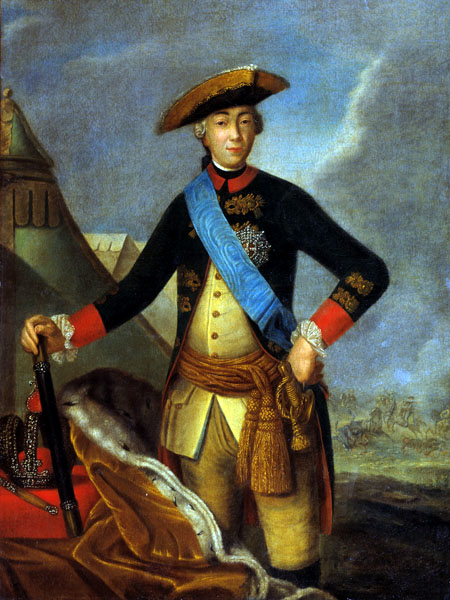 F.S. Rokotov. Portrait of Peter III. 1762 Nizhny Novgorod Art Museum
What is famous
For his brief reign, Peter III almost did not manage to significantly affect the fate of the Russian Empire, but some of his steps are quite remarkable. He signed the manifesto of the liberties of the nobility, which freed the Russian nobles from the obligatory service. Peter III liquidated the office of secret affairs and softened bodily punishments for soldiers and sailors. In the economy, he took a number of measures to facilitate foreign trade, in particular, he allowed free export of a number of goods and reduced export duties. By decree of January 29, Peter III stopped the persecution of the Old Believers. Under him, the process of secularization of the monastery lands was launched, then continued under Catherine.
Peter III in a short time managed to restore many layers of Russian society against himself. The military was unhappy with the reform of the uniform of Prussian patterns he had begun, and most importantly - the rejection of conquests made during the Seven Years War. It was extremely unpopular to the intention of Peter III to enter the war with Denmark for the return of Schleswig to the Golstein Duchy. The clergy was dissatisfied with the alienation of monastic property and was afraid that he would introduce Lutheranism in Russia, especially since Peter III condemned veneration of icons in conversations.
What you need to know about
We do not know exactly how Peter III died. According to the manifesto of Catherine II of July 7 (18), 1762, he died of the “previous colic”, caused by the “hemorrhoiding seizure”. Later, Catherine wrote that, according to the results of the autopsy, death occurred as a result of “inflammation in the guts” and “apoplexy stroke”. The rumors that Peter III was killed, appeared in St. Petersburg immediately after a message about his death. As probable killers, they usually call officer Alexei Shvanvich, as well as two civilians who were part of the guard: official Grigory Teplov and actor Fedor Volkov. The modest funeral in the Alexander Nevsky Lavra gave rise to rumors that instead of Peter III, another person was buried. In subsequent years, reports have repeatedly arose about the “miraculous salvation” of the emperor. Emelian Pugachev became the most famous impostor who pretending to be as Peter III.
Direct speech
He was delighted when he talked about his service and boasted of her severity. The most remarkable day in his life was for him the one, in 1738, in which, in the 9th year of his age, he was made from non-commissioned officers in a second-lieutenant. Then, at the court, with a possible splendor, the duke's birthday was celebrated and there was a big dinner. The little prince in the rank of sergeant stood on the clock with another adult sergeant at the door in the dining room. Since this time he had to look at lunch in which he usually participated, he often had saliva. The duke looked at him laughing and pointed to him some of the sitting with him. When they served the second dish, he ordered to change the little non-commissioned officer, congratulated him with the lieutenant and allowed him to take a place at the table, according to his new rank. In joy from such an unexpected increase, he could eat almost nothing. Since that time, all his thoughts were occupied only by military service, and his circumvention with the empty -headed comrades became free. He told them all “you” and wanted them to also say “you” as his brothers and comrades. But they did not do this, but called him as their hereditary prince, only “Your Royal Highness”
From the memoirs of Jacob Shtelin
Your Majesty, I’m asking me, which I performed your will in everything, let me go into the foreign lands, with those who, your Majesty, had previously asked, and I hope for your generosity that you will not leave me without food. Faithful servant, Peter
Letter of Peter III Catherine II from Ropshi
Mother merciful sovereign! How can I explain, describe what happened. You will not believe the faithful to your slave, but as before God I will tell the truth. Mother is ready to Its to death. But I myself do not know how this trouble happened. We died when you will not have mercy. Mother, he is not in the world. But no one thought, and how to think of raising our hands on the sovereign - but, the sovereign, the trouble happened, we were drunk, and he, too, he argued at the table with Prince Fedor, we did not have time to separate, and he didn’t even remember what we did, but everyone was to blame - they worthy of execution, have mercy at least for my brother; There was nothing to be guilty of you and find nothing to sorry or order more to finish, the light is not sweet, forecasted you and destroyed the souls forever!
The letter of Alexei Orlov Ekaterina with a message about the death of Peter III (the original has not been preserved, perhaps the letter was falsified with Count Fedor Rostopchin)
Ten facts about Peter III
- Almost simultaneously with Elizabeth, who declared the boy the heir to the Russian throne, the Swedish parliament chose him as the future king of Sweden. But the Swedish delegation arrived in St. Petersburg after he accepted Orthodox baptism.
- Peter III loved to play the violin and even arranged concerts in the Winter Palace. He also collected a collection of musical instruments.
- On the territory of Oranienbaum for Peter, a funeral fortress of Petershtadt was built. Now the entrance gates and part of the earthen embankments have been preserved from it.
- In addition to Oranienbaum, Elizabeth gave Peter the village “Novo-Preobrazhenskoye, liberitsa too” (in the modern city of Lyubertsy). Peter himself never visited his estate, but Catherine visited several times. The construction of the Great Palace began in the Lyubertsy, but after the overthrow of Peter the work ceased.
- Peter III canceled the use of the conditional expression "Word and deed of the Sovereign" in the detective practice.
- Peter III was the godfather of Ekaterina Dashkova.
- According to the decree of Peter III in Russia, a reform of the medical service prepared by the Jacob Manzeem (James Maowsi) was launched. From now on, all the doctors and pharmacists in Russia received the ranks that corresponded to them privileges, the salary of “in seniority, art and merits” and the pension after resignation. To combat epidemics to help the city, provincial and provincial doctors, the position of provincial and provincial doctors (Landfisikov) was established.
- Peter III was buried in the Annunciation Church of the Alexander Nevsky Lavra. After his accession, his son Paul I in 1796 ordered his remains to the Peter and Paul Cathedral to transfer his remains. At the same time, Paul made a rite of the posthumous coronation of his father.
- On the tombstones of Peter III and Catherine II in the Peter and Paul Cathedral, one burial date is indicated - on December 18, 1796, which may have the impression that the couple lived together for many years and died on the same day.
- In 2014, in Kile, the hometown of Peter III, the world's first monument was erected to him.
Materials about Peter III
Article about Peter III on Russian Wikipedia
Peter III in the project "Chronos"
Article about Peter III in the Encyclopedia "Circumspices"