
Translated material
The best online campaigns of 2018

To collect a million truths, to sacrifice the funds of the ruble per day, to build a club in the Ural village - non -profit organizations and activists addressed people with these and other calls in 2018. The journalist of Teplitsa Ekaterina Ulyanova chose online campaigns who received the most response from users, and found out what exactly it was worth taking an example from them.
Club in a small tour
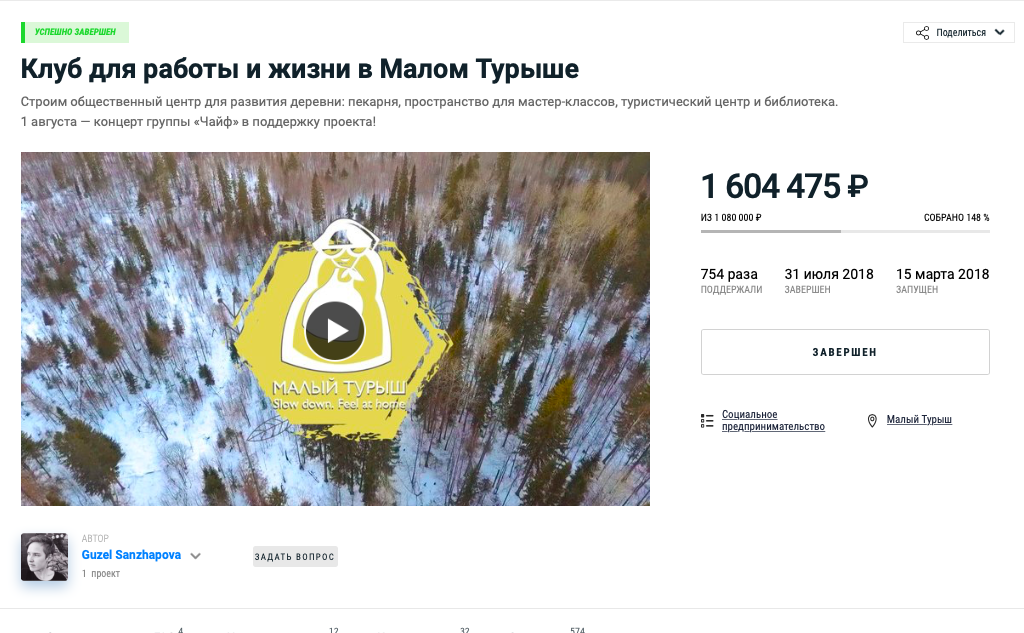
In July 2018, the fifth successful crowd-project of the founder of the honey brand Coccobello Guzel Sanjapova ended . She collected money for the construction of a club for work and life in the village of Maly Turysh, where the “headquarters” Coccobello is located. But only this time the entrepreneur abandoned the usual instruments of crowbal processes-social networks and mailings. Guzel Sanzhapova relied on offline events.
She bought a domain and made a redirect from him to crowd campaign. At the end of each of his performances at various events, the entrepreneur offered the audience the game: she brought a slide with Domain Turysh.rf on the screen, asked to cross it and participate in the project. The first five sponsors, she promised a prize-Coccobello Cream-Med. According to Guzel Sanjapova, at the “ Business with meaning ” forum, such a game with the hall brought about 270 thousand rubles to the project.
The campaign was also supported by the Chayf group, giving a charity concert on the site of the future club. All funds from the sale of tickets went to the construction of the building. Invitations to the concert were exhibited as lots of crowds. In the village, where only 52 people live, people from all over the country gathered. And the Croud-project eventually raised more than half a million rubles (148% of the declared amount).
Board game "74"
In April 2018, the Memorial human rights society announced the collection of money to print the board game “ 74 ”, dedicated to Soviet history and people's lives in the USSR. Players begin their way in 1917 and finish in 1991. Participants collect cards that form the biography of the game character, and then the whole family. The game ends when someone reaches 1991. At the end, participants tell the story of the life of their characters.
At Planeta.ru "Memorial" collected more than half a million rubles (772% of the declared) to print the game. By the way, in December 2018, another similar project also successfully ended - the Gulag Museum of History raised funds for a collection of graphic short stories about victims of repression. A new trend is probably developing - with a young generation they begin to speak important historical and social topics in the language that they understand.
Petition "House with a lighthouse"
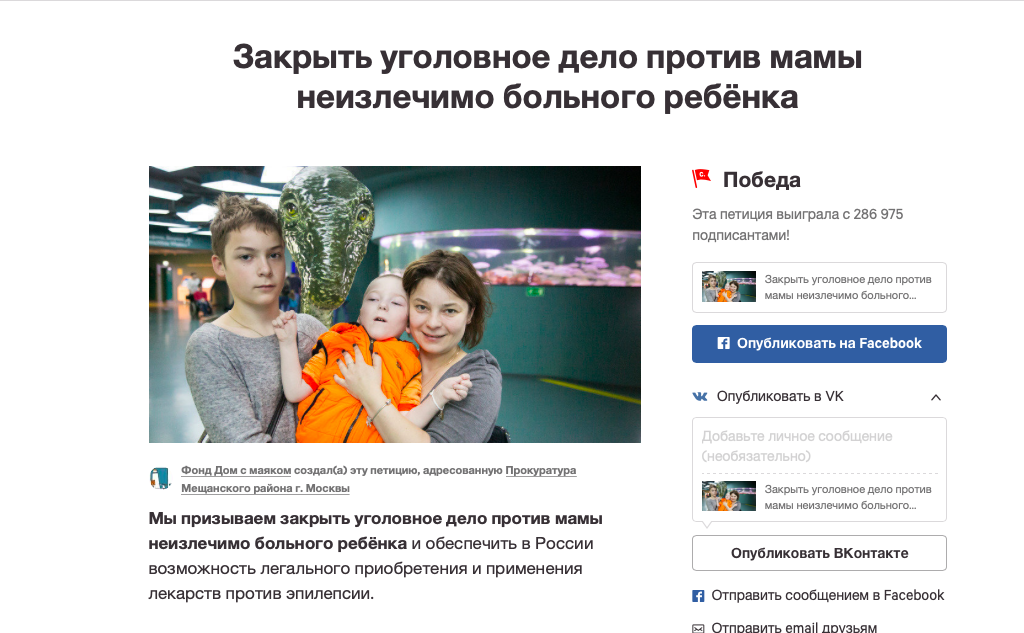
In June 2018, the police detained Ekaterina Konnova, the mother of six -year -old Arseny, the ward of the House with a Lighthouse . The child suffers from atresia, cerebral palsy and epilepsy. Convulsions tormented him several times a day. To remove attacks from her son, Ekaterina Konnova bought microclysters with diazepam on the Internet, it is impossible to officially purchase them in Russia.
The woman did not use all the enemas and decided to sell the remnants of the medicine on the VKontakte social network. The buyer turned out to be an employee of the Department of Internal Affairs of the Meshchansky District, who conducted a “verification purchase”. A criminal case was brought against Ekaterina Konnov under an article on the production and sale of narcotic drugs.
Hospice "House with a lighthouse" launched a petition in defense of a woman on the Change.org platform. Other charitable organizations and officials also made support with Ekaterina Konnova. The petition was signed by more than 286 thousand people. The case was officially closed. Employees of the “House with a lighthouse” hope that this story will lead to another victory - a change in legislation and registration of drugs in Russia, which parents now buy illegally.
"Smeshariki" and "Fixiki" against forest fires

In December 2018, the Russian branch of Greenpeace began raising funds for the new series of Smesharikov and Fixikov , which will teach children the right attitude to the fire. 90% of forest fires arise through the fault of a person. Representatives of Greenpeace are sure that in order to solve this problem it is necessary to change the consciousness of people. And to convey the right values is easiest for children. Moreover, this must be done using games and cartoons, and not moralizing.
Animation studios went towards Greenpeace and allowed the brands of Smeshariki and Fixiki for free. To create animated films, the environmental organization launched crowdfunding projects on its website and on Planeta.ru . The campaign is participated in the famous artist and musician Alexei Kortnev .
Representatives of Greenpeace say that a fundraising project with Smeshariki and Fixiki today is the most successful for the organization. Now more than 1.5 million rubles have already been raised on both resources. The collection continues, special series will be released in 2019.
A million truths
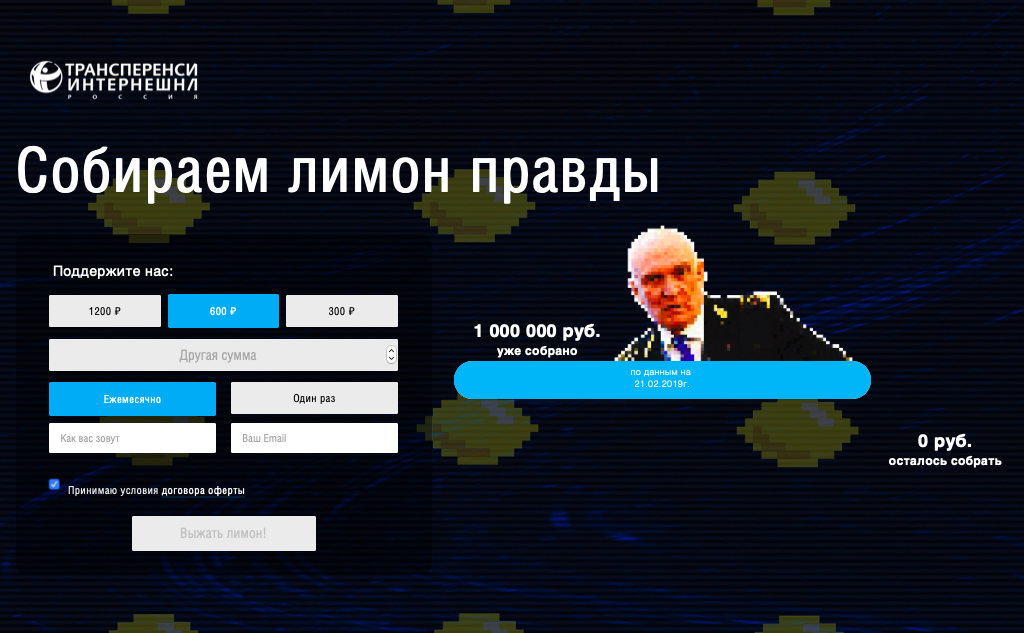
In September 2017, the rector of the St. Petersburg Mining University, Vladimir Litvinenko, filed a lawsuit to protect the honor, dignity and business reputation of the year due to the investigation of the billionaire from the mountain , which was held by the Russian Department of Transpenser Internet . The court sided with the anti -corruption organization, but demanded to pay 1 million rubles of compensation for another material, where Vladimir Litvinenko is mentioned in the list of the main “corruption cases” of 2016.
The organization began fundraising in October 2018. “One million is our right to tell the truth with you, which is why we called him so - the Lemon of Pravda,” wrote representatives of Transpenseni International on social networks. The call was successful, and in a month the required amount was collected.
Vladimir Litvinenko promised to give money to charity, but so far he does not get in touch and does not take his million. To attract the attention of the rector of LNS, the organization even launched a hashtag #pick -up on social networks.
Cartoons about human evolution
In December 2018, the team of the Anthropogenesis.ru project began collecting funds for children about anthropogenesis at Planeta.ru. The authors want to introduce children to a scientific view of the world in the language that they understand. Therefore, they decided to answer serious questions in bright cartoons that will be available to everyone.
The project has a community, Anthropogenesis.ru has been talking about human evolution for 8 years. In addition, in 2017, the team has already released the cartoon “ Evolution from Monkey to Man ” , which collected more than 3 million views on YouTube. For the crowd campaign, the team picked up interesting rewards and attracted to work on the project of leading Russian scientists. The project collected 1.7 million (115% of the declared amount).
More on the topic: the main mistakes in promoting crowdfunding projects
"Harry Potter and methods of rational thinking"
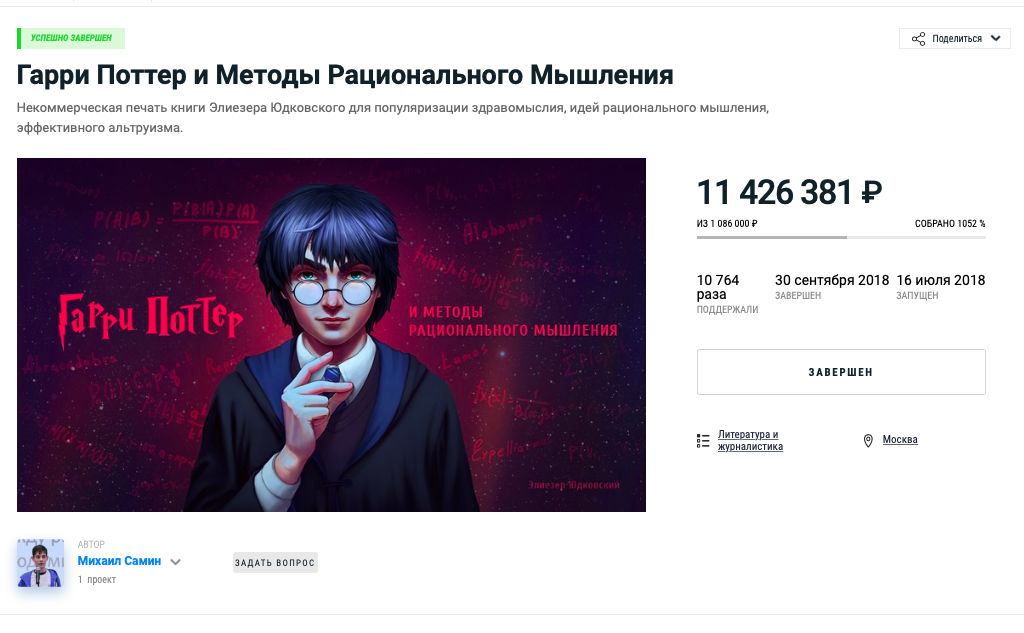
The most loud crowd campaign last year on the Planeta.ru platform is the non-profit printing of Elizer Yudkovsky’s book “Harry Potter and methods of rational thinking”. The project for one day even became the most successful in the history of Russian crowdfunding, he managed to collect more than 11.4 million rubles.
Harry Potter and methods of rational thinking is the most famous fan fiction on Joan Rowling. It is in the public domain at GPMRM.rf . But the book was not published, because Rowling allowed the use of the world invented only for non -profit purposes. The publication and printing of fan fictions are legal if no one gets profit for this.
The initiator of the campaign, the ex-head of the Russian Pastafarian Church , Mikhail Samin, paid great attention to the promotion of the project. During the three months of preparing the crowd campaign, he collected applications from those who wanted to get a book, calculated the maximum circulation and the cost of one copy. And when the project launched, people who left applications for participation received a notification of the start of crowdfunding. Thanks to this training, 1052% more funds were raised than it was stated.
Ruble per day
In December 2018, the Help Charity Fund launched the “ruble per day” campaign on the network. Anyone can arrange a small monthly donation (from 30 to 300 rubles) in favor of one of 133 proven charitable organizations. The main thing is that the help is regular. The organizers emphasize that it is systemic support that helps organizations plan their work and resolve social issues.
The action was supported by many famous people, including Konstantin Khabensky, Vladimir Pozner, Danila Kozlovsky and Irina Gorbacheva. She received wide coverage on social networks and the media. At the moment, almost 50 thousand people joined the action, who donated 8 million rubles.