
Translated material
Equal rights for children and adults
"Gorky" in "Labyrinth": Do not miss these books
The theoretical texts of the great teacher, a detective about post -war Italy, an honest book about the modern Russian factory and a collection of stories about people who unexpectedly faced with the present: meet the next issue of the “Gorky” section in Labyrinth. ” Today we will talk about the books of Janusz Korchak, Kate Fernwall, Vlad Ridosh and Leonid Nikitinsky. 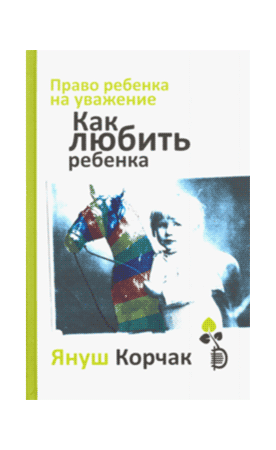 Yanush Korchak. The child’s right to respect. How to love a child. Minsk: Discourse, 2019. Translation from Polish Ulyana Khomich
Yanush Korchak is a Polish teacher who was both a respected theorist and no less brilliant practice. He was engaged in the buildings of the “houses of orphans”, in which he embodied the ideas of a self -governing society - he was convinced that children were not inferior to adults in opportunities, which means that they should not be inferior in rights. When the Nazis sent the pupils of his shelter to the death camp, Korchak went with them, although he had the opportunity to escape. And he died with them in a gas chamber together in 1942.
Korchak left behind both children's books and work on pedagogy, which are still reprinted: what was said in them and now does not seem archaic. Strictly speaking, these are not scientific works, but in free thoughts and thoughts, based on many years of experience in children's shelters. The reviewed book contains new translations of two well -known works: “The child’s right to respect” (1929) and “How to love a child” (1914–1918). The first publishers (and absolutely true) are called a manifesto. For example, Korchak says that the child of a priori is a weak creature, often having no choice and conditions for independent development, too dependent on adults. This seems to be somewhat granted, but the child actually does not consider it normal, and the contradiction inevitably affects his psyche and attitude to the world.
The second work, despite its name, practically does not contain any advice and recommendations. Korchak himself is recognized in distrust of the already “approved truths” and says that not a single book “can replace his own sensitive thought”; And the creative “I don’t know” is one of the main sources of knowledge about the child. He pushes parents not to raise children as they raised them, but to listen to their feelings. “How to love a child” - these are four different articles: “Child in the family”, “boarding school”, “Summer camps” and “House of orphans”. It is most interesting to read, of course, the “House of Orphan” - there are just specific tips in it: Korchak describes in detail how the corresponding house should be arranged so that the children are good there.
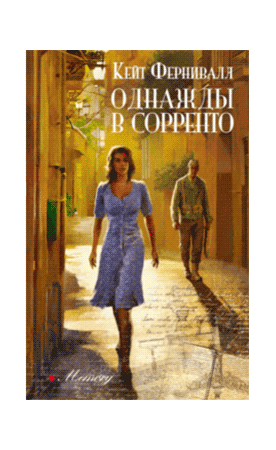 Kate Fernivall. Once in Sorrento. St. Petersburg: Arkady, 2019. Translation from English Victoria Dyakova
The post -war Italy, in which there is a corny there is nothing: gangs of orphans and poor are snooping in bombed and ruined cities and kill each other for any food. The main character, the young girl Katerina, does not go anywhere without weapons. She becomes the main defender and breadwinner of the family: on her hands the younger brother and blind grandfather; Father died during one of the bombing, the mother left them before the war. Once Katerina is detained by Anglo-American allies, who dispose of Italy at home. From the military, Katerina learns that her father was involved in the abduction of works of art in wartime, and his tricks are now investigated by the American military. Katerina knows no more than investigators, but she includes with interest in the investigation: simply because he cannot believe in the presence of a second, hidden life of her father.
Before us is historical fiction, where, probably, the most interesting is the details of Italian life immediately after the end of World War II. It is hardly the most famous episode of history for the Russian reader. And this is a book about the clash of cultures and about the novel between the representative of the winners and the representative of the vanquished. If you have not yet guessed, the heroine has a romance with one of those who investigate the work of her father. But the main storyline is still detective. The heroine is immersed in the biography of her father and more and more learns about criminal schemes, about illegal sales of paintings and statues.
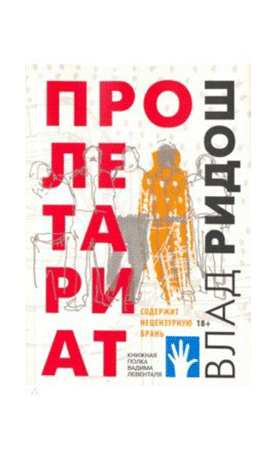 Vlad Ridosh. Proletariat. M.: Fluid Frifly, 2019
At a certain plant, sour, dosha, speed, and another two dozen men of different ages, but with the same nicknames work. Well, how they work - more often smoke breaks arrange and drive tea; Sometimes they will spread to the screams, and sometimes they just sleep. Because “if we quickly do one thing, we will be puzzled by others. And they pay us, ****, for time, and not for what has been done. ” The heroes themselves quite adequately regard such a pastime as “suffering ****”, but perceive it as inevitable. Moreover, perfectly understanding that “the proletariat is a herd that **** is not lazy,” they ask fate not of another work, but “at least worthy compensation for ****”.
By and large, here, although too straightforwardly, the essence of the labor process is true, when even his goals and objectives are not quite clear. The purpose of production, like the heroes themselves, remain unnamed. And this is characteristic not only for workers in production. Imitation of workload, eternal chatter with colleagues, as well as the dominant idea that the authorities are unjustly tearing three skins from you, you can also find among office employees - there will simply be a little less mat. Despite the fact that even the slightest malfunction of one valve can lead to a disaster.
But not only in this difference between the factory space and any other. The plant is unknown to change the soul of its inhabitants. Even life outside the plant is inextricably linked with him: someone spends the night in the local hostel, someone finds the production of future spouses and lovers, someone acquires skills that cannot be acquired in a different place: where they will still say that the smell of fumes can be interrupted by drinking fresh urine. If, say, Daria Bobyleva in the "Vyurki" represents the cottage as a space that cancel the time and collects evil spirits, then the plant in Ridosh is a place where the masculine, uncompromising philosophy penetrates the brains. We get an absurd concentrate of cruelty and love of love; Aggression to any manifestation of non -traditional practices - and a latent attraction to colleagues with whom you spend a lot of time. Before us is a model of an isolated male society, extremely inelerant of both vegetarianism and composing poetry. In connection with the “proletariat”, Sorokin was already mentioned, so Vladimir Georgievich exactly the same scenes would end with a blood bath, and Ridosh shows that no one would lead an eyebrow here. It is based on personal experience, so it seems that you can believe.
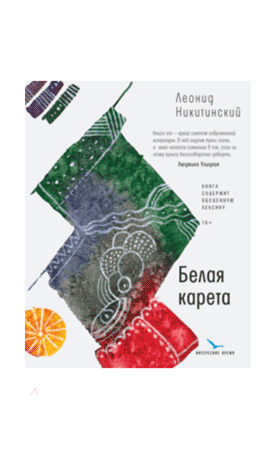 Leonid Nikitinsky. White carriage. M.: Time, 2019
Leonid Nikitinsky is a journalist who writes about human rights and violations in the judicial system. His first novel “The Secret of the Advisory Room” is devoted to the same topics - a detective in which the jury conducts their own investigation. The collection of prose “White Carriage” turned out to be no less social: heroes, seemingly far from politics, still feel all the contradictions of the country's socio-political life.
The title story begins as a story about random acquaintance, and ends as an action -packed drama, where one of the heroes is brought from Ukraine in a zinc coffin. Nikitinsky calmly, without enthusiasm and condemnation, demonstrates that not only fanatics can go to the zone of military operations, but also ordinary people who feel that there they will simply bring more benefits. Or, in the story “The Sitza Angel”, a trip to her hometown in a trifle business turned into a journey in the 1990s, which, as it turns out, did not go anywhere.
This is a book about modernity, but the problems of today, as the author gives a distinctly understanding, existed in one form or another. The only thing, perhaps, can be blamed for the author - his romantic view of things, which, whatever one may say, looks somewhat pathos against the background of the events.