
Translated material
Sticking navels, proofiler against maniacs and hypothetical history
Novelties non-fiction. February
Could Hitler defeat Stalin, why use the pubis as a towel and how to catch a rider sadist? We publish the next issue of the monthly section of Polina Ryzhova with a review of the best novelties of non-fiction.Virtual history: alternatives and assumptions. Edited by Niala Ferguson. M.: AST: Corpus, 2019. Translation from English Zaur Mamedyarov
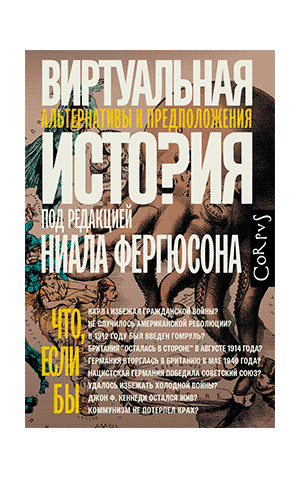
What if the United States War did not take place? What would the world be if the UK had not entered the First World War? And if Hitler defeated Stalin? Could the Russians win the Cold War and was the collapse of the USSR so inevitable? A collection of solid historical essays, edited by a professor at Harvard University, Niala Ferguson, shows that history not only suffers a subjunctive mood, but also forms a whole scientific direction thanks to him.
Ferguson admits that a hypothetical story seems to many heresy: we are accustomed to the fact that the union “if” is found either in the odious works of revisionists, or in innocent jokes of the bored academics. The fault of this is the love of determinism. It seems to us, like scientists from the 19th century, that the course of history is logical, inevitable and determined by some kind of common intention, while in reality the reality is extravagant and unpredictable. Ferguson, in his stagnant introduction, as if demonstrating the seriousness of intentions, describes all the milestones of the development of historical science from Lucretius to Hegel, from Hegel to Popper, tells how the story flirted with sociology, anthropology and literature, in order to ultimately reconcile the history of mathematics and quantum physics, reveal the philosophical significance of the theory Postulate the principles of the new "chaos".
Contrary to such an ambitious manifesto, the “virtual story” is not like a collection of bold fantasies that demonstrate the work of the “butterfly effect”: it is rather a scrupulous building of hypothetical scenarios using only those alternatives that were really considered by contemporaries. Moreover, if the first chapters about the history of the XVII and XVIII centuries are close to entertaining intellectual exercises, then chapters about the Second World War or the collapse of the Soviet Union are able to cause strong emotions that shake the idea of the past as a folding story with a prescribed finale. The book of Ferguson and its co -authors helps to feel the unpredictability and randomness of key events in the history of mankind, to live the past as the present, as well as to relieve this present from the hassle of rationality and predestination.
John Douglas, Mark Olshaker. Mind hunter. A special section of the FBI to investigate serial murders. M.: Ripol Classic/Palmyra, 2019. Translation from English G. Mikhailov
 The book of one of the pioneers of criminal profiling, that is, the preparation of psychological portraits of alleged criminals based on the characteristics of the crime. The profile carefully studies what happened, how and why, and then suggests which person could decide on this, helping the police narrow the circle of suspects. Former FBI agent John Douglas, who specializes in the psychology of serial killers, not only made a significant contribution to the development of forensics, but also contributed to its penetration into the world of popular culture: the figure of Douglas was embodied in the image of Jack Crawford from the thriller "Silence of the Yagnis", and the "hunter for the mind", first released in 1995, was shot in the same name. The series David Fincher.
The book contains perhaps the most wild and gloomy crimes of America of the 1970-1980s. In addition to the cases with whom Douglas worked as a profile, it included the stories of legendary serial maniacs - with them, at the dawn of his career, the author conducted a long prison interview. An obedient son who scored his mother with a hammer; The fetishist who kept in the freezer cut off the victim in the shoe; A well -free baker who abducted prostitutes and arranged Safari with their participation; cannibal, trying to eat the genitals of a murdered girl; A variety of gipers, stranglers, and perverts - Douglas shows that even the most crazy crimes can give grounds for rational analysis. Maniacs combine difficult childhood, complexes, problems with peers. Most of the killers, according to the author, suffer from Enorez, brutally treated animals and are prone to arson. In order to feel their power, serial criminals often imitate the police, get in security, go to the bars where the cops are looking, or the German shepherds are being made.
 “The Hunter for the Reason” is not only a collection of shock -free shoes (although this is also, which is why it is impossible to break away from the book), but also a kind of production drama. The author explains in detail how the FBI works, how the bureau is connected with the police, and the stroke of Douglas, which occurred due to burnout at work, is the key event of the book. At the same time, it is clear that the capture of criminals for him is more than the daily routine of the special agent: he compares the handwriting of the killers with the handwriting of the painter, and a good profiling - with the creation of a literary masterpiece that the book is not about protecting the rule of law from numerous psychopaths, but about the confrontation of two artistic worlds.
Mara Oltman. The body is rubbish. Reports from the front (and from the rear). M.: Individuum, 2019. Translation from English Katya Kazbek
 The most embarrassing questions about the body, mainly female: why hair hair grows, why groans are needed during sex, which is why hemorrhoids arise, which is not so with later, on which the vaginal smell depends on, as well as educational programs dedicated to moles, fainting and lice. American journalist Mara Oltman is shared by intimate stories from personal experience, and also pestering the family, friends and scientists with provocative questions - all this in order to free himself from a burning sensation of awkwardness for his body, to learn him better and more, and if you do not accept yourself with all the low -sympathetic features, then at least start treating the sticking navels and sagging anus with irony and warmth.
By the number of personal details and the jokes released in connection with them, the book of Oltman is most reminiscent of a stand -up: the degree of sweating of the author, the sounds that it makes during sex, and the location of the hair over her upper lip we learn more than we would like, but all this is a prerequisite for a trusting conversation with the reader, a literary mask of absolute frankness. Oltman not only continuously exposes itself, but also finds out of the surrounding reality a tremendous amount of wild (and wildly interesting) facts: in ancient Greece, the vagina was fumigated with dead puppies; There is a tribe using hairy pubes as a towel; axillary bacteria can be transplanted from person to person; Naughty rollers help to keep the navel clean; The size of women's buttocks affects the IQ of the unborn child; The form of modern toilets contributes to the occurrence of hemorrhoids, etc.
At first glance, the “rubbish body” is strictly for women, and its plot is built around the gradual liberation from imposed attitudes about beauty and from internal, well -learned hatred for oneself. However, Oltman defends not only the right of a woman to do without razor, but also the right of a person of any gender not to be shy of her body. At the same time, the author admits that emancipation is not easy, aversion to his own physiologicality is akin to the denial of death, from the fear of which, alas, not to get rid of a couple of funny jokes about hairy legs.